8 Collision Worksheets — Grade 4 NGSS 4-PS3-3 | Workybooks
Have you ever rolled two toy cars straight into each other and watched them bounce, spin, or stop dead? That little crashis one of the coolest ways to learn physical science. When objects collide, they don’t just make noise — they trade energy back and forth in ways you can see, hear, and even feel. This guide explains the science and points you to ready-to-use collision worksheets for your classroom.
This post breaks down collisions for Grade 4 science in a way that’s fun to read and easy to teach, and it lines up perfectly with NGSS 4-PS3-3: “Ask questions and predict outcomes about the changes in energy that occur when objects collide.”
If you want your students to practice everything below, grab the collision worksheet pdf to go along with the lesson.
What Is a Collision?
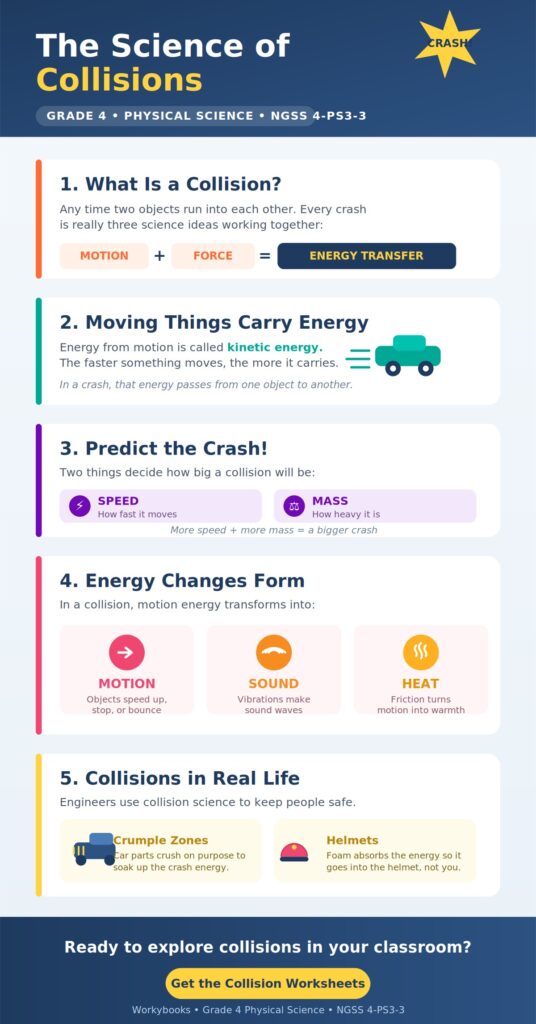
A collision happens any time two objects run into each other. A soccer ball hitting a wall, two bumper cars smacking together, a bat meeting a baseball — all collisions.
Every collision involves three big science words:
- Motion — an object that is moving
- Force — a push or a pull
- Energy transfer — energy moving from one object to another
When a moving object crashes into another object, it pushes on it with a force. That force moves energy from the first object into the second one. Nothing disappears — the energy just changes hands (and sometimes changes form).
Predicting Collisions: Speed and Mass
Here’s where young scientists get to make predictions. Two things decide how much energy an object brings to a collision:
- Object speed — how fast it’s moving
- Object mass — how heavy it is
Scientists and engineers love predicting what will happen before a collision even occurs. By looking at two main things—speed and weight (mass)—you can usually guess the outcome:
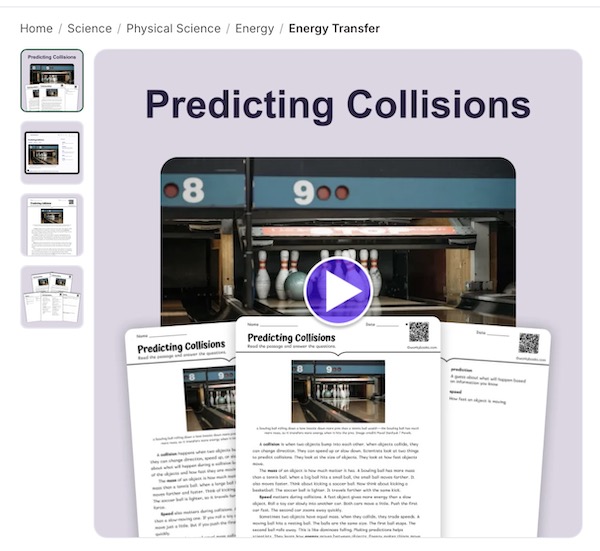
Heavier objects are harder to stop and push lighter objects out of the way much more easily.
Faster objects carry more energy, so they cause bigger changes when they hit something.
Try this prediction game: which will cause a bigger crash — a slow bowling ball or a fast ping-pong ball? Making and testing these guesses is exactly the collision prediction skill fourth graders are expected to build.
What Happens to Motion After a Collision?
After objects collide, their motion changes. One might speed up, one might slow down, both might change direction, or they might stop completely.
Toy car collisions are the perfect way to see this. Roll one car into a parked car:
- Sometimes the moving car stops and the parked car zooms off (energy transferred!).
- Sometimes both cars move together.
- Sometimes the moving car bounces back the way it came.
Watching objects in motion before and after a crash shows students that energy didn’t vanish — it moved and changed the motion of everything involved.
Collisions Make Sound
Ever notice that crashes are loud? That’s sound energy, and it comes straight from the collision.
When two objects hit, they vibrate. Those vibrations push on the air and create sound waves that travel to your ears. So some of that original motion energy turns into sound — a perfect example of energy transformation. The bigger the crash, the louder the sound.
Collisions Make Heat
Rub your hands together fast and they get warm. That’s friction — and collisions create it too.
When objects scrape, slide, and smash, friction turns some of the motion energy into heat energy (also called thermal energy). It’s usually a small change, but it’s real. This is another way collisions show energy transfer: motion energy becoming heat.
Modeling Collisions Like a Scientist
Scientists can’t always crash real cars to study them, so they build science models instead — smaller, safer versions they can test again and again.
Your students can do the same thing. Using ramps, marbles, and toy cars to stand in for bigger crashes is modeling collisions, and it connects directly to PS3.B (the “Conservation of Energy and Energy Transfer” idea in the standards). A good collision model lets kids test their predictions without needing a real crash.
Collisions in Real Life: Cars and Crumple Zones
Here’s the amazing part — engineers use these exact ideas to keep people safe.
When a car crashes, it has a lot of kinetic energy that has to go somewhere. Read about kinetic energy here. Cars are built with crumple zones: parts at the front and back designed to crush and fold on purpose. As the metal crumples, it absorbs the motion energy and spreads it out over more time. That energy transformation means less energy reaches the people inside. A car collision that looks scary is actually the car doing its job.
Staying Safe: Helmets and Impact Protection
The same science protects you every time you ride a bike or scooter.
A helmet works just like a crumple zone. In a collision, the foam inside squishes and absorbs the kinetic energy and force of the impact — so that energy goes into the helmet instead of your head. That’s energy transfer and impact protection working together to keep you safe. Understanding collisions isn’t just cool science; it’s a great reason to always buckle up and buckle on that helmet.
Grade 4 Collision Worksheets to Bring It All Together
Collisions are a fantastic way to explore physical science because kids can see energy move. In one crash they can watch motion change, hear sound energy, feel a tiny bit of heat, and predict what will happen next — all the core ideas of NGSS 4-PS3-3 in a single moment.
Ready to put it into practice? Use these collision worksheets with your class:
Aligned to NGSS 4-PS3-3 | Grade 4 Physical Science | Energy Transfer & Collisions
Related Posts
Transcontinental Railroad:Classroom Resources
Evidence for Climate Change: Reading Passages and Activities