Cenozoic Era Timeline: The Age of Mammals Explained
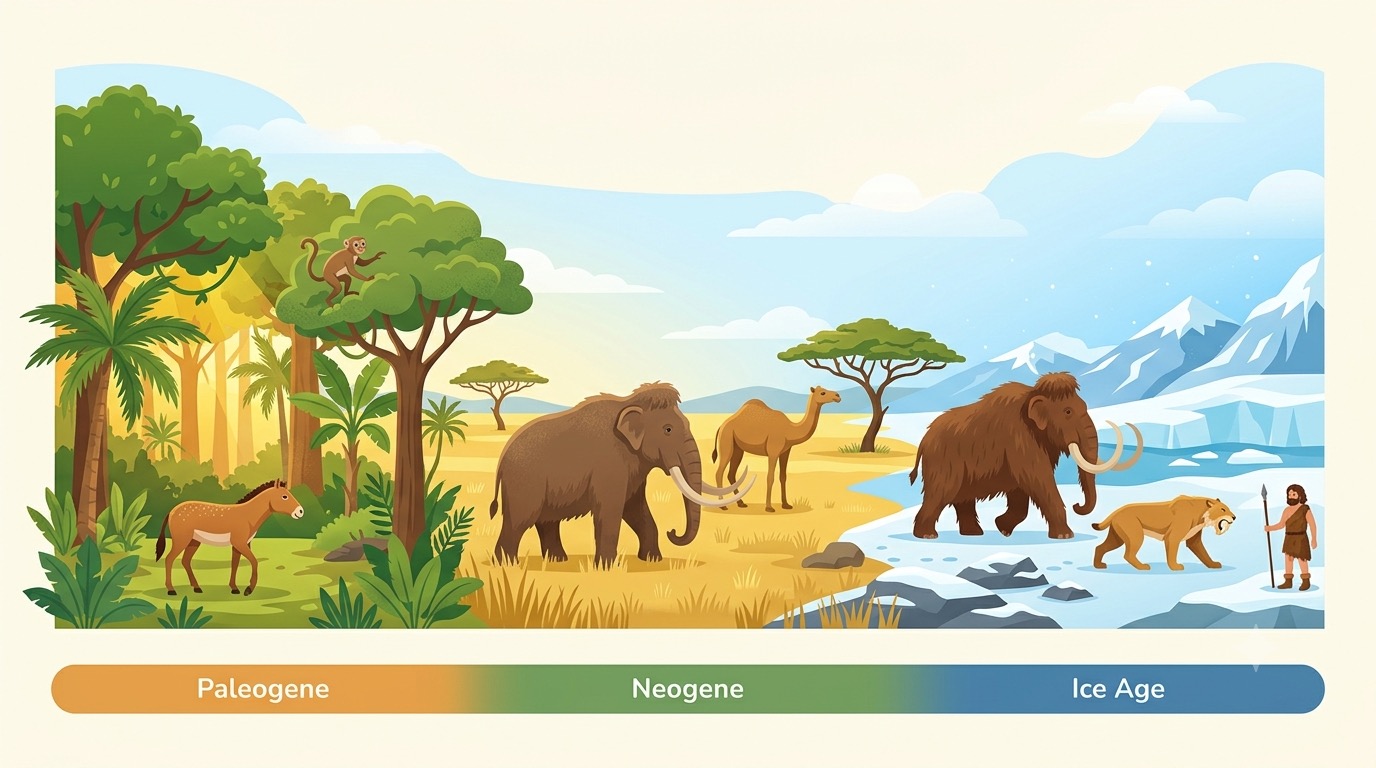
Teaching the Cenozoic Era is one of the easiest units to make exciting. It has an asteroid, the end of the dinosaurs, woolly mammoths, ice ages, and the arrival of the first humans. If you’ve taught it before, you know students lean in the moment you say, “This is the chapter of Earth’s history we’re still living in.” This guide walks you through how to teach the Cenozoic Era with the help reading passages and activities you can print tomorrow.
A quick Cenozoic Era summary
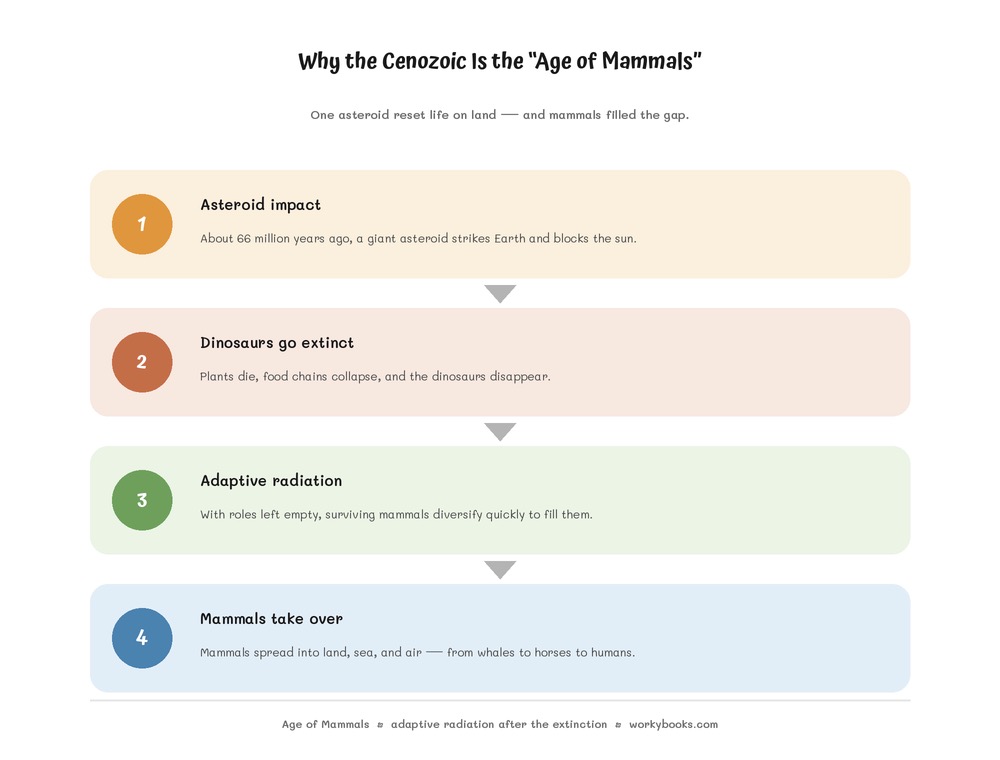
Here’s the short version you can give your class. The Cenozoic Era began about 66 million years ago and continues today. Its name means “recent life,” and in geological time it is the most recent of Earth’s three great eras, following the Mesozoic Era (the age of dinosaurs). The event that started it was a massive extinction that wiped out the dinosaurs and opened the door for mammals.
A few Cenozoic Era facts for kids that always land well: it started with an extinction event — the dinosaurs died out and mammals took their place; continents drifted into the shapes we see on today’s maps. The climate slowly cooled, grasslands spread, and eventually the ice ages arrived; and humans appeared near the very end — a tiny sliver of the whole era.
The Cenozoic Era timeline: periods and epochs
Middle schoolers understand the Cenozoic best when they can see it. The era is divided into three periods — the Paleogene, Neogene, and Quaternary — and those break down further into seven epochs. The visual is a Cenozoic Era timeline your students can use as a reference all unit long.
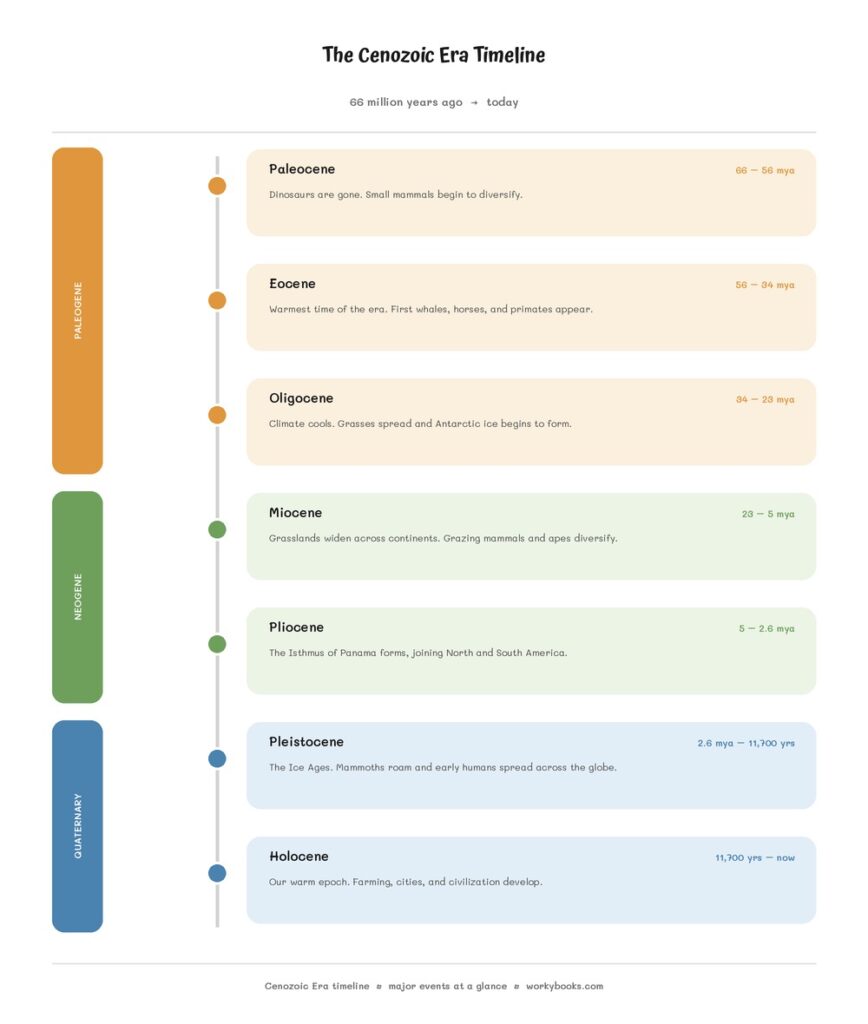
Two things are worth pointing out. First, the Paleogene and Neogene together — once grouped as the “Tertiary” — make up almost the entire era. Second, humans show up only in the last blink of the timeline. Putting those facts side by side makes geological time click in a way a paragraph never will.
The Age of Mammals: Cenozoic Era animals
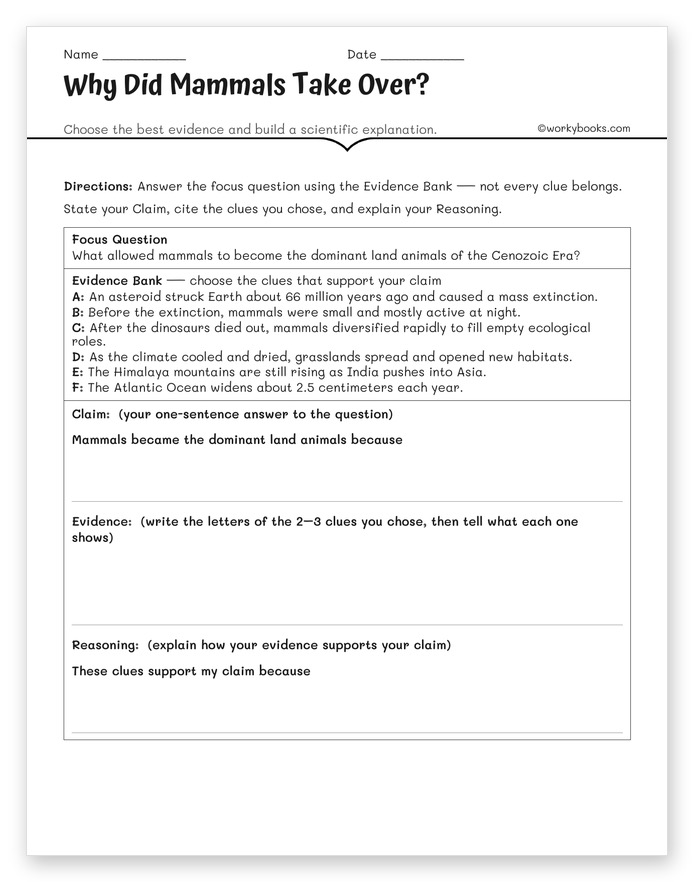
If your students remember one nickname, make it this one: the Cenozoic Era is the Age of Mammals. After the dinosaur extinction, the small mammals that survived suddenly had a world full of empty roles and few predators. Over millions of years they went through adaptive radiation — a burst of diversification where one group evolves into many forms to fill available habitats.
The mammal evolution story is a perfect way to teach natural selection and fossil evidence. Whales evolved from land animals and returned to the sea. Bats developed wings. Horses, camels, and elephants spread across the new grasslands. And primates appeared in the forests, eventually giving rise to us.
How the modern continents formed
The Cenozoic is also when Earth’s surface reached its current arrangement. Through plate tectonics and continental drift, the continents slid into their modern positions. At convergent boundaries, India crashed into Asia and pushed up the Himalayas — which are still rising today. At divergent boundaries, the Atlantic Ocean kept widening by a couple of centimeters a year. This Earth science thread also explains a great puzzle for students: why matching fossils turn up on continents now separated by wide oceans.
Cenozoic Era climate and the Ice Ages
The Cenozoic Era climate tells a clear story: it started warm and cooled over time. By the Quaternary Period, that cooling produced the Pleistocene ice ages. The period when huge ice sheets spread across the continents in repeating glacial periods. These cycles were driven partly by small, predictable changes in Earth’s orbit — the Milankovitch cycles. You can tie-in to NGSS MS-ESS1-4 and the rock and ice record of Earth’s history.
The ice ages also gave us the animals students love most: the megafauna. The woolly mammoth, the saber-toothed cat, and the giant ground sloth all roamed the Pleistocene epoch before climate change and other pressures drove many of them to extinction. It’s a memorable way to connect paleontology, climate, and survival.
When humans appeared — and the Holocene
Near the end of the Pleistocene, human evolution reached a turning point. Relatives like Homo erectus came and went, and eventually Homo sapiens emerged in Africa and spread across the globe, adapting to many environments. The fossil evidence and geological time here make another strong link to NGSS MS-ESS1-4.
Then the ice pulled back. About 11,700 years ago the Holocene Epoch began — the warm period we live in now. In this geologic time, humans developed agriculture, built cities, and reshaped Earth systems so much that some scientists now discuss a proposed “Anthropocene.”
Reading passages for your Cenozoic Era unit
Strong reading anchors the unit. Each Cenozoic Era reading passage below is written for middle school readers and builds on the last: (1) What Was the Cenozoic Era; (2) How Did Modern Continents Form; (3) The Age of Mammals Begins; (4) Why Did Pleistocene Ice Ages Happen; (5) What Were the Ice Age Megafauna; (6) When Did Humans Appear; (7) What Is the Holocene Epoch.
Teaching tip: pair each passage with a quick “what changed and why” question.
Three activities that build real reasoning
Reading gives students the facts. These three printable activities push them to use those facts — the difference between a recall worksheet and one that builds thinking.
- The Cenozoic Era — Guided Notes with Vocabulary. Cenozoic Era guided notes with a word bank, an answer key, and a self-grading digital version. They cover mammals, fossils, ice ages, and plate tectonics, so students capture the key vocabulary as they read. A perfect first-day anchor.
- Reading the Cenozoic Time Scale — Data Activity. A time scale worksheet for grades 5-8. Students read the geologic timescale table, then analyze climate and epoch trends — which epoch lasted longest, what came before what, and how the climate shifted over 66 million years. Answer key included.
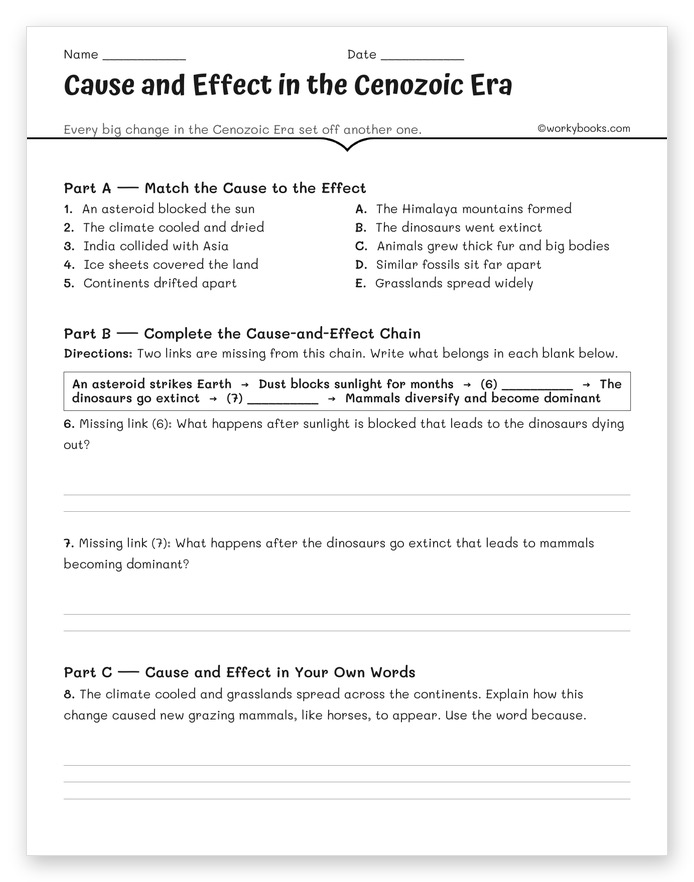
- Cause and Effect in the Cenozoic Era. Students match causes to effects, fill in the two missing links of a cause-and-effect chain (asteroid → extinction → the rise of mammals), then write their own explanation using the word “because.” It builds from recognizing a link, to sequencing a chain, to explaining causation — with an answer key included.
Cenozoic Era FAQ
Which period makes up nearly all of the Cenozoic Era? The Paleogene and Neogene together — historically grouped as the “Tertiary” — make up about 96% of the era, roughly its first 63 million years. The Quaternary, our current period, covers only the last 2.6 million years.
What is the oldest epoch in the Cenozoic Era? The Paleocene, from about 66 to 56 million years ago. It began right after the dinosaur extinction, when mammals first started to diversify.
Why is the Cenozoic Era called the Age of Mammals? Because once the dinosaurs went extinct, mammals rapidly diversified to fill the empty roles and became the dominant land animals — on land, in the sea, and in the air.
Ready to teach it? Grab the Cenozoic Era reading passages, guided notes, and the time scale data activity at workybooks.com — standards-aligned, answer keys included, and print-ready for grades 5-8.
Related Posts

Life and Society in the Industrial Revolution: Middle School Teaching Guide
Transcontinental Railroad:Classroom Resources