Divergent Plate Boundaries
Interactive passage with audio narration, comprehension questions, and printable PDF.
By completing this purchase you agree to our Terms of Use and Privacy Policy. Your subscription renews automatically until you cancel. You can cancel anytime from your account settings. All sales are final and non-refundable. Digital content is available for download in your account immediately upon purchase.
What's included
Divergent Plate Boundaries preview and details
About this printable Divergent Plate Boundaries science reading passage, NGSS-aligned (Grades 5-8)
Sample passage and quiz from Divergent Plate Boundaries
Reading passage and comprehension quiz preview
Divergent Plate Boundaries
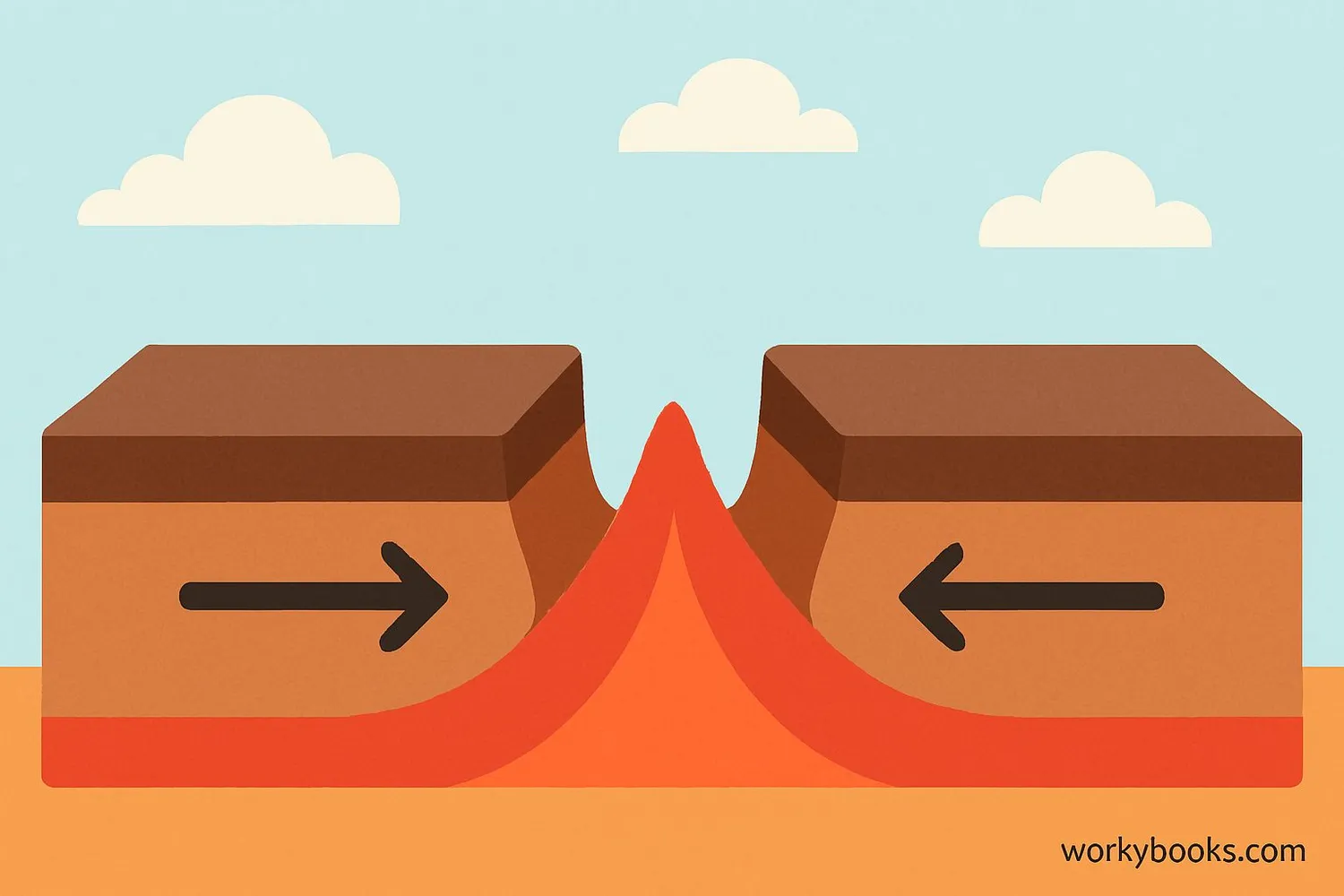
Divergent plate boundaries play a crucial role in shaping the surface of the Earth. These are regions where two tectonic plates move away from each other, causing the crust to split and new material to rise from below. This process is responsible for creating some of the most dramatic features on our planet, such as mid-ocean ridges and rift valleys. Understanding how divergent boundaries work helps scientists explain earthquakes, volcanoes, and the constant renewal of Earth's crust.
How Divergent Plate Boundaries Work
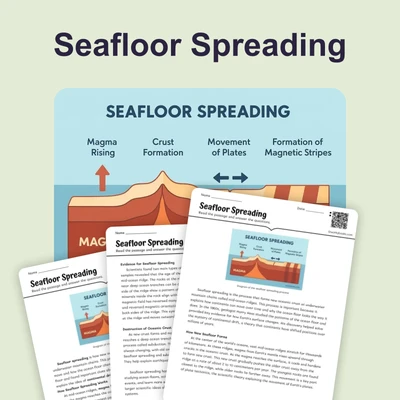
At a divergent boundary, the movement of plates apart is driven by forces deep inside the Earth, mainly the heat from the mantle causing convection currents. As plates separate, magma from the mantle rises to fill the gap, solidifying to form new crust. In the ocean, this process creates mid-ocean ridges, such as the Mid-Atlantic Ridge, which stretches for over 16,000 kilometers. Here, new seafloor is produced at a rate of about 2.5 centimeters per year. Shallow earthquakes and frequent volcanic eruptions occur as the plates move. Normal faults, or cracks in the crust, are common features due to the stretching of the Earth's surface.
Examples and Variations: Oceanic and Continental Divergence
Divergent boundaries are found both under the ocean and on land. In oceanic-oceanic divergence, like the Mid-Atlantic Ridge, new oceanic crust forms as magma rises. Sometimes, these ridges become visible above sea level, as seen in Iceland, which sits directly on the Mid-Atlantic Ridge. On continents, divergent boundaries create rift valleys. The East African Rift Valley is a continental-continental divergent boundary, where the African Plate is slowly splitting apart. This rift may eventually widen enough to form a new ocean, as has happened in the past with the Red Sea, a young ocean basin. Both settings experience volcanic activity, earthquakes, and the formation of new landforms.
Broader Implications and Scientific Connections
Divergent boundaries are part of the larger system of plate tectonics, which explains the movement and interaction of Earth's plates. The creation of new crust at divergent boundaries helps balance the destruction of crust at convergent boundaries, where plates collide. Scientists study these areas using sonar mapping, satellite data, and seismographs to learn how Earth's surface changes over time. The understanding of divergent boundaries has led to advances in earthquake prediction and hazard planning, as well as insights into the cycling of materials and energy within Earth’s systems.
In summary, divergent plate boundaries show how dynamic and interconnected Earth's systems are. The movement of plates not only creates new landforms but also drives the processes that shape our planet over millions of years. Studying these boundaries connects us to the broader principles of geology and Earth science, highlighting how the planet is constantly changing beneath our feet.
Interesting Fact: Iceland is one of the few places on Earth where you can walk along the crest of a mid-ocean ridge above sea level, standing between two separating tectonic plates.
Comprehension quiz (10 questions)
1. What is a divergent plate boundary?
2. Which feature is formed at oceanic divergent boundaries?
3. What happens at the Mid-Atlantic Ridge each year?
4. What does the term 'magma' mean in the passage?
5. What is a rift valley?
6. Why are shallow earthquakes common at divergent boundaries?
7. How does divergent boundary activity contribute to plate tectonics?
8. What is one reason scientists study divergent boundaries?
9. True or False: Iceland is located on a mid-ocean ridge and shows a divergent boundary above sea level.
10. True or False: At divergent boundaries, only earthquakes occur, but no volcanic activity.
Perfect for the way you teach
- Build comprehension skills
- Auto-graded quiz
- Differentiated reading
- Read together at home
- Improve fluency
- Quiet reading time
- Reading curriculum support
- Independent practice
- Track Lexile growth