Homo Erectus
Interactive passage with audio narration, comprehension questions, and printable PDF.
By completing this purchase you agree to our Terms of Use and Privacy Policy. Your subscription renews automatically until you cancel. You can cancel anytime from your account settings. All sales are final and non-refundable. Digital content is available for download in your account immediately upon purchase.
What's included
Part of this bundle

Homo Erectus preview and details
About this printable Homo Erectus reading passage (Grades 5-8)
Sample passage and quiz from Homo Erectus
Reading passage and comprehension quiz preview
Homo Erectus
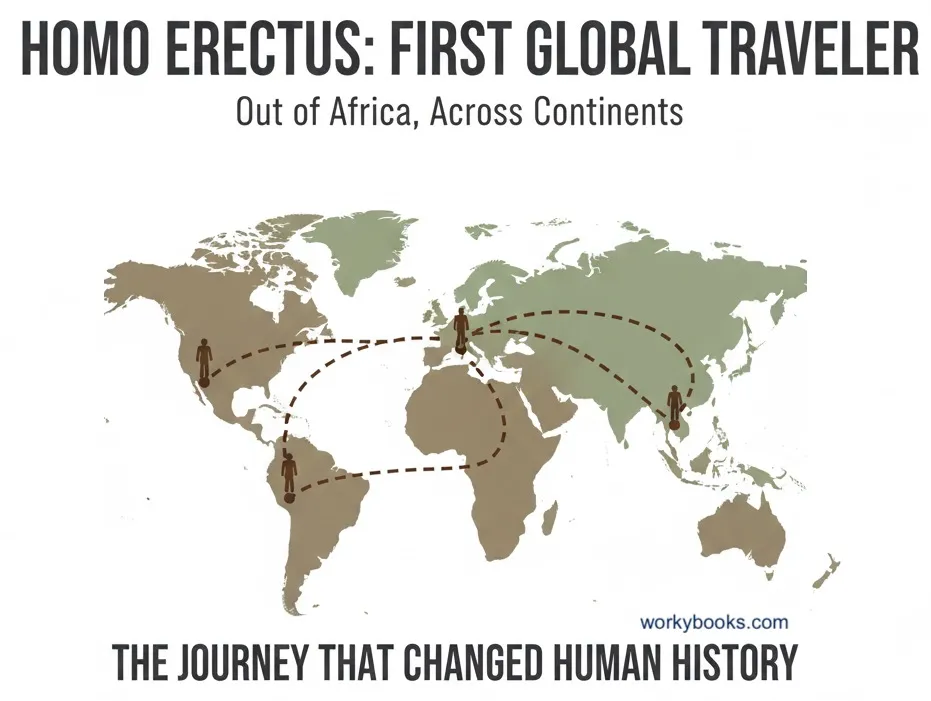
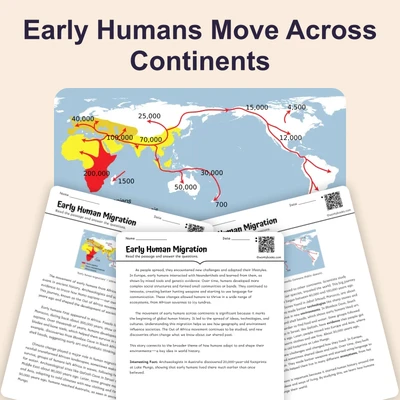
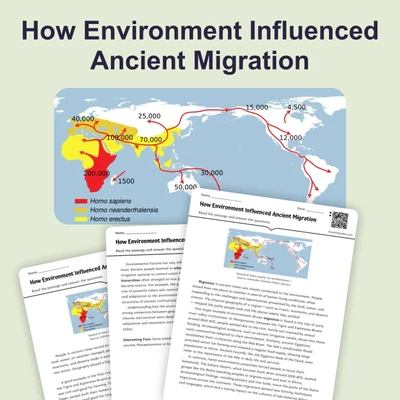
Homo erectus was one of the earliest members of the human family to leave Africa, beginning a journey that changed the course of prehistory. Scientists believe that Homo erectus lived from about 1.9 million to 110,000 years ago, spreading from Africa to Asia and even parts of Europe. Fossils and stone tools found at archaeological sites provide strong evidence for their migrations and daily life.
One of the most important discoveries was at the site of Zhoukoudian, near modern-day Beijing, China. Here, archaeologists uncovered fossils of Homo erectus known as "Peking Man," along with artifacts such as stone tools and evidence of fire use, dating back over 700,000 years. In Africa, the famous "Turkana Boy" skeleton, found near Lake Turkana in Kenya, is the most complete Homo erectus skeleton ever discovered. These findings help us reconstruct the physical characteristics, behaviors, and adaptations of Homo erectus.
Homo erectus was different from earlier hominins because of its advanced technology and larger brain size. They created more complex tools, such as hand axes, and were one of the first species to control fire. The ability to use fire gave them many advantages: it offered warmth, protection from predators, and allowed them to cook food, making nutrients easier to digest. This technological leap helped Homo erectus survive in a wide range of environments, from African savannas to cold Eurasian forests. Archaeological evidence, such as tools and hearths, shows how they adapted to different geographic regions and climates.
The migration of Homo erectus out of Africa is considered a major turning point in human evolution. By moving into new territories, they encountered unique challenges and developed new survival strategies. Their spread across continents set the stage for the later evolution of Homo sapiens. Some scientists debate how quickly Homo erectus migrated and whether they interacted with other hominin species, but most agree their travels were crucial for the story of humanity.
The journey of Homo erectus shows the importance of innovation and adaptation in human history. Their ability to move into new lands, create tools, and use fire contributed to the growth of early human societies. Studying their remains and artifacts helps us understand how humans have always been resourceful and willing to explore unknown places. These themes connect to broader patterns of migration, technology, and survival in ancient history.
Interesting Fact: Some Homo erectus fossils have been found on the Indonesian island of Java, showing they crossed water and adapted to island life over 1 million years ago!
Comprehension quiz (8 questions)
1. Where was Turkana Boy found?
2. What tool did Homo erectus make?
3. What major new skill did Homo erectus have?
4. Why was fire important for Homo erectus?
5. How did migration help Homo erectus?
6. What is an artifact?
7. Homo erectus lived only in Africa. True or false?
8. What does 'resourceful' mean?
Perfect for the way you teach
- Build comprehension skills
- Auto-graded quiz
- Differentiated reading
- Read together at home
- Improve fluency
- Quiet reading time
- Reading curriculum support
- Independent practice
- Track Lexile growth