Life and Society in the Industrial Revolution: Middle School Teaching Guide
Life and society in the Industrial Revolution changed faster, and more completely, than at almost any other point in human history. In just a few decades, families who had farmed the same land for generations packed up and poured into cities they had never seen, to work in factories that had not existed when their parents were born. When we teach this era to middle schoolers, the machines and inventions grab the headlines — but the real story is about people: where they lived, how they worked, what they breathed, and how the rules of society were rewritten around them.
This guide walks through six threads of everyday life in the industrial age — from crowded cities to the factory floor — and points you to ready-to-teach reading passages, primary sources, and activities for each one. Whether you’re building a full unit or filling a single class period, you’ll find something you can use tomorrow.
The Rise of the Industrial City
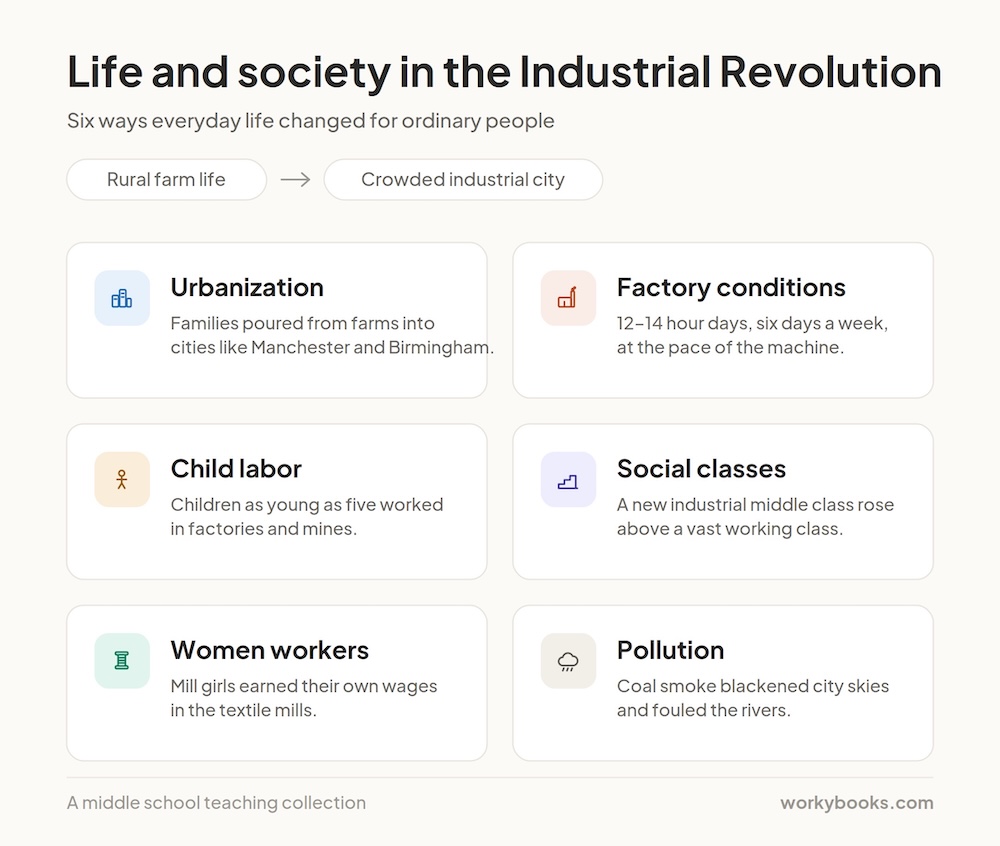
Before industrialization, most people lived in the countryside. Factories changed that almost overnight. Drawn by the promise of steady wages, workers crowded into fast-growing cities like Manchester and Lowell, where housing, sanitation, and clean water couldn’t keep pace with the flood of new arrivals. Families of six or eight often shared a single room; disease spread through neighborhoods with no sewers and few doctors. Students are often surprised to learn that the “opportunity” of the city and the misery of the slum were two sides of the same coin.
This is where our Industrial Revolution urbanization lesson plan begins — with the human geography of the boomtown. To help students hear the era in the words of the people who lived it, the unit pairs the lesson with primary sources on urbanization for middle school: census records, sanitary reports, and eyewitness letters that make abstract “growth” concrete. From there, a hands-on city life Industrial Revolution activity asks students to map a growing factory town and weigh the trade-offs its residents faced.
Inside the Factory
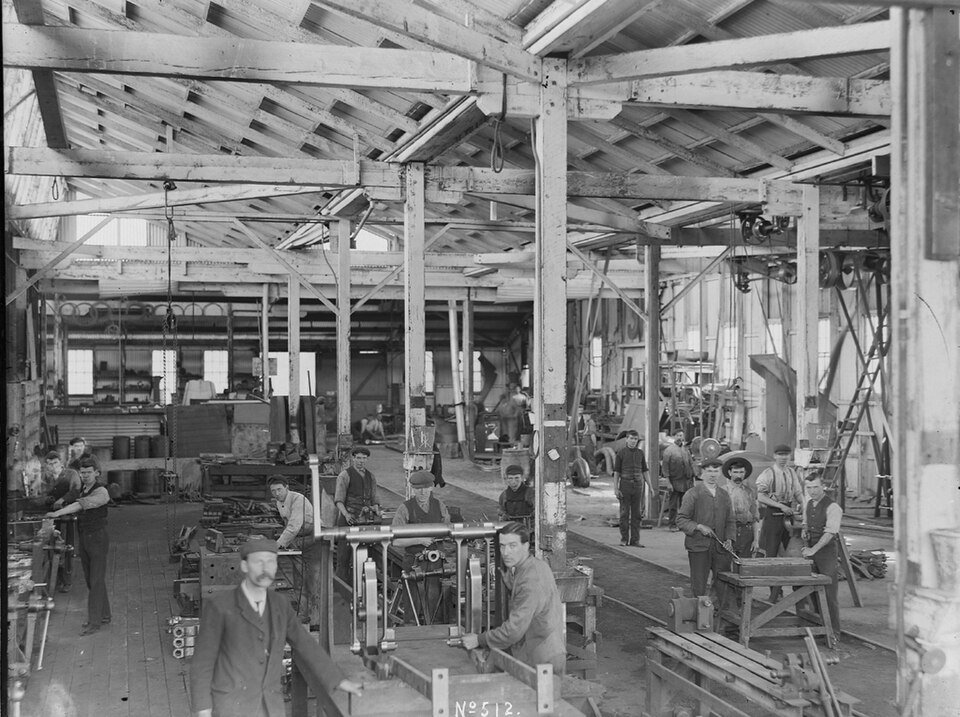
The factory replaced the workshop, and with it came a whole new experience of work. Instead of setting their own pace, workers followed the rhythm of the machine and the clock — often for twelve to fourteen hours a day, six days a week. Fines for lateness, dangerous unguarded equipment, and the constant roar of machinery made the factory floor a difficult and sometimes deadly place. Understanding these conditions helps students grasp why reform movements and labor laws eventually emerged.
Our Industrial Revolution factory conditions reading passage gives students a clear, grade-appropriate account of a typical workday, complete with comprehension questions that build close-reading skills. For a broader look at how manufacturing itself transformed, the rise of factories worksheet traces the shift from cottage industry to mass production. Together they anchor a strong working conditions middle school history lesson that connects economic change to lived experience.
The Children Working in the Factories
Perhaps nothing brings this era home to students like the fact that many factory workers were children their own age — or younger. Boys and girls as young as five or six worked long shifts as “scavengers” crawling beneath moving machines, or as breaker boys sorting coal. Their small size made them “useful” for jobs adults couldn’t do, and their families often needed the wages to survive. The story of child labor is where empathy and history meet most powerfully in the classroom.
The factory children reading comprehension passage, gives students a personal entry point into a hard topic. A set of child labor history activities then invites students to understand, compare working conditions across industries, and debate the reforms that eventually followed. It’s some of the most engaging child labor Industrial Revolution middle school content.
A New Middle Class Social Order
Industrialization didn’t just move people — it reshuffled society itself. A newly powerful middle class of factory owners, merchants, and professionals rose alongside a vast working class whose labor made their wealth possible. The gap between the mill owner in his country house and the family in the back-to-back tenement defined the age. Helping students see these class differences clearly gives them a framework for understanding everything else in the unit.
The Industrial Revolution social classes worksheet breaks down who held power, who did the work, and how daily life differed at each level. For a focused comparison, our middle class vs working class middle school activity has students contrast housing, diet, education, and leisure across the two groups. Both feed directly into a wider discussion of the social impacts of industrialization — and why the era planted the seeds of the reform movements that followed.
Women in the Industrial Revolution
Women were not bystanders in the industrial age — they were central to it. In textile mills especially, young women made up much of the workforce. The famous mill girls of Lowell, Massachusetts, left family farms to earn their own wages, live in company boarding houses, and even publish their own magazine — an extraordinary degree of independence for the time. Yet they also worked grueling hours for lower pay than men and had little say over their conditions. Their story complicates the simple “victim” narrative and gives students a richer picture of women’s history.
Our women in the Industrial Revolution worksheet explores both the new opportunities and the real limits these workers faced. The reading passage brings their voices into the classroom through boarding-house letters and firsthand accounts. It’s a natural bridge to later conversations about labor rights and the fight for suffrage.
Pollution due to Industrial Revolution
The Industrial Revolution ran on coal — and coal came at a cost. Factory chimneys turned skies gray, rivers ran black with dye and waste, and cities like London grew notorious for their thick, choking smog. For many students, this is where the era connects most clearly to the present: the environmental questions first raised by industrialization are still with us today. Studying the pollution of the 1800s gives students the historical roots of modern climate and sustainability debates.
Our Industrial Revolution pollution reading helps students understand how coal-powered growth transformed the air, water, and land around industrial cities. Paired with a coal and smoke history lesson, it builds a clear picture of cause and effect. And because these issues echo forward in time, the environmental impact of Industrial Revolution middle school activities make excellent cross-curricular links to science and geography.
Teaching the Full Unit
You can teach any of these threads on its own, or weave them together into a complete study of everyday life in the industrial age. To make that easier, the collection is built around flexible, standards-aligned building blocks:
- Industrial Revolution reading comprehension passages that meet students at grade level while building close-reading and evidence skills
- An Industrial Revolution social impacts worksheet that helps students synthesize how urbanization, labor, class, and environment fit together
- Child labor and factory conditions activities for hands-on analysis, debate, and primary-source work
- A cohesive life and society in the Industrial Revolution middle school sequence you can teach in order or mix and match
Because every resource shares a consistent format and difficulty level, you can differentiate for mixed-ability classes without prepping six separate lesson styles.
Frequently Asked Questions
What grade level is this Industrial Revolution content for? The passages, worksheets, and activities are written for middle school (grades 6–8), with reading levels and primary sources chosen to challenge students while staying accessible. Many teachers also use them for advanced 5th grade or on-level 9th grade support.
Are these resources accessible for English language learners and struggling readers? Yes. Every passage includes a full Spanish translation and read-aloud audio, plus a glossary of key vocabulary and graphic organizers. That means English language learners and below-level readers can access the same rigorous content as the rest of the class, with built-in supports rather than a watered-down version.
How do the topics connect to standards? The unit supports common middle school social studies goals around industrialization, cause and effect, and the social impacts of economic change, and pairs naturally with ELA reading-comprehension and evidence-based writing objectives.
Can I teach just one topic instead of the whole unit? Absolutely. Each section — urbanization, factory conditions, child labor, social classes, women workers, and pollution — works as a standalone lesson, so you can drop in a single passage or build out a multi-week study.
Bring the Industrial Age to Life
The Industrial Revolution wasn’t just an era of new machines — it was a turning point in how people lived, worked, and thought about their place in the world. Give your students the human story behind the smokestacks. Explore the full Life and Society in the Industrial Revolution collection and start teaching with ready-made passages, primary sources, and activities today.
Related Posts
Cenozoic Era Timeline: The Age of Mammals Explained

All about Earthquake for Your Classroom: Worksheets and Activities