How to Teach Weather in K-2: Science Reasoning Worksheets
Post 1 in our Climate Literacy from the Ground Up series.
The easiest way to teach weather in K-2 is to start with what’s right outside the window. Ask a kindergartner what the weather is, and they’ll tell you. They already know. They felt the cold on the walk in; they noticed the puddles; they wanted the hood up. Weather is the rare science topic that needs no introduction, no lab kit, and no field trip — it’s outside the window every single morning, changing in ways young children can see, feel, and talk about. That’s what makes teaching weather in K-2 such a natural place to begin real science.
That’s exactly why I think weather is where climate literacy should begin. Not with melting glaciers or carbon — those come much later, when the thinking is ready for them — but with the quiet, foundational habit underneath all of it: watching the world closely, noticing patterns, and explaining what you see with evidence. If a child learns in kindergarten to observe the weather and say what they think will happen, and why, they have started down the road to climate literacy, whether or not the word “climate” is ever spoken.
The trouble is that most weather worksheets for young learners stop short of that. They ask kids to match a cloud to a word, color a sun, circle “rainy.” That’s not wrong — naming is a real and necessary step — but it’s recall, and recall is the floor, not the ceiling. Five- and six-year-olds are capable of far more if we give them the language to do it.
It all turns on one word: because
The whole routine I’m about to describe hangs on a single talk move: because — the heart of claim-evidence-reasoning (CER).
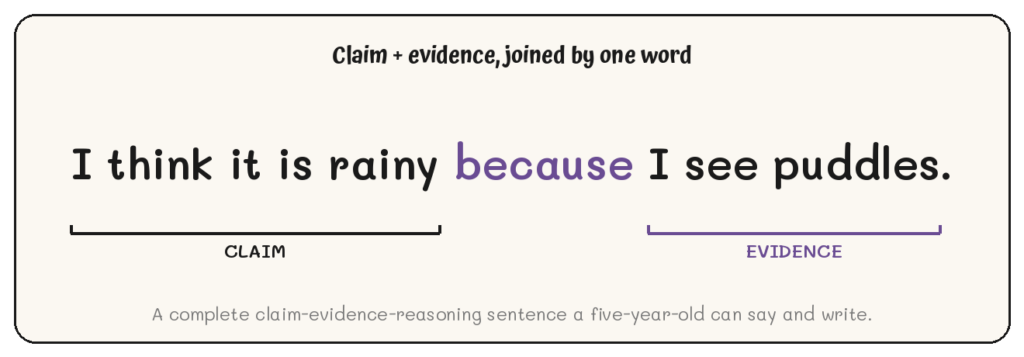
That little word is claim-and-evidence reasoning — the same structure scientists use, scaled down to a sentence frame a first-grader can finish. A claim (“it is rainy”), a piece of evidence (“I see puddles”), joined by because. Teach children to reach for that word when they talk about the sky. They will develop a thinking tool they’ll use for the rest of their science lives. It’s also their very first science writing — an opinion backed by evidence.
You don’t need a unit plan to start. You need a short daily rhythm and a handful of printable weather worksheets that move in deliberate steps from naming to reasoning.
Teach Weather in K-2: A six-part routine, from naming to reasoning
Here’s the arc, and the order I’d teach it in.
First, name it.
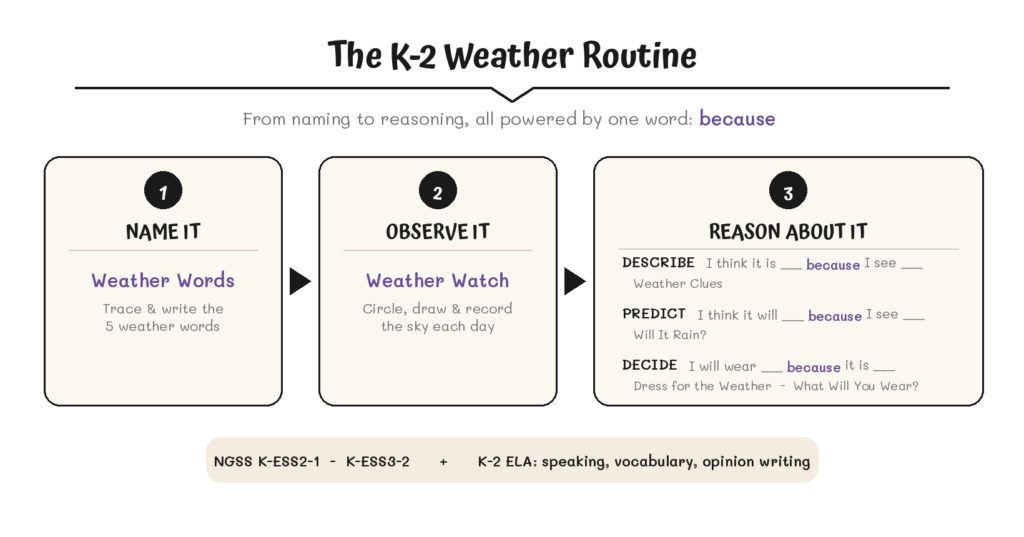
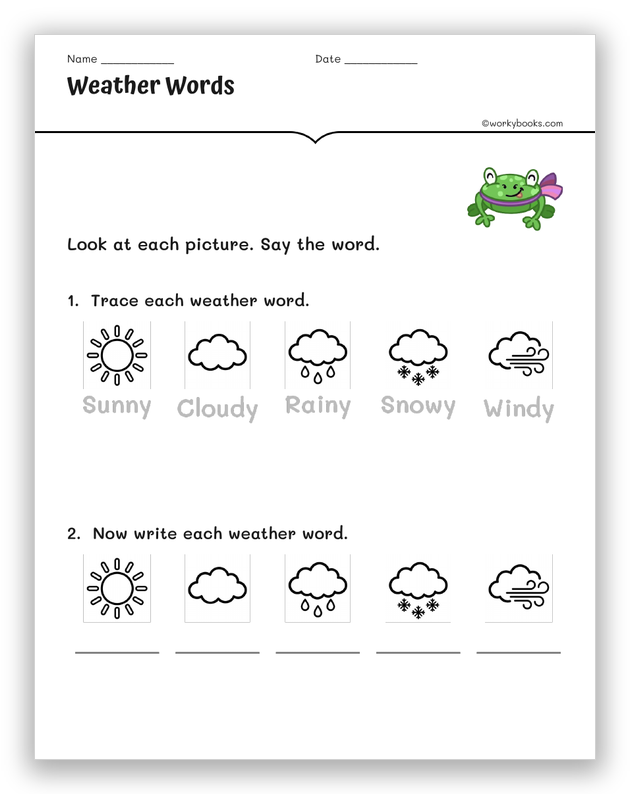
Children can’t reason about what they can’t name. Weather Words builds the core weather vocabulary — sunny, cloudy, rainy, snowy, windy — with a trace-then-write step so the words actually stick. This printable weather worksheet is your week-one foundation.
Then, observe and record it.
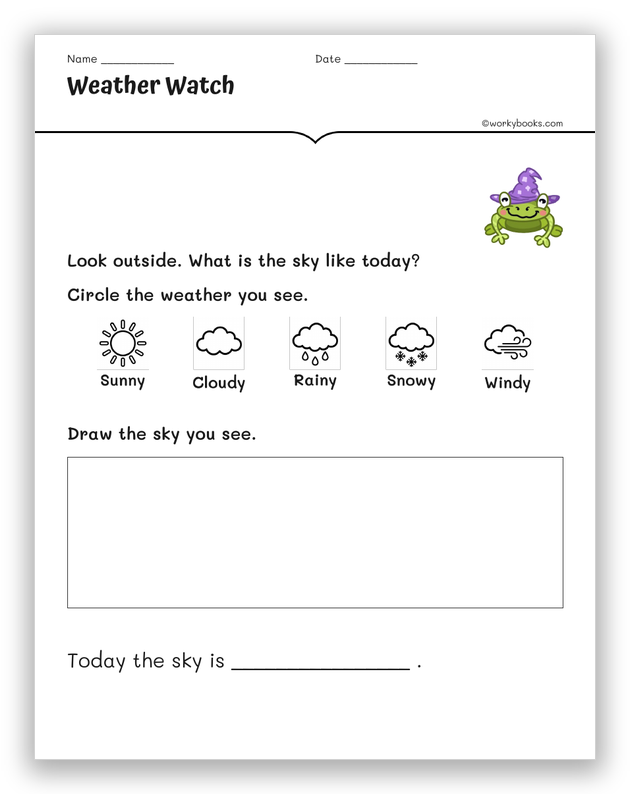
Weather Watch turns the daily glance out the window into a habit: observe the weather, circle it, draw the sky, and finish “Today the sky is ___.” Run this weather observation routine every morning. The magic of weather is that it’s a pattern over time, and patterns only appear when you record day after day.
Then, reason about it — three ways.
This is the heart of the routine, and where the because move lives. There are three distinct kinds of reasoning here, and children benefit from meeting all three.
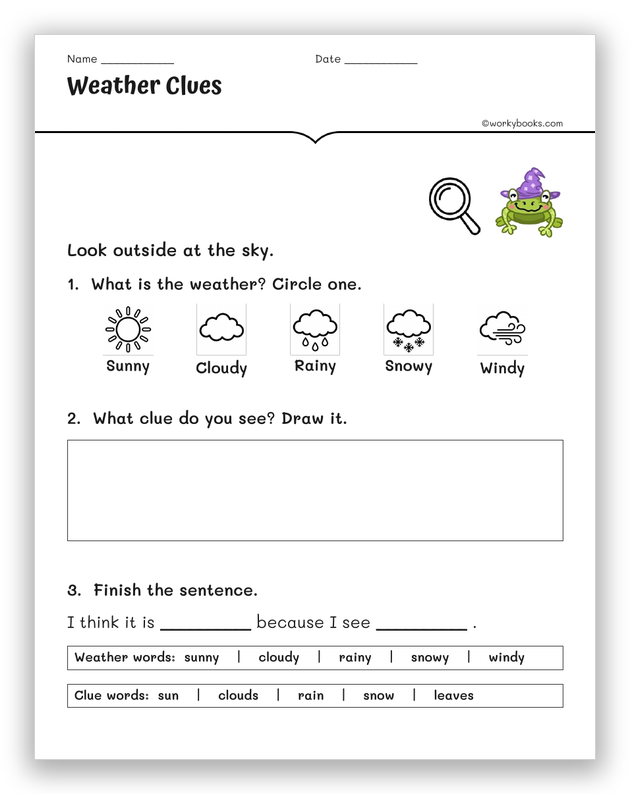
Describe — “I think it is ___ because I see ___.”
Weather Clues asks children to explain the weather happening right now: circle what it is, draw the clue they see, and join the two with because. It’s claim-evidence-reasoning for kindergarten in its simplest form — a weather sentence frame that turns a guess into a claim backed by evidence.
Predict — “I think it will ___ because I see ___.”
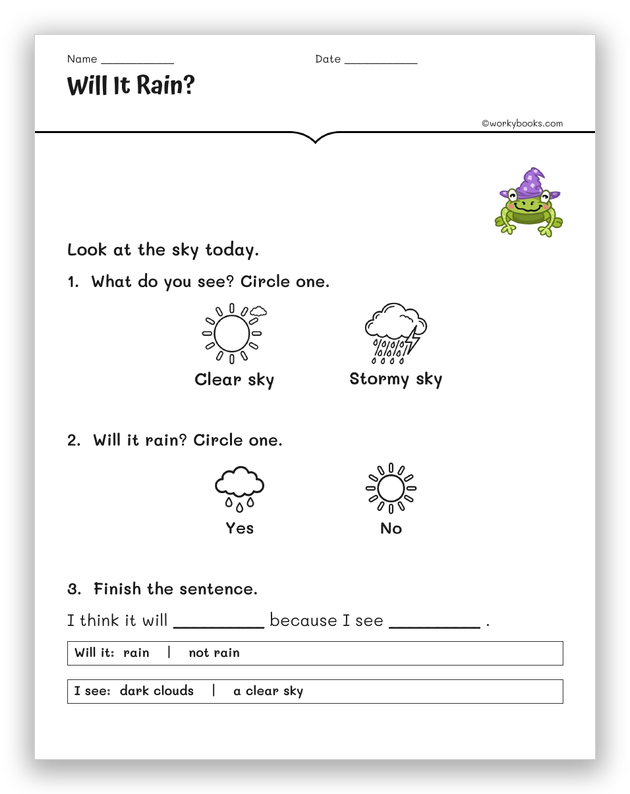
Will It Rain? is a true forecasting move: read the sky (clear or stormy), predict what’s coming, and back it with evidence. Predicting is a genuinely different kind of thinking than describing — and kids love it.
Decide — “I will wear ___ because it is ___.”
Here the reasoning flips: the weather becomes the evidence, and the choice is the claim. Dress for the Weather matches clothing to conditions, and What Will You Wear? turns it into a full reasoning sentence. This is where grade 1 weather lessons connect science to an everyday decision.
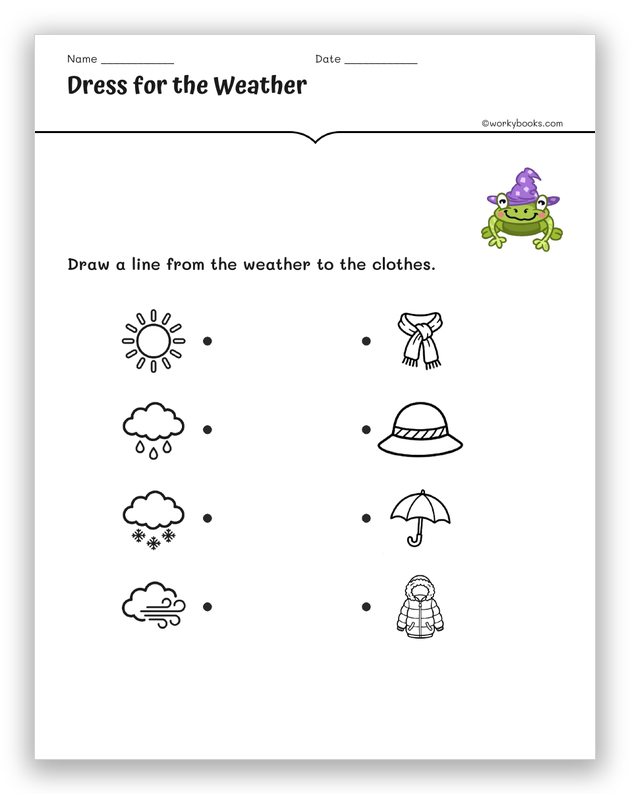
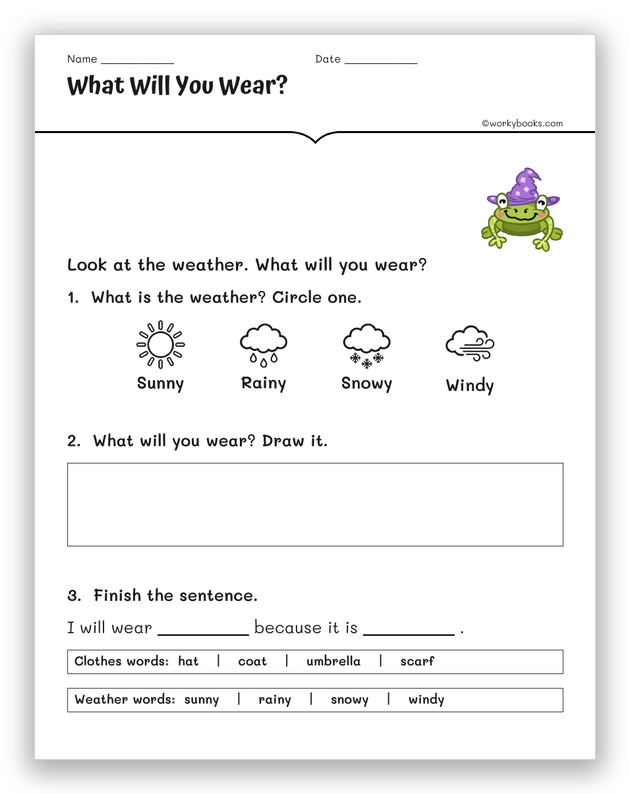
Describe, predict, decide. Same engine, three different jobs — and together they show children that observing the sky isn’t just labeling, it’s thinking.
Want the three reasoning sheets? Grab Weather Clues, Will It Rain?, and What Will You Wear? to build the full describe · predict · decide set.
How to teach weather in K-2, day to day
These weather activities for kindergarten through grade 2 are built to be low-prep and flexible. A few ways teachers use it:
Use a morning-meeting anchor — one quick observation page a day, building the week’s pattern. As science-center work — the matching and trace-and-write pages run independently while you pull small groups. As partner talk — have children say their because sentence aloud to a neighbor before they write it; the talking is where the reasoning gets rehearsed.
And because the band spans K through 2, the same routine differentiates naturally: your youngest trace and circle, your writers fill the sentence frames, and your most capable explain their reasoning aloud. Every page is a no-prep, printable PDF that prints clean in black and white, so it photocopies and colors without a color budget.
What standards these weather worksheets cover
For your planning, the set aligns to NGSS K-ESS2-1 (observe and describe weather patterns) and K-ESS3-2 (reading the sky to prepare for the day), and it does real double duty in ELA — grade-banded speaking and listening, vocabulary, and early opinion writing (that “because” sentence is a first opinion-with-reason). It’s science and literacy in the same ten minutes.
Why this is where climate literacy begins
I want to be clear about what this is and isn’t. At K-2, we keep weather observational and joyful. No mechanisms, no climate change, no anxiety — that’s not developmentally where these children are, and rushing it does more harm than good.
What we are doing is quietly laying the cognitive foundation. Climate literacy, when it eventually arrives in the upper grades, asks students to do exactly what this routine practices: gather evidence, notice patterns over time, distinguish what they observe from what they conclude, and reason carefully about cause and effect. A second-grader who has spent two years saying “I think ___ because I see ___” is not learning climate science yet — but they are becoming the kind of thinker who will be ready for it. That’s the long game, and it starts at the classroom window.
Frequently asked questions
How do I teach weather in K-2?
Begin with weather vocabulary, add a short daily weather observation routine, then layer in reasoning with simple sentence frames like “I think it is ___ because I see ___.” Naming first, observing second, reasoning third.
What is claim-evidence-reasoning (CER) for young learners?
CER for kindergarten is just a claim, a piece of evidence, and the word because that connects them. “I think it is rainy because I see puddles” is a complete claim-evidence-reasoning sentence a five-year-old can say and write.
What standards do these K-2 weather worksheets cover?
They align to NGSS K-ESS2-1 and K-ESS3-2, plus grade-banded K-2 ELA standards for speaking and listening, vocabulary, and opinion writing.
Are the weather worksheets printable and no-prep?
Yes. Every page is a print-ready PDF that prints clean in black and white — ideal for morning meeting, science centers, sub days, or homework.
Coming up in this series
This is the first post in a series that will grow with your students — from these early observation routines toward the richer earth-and-sky topics of the later elementary grades, always keeping the same through-line: reasoning from evidence, not memorizing facts. Next, we’ll look at extending the weather routine into multi-day data — how even kindergartners can build and read their first weather graph.
For now, start small. Pick one window, one sentence frame, and one word: because.
Related Posts
Severe Weather Worksheets for 2nd Grade
Engaging Prefix and Suffix Worksheets for 1st Grade