Factory Working Conditions
Interactive passage with audio narration, comprehension questions, and printable PDF.
What's included
Factory Working Conditions preview and details
About this printable Factory Working Conditions reading passage (Grades 5-8)
Sample passage and quiz from Factory Working Conditions
Reading passage and comprehension quiz preview
Factory Working Conditions
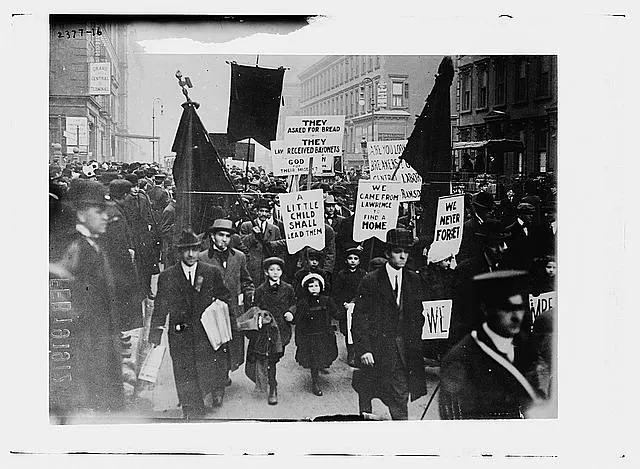
"Lawrence, Mass strikers parading in N.Y.C. 1911" by Bain News Service / Library of Congress.
The Industrial Revolution was a period of major economic and social change that began in Britain in the late 1700s and spread to other parts of the world. During this time, new machines, such as the steam engine, allowed factories to produce goods faster and at a larger scale. However, these technological advances also led to difficult and often dangerous working conditions for millions of people.
Factory work was very different from previous jobs in farming or small workshops. In early factories, employees—including men, women, and even children—worked long hours, often from sunrise to sunset or for more than 12 hours a day. The work was repetitive and exhausting, with little time for breaks. Factory owners wanted to maximize production, so they did not always consider the health or safety of their workers. For example, in textile mills in Manchester, England, in the early 1800s, children as young as eight operated heavy machinery. These children risked injury every day, as documented by government inspectors in 1832, who reported accidents involving crushed fingers and even deaths.
The conditions inside factories could be dangerous. Many buildings had poor ventilation, so dust and smoke filled the air and caused workers to develop lung diseases. In some cases, machines were not properly guarded, leading to serious injuries. According to a letter written by a factory worker in Leeds in 1833, "We work in heat and noise, and our bodies are always tired." Workers were paid very low wages, and there was little job security. Some families depended on every member, including children, to earn enough to survive.
Over time, workers began to organize to demand better treatment. They formed early labor unions—groups of workers who joined together to ask for better pay and safer conditions. In 1833, the British government passed the Factory Act, which limited the working hours of children and required factory inspections. Strikes, or organized work stoppages, also became more common. For example, in 1842, thousands of British coal miners went on strike to protest dangerous conditions and low pay. Although not all strikes were successful, these actions helped raise public awareness and pushed governments to pass more reforms.
The struggles of industrial workers in the 1800s led to important changes in laws, working hours, and safety rules. Over time, labor unions grew stronger and spread to other countries, including the United States. These changes improved the lives of millions and continue to shape workplaces today.
The fight for better working conditions during the Industrial Revolution connects to larger themes in world history, such as human rights, social change, and the impact of technology on daily life.
Interesting Fact: In 1912, thousands of textile workers in Lawrence, Massachusetts, organized a strike known as the "Bread and Roses" strike, demanding not only fair wages but also dignity and respect at work.
Comprehension quiz (8 questions)
1. Where did the Industrial Revolution begin?
2. Who worked long hours in early factories?
3. What law limited children's work hours in 1833?
4. Why did workers form labor unions?
5. How did factory owners increase production?
6. What was one effect of strikes?
7. The Bread and Roses strike happened in 1912.
8. What is a 'strike'?
Perfect for the way you teach
- Build comprehension skills
- Auto-graded quiz
- Differentiated reading
- Read together at home
- Improve fluency
- Quiet reading time
- Reading curriculum support
- Independent practice
- Track Lexile growth