Reading PassagePremium

How might climate change affect animals?

Interactive passage with audio narration, comprehension questions, and printable PDF.

No ratings yet
Grades 2–4ElaReadingScienceClimate changeEnglish · SpanishInteractive · Printable
Aligned toRI.3.1RI.4.14.ESS2.D4-ESS3
Just this resource
$1.50
One-time purchase
Best value
Unlock everything
$49.99$24.99/yr
50% off until Sept 15 — 10,000+ resources
Renews at $49.99/year.

By completing this purchase you agree to our Terms of Use and Privacy Policy. Your subscription renews automatically until you cancel. You can cancel anytime from your account settings. All sales are final and non-refundable. Digital content is available for download in your account immediately upon purchase.

Unlock above to use these actions

What's included

Reading passage
Audio narration
Comprehension quiz
Writing activity
Glossary & flashcards
Differentiated version
Spanish translation

How might climate change affect animals? preview and details

About this printable How might climate change affect animals? science reading passage, NGSS-aligned (Grades 2-4)

This passage explains to children how climate change impacts animal life. It uses specific examples like polar bears losing their icy habitats and birds needing to migrate to new areas for food. The text also mentions effects on marine life and amphibians. By illustrating how climate change can alter where animals live, what they eat, and how they survive, the passage helps children understand the broad ecological implications of global warming, emphasizing the interconnectedness of climate and wildlife.
Written by Neha Goel TripathiPublished by Workybooks
Preview

Sample passage and quiz from How might climate change affect animals?

Reading passage and comprehension quiz preview

How Might Climate Change Affect Animals?
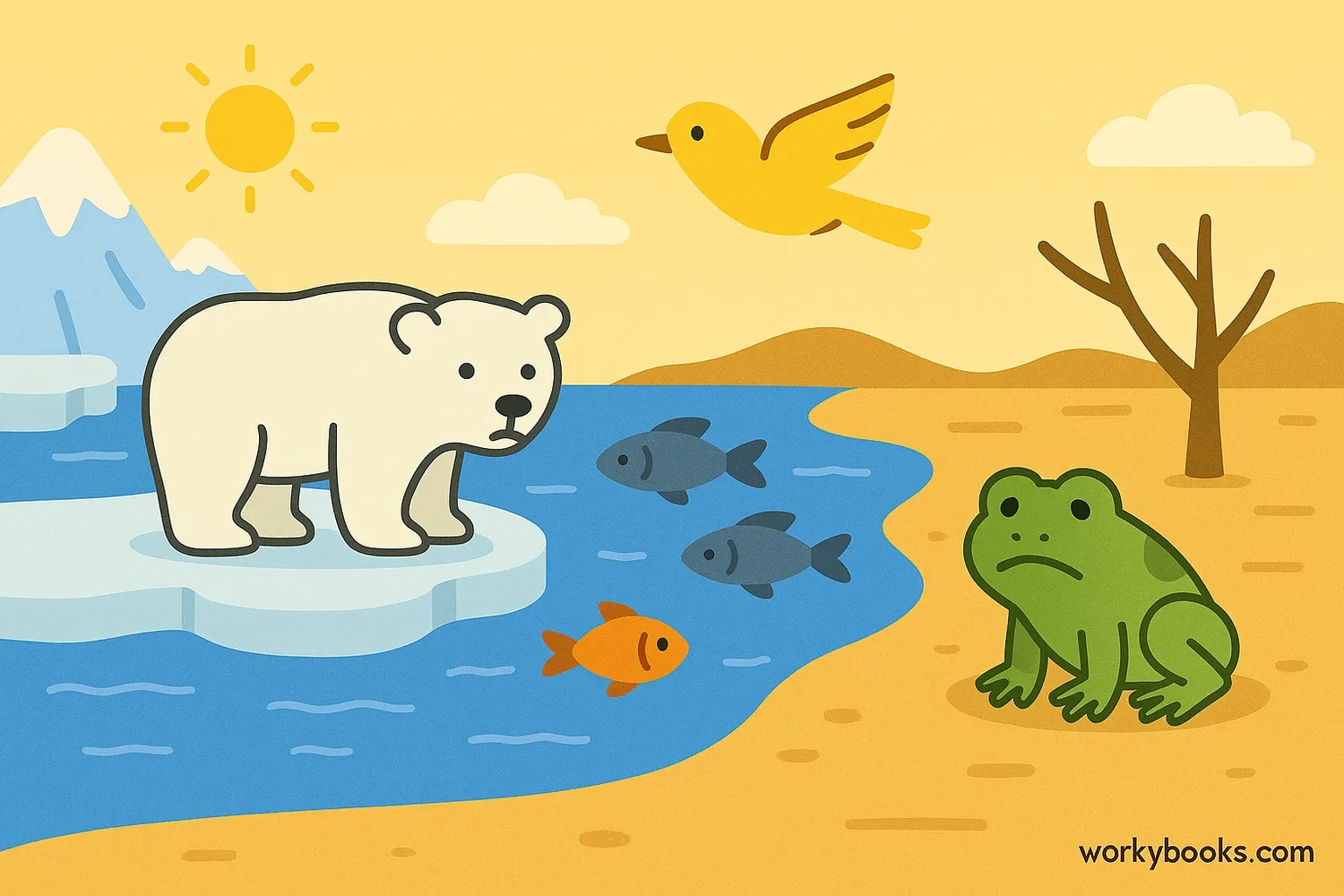
How might climate change affect animals
Climate change forces animals to adapt, migrate, or face extinction.

Climate Change and Animal Habitats

Climate change is causing big changes for animals all over the world. Habitat means the place where an animal lives. When the climate gets warmer or wetter, animal habitats can change or disappear. For example, in the Arctic, polar ice is melting. Animals like polar bears, penguins, and seals lose the ice they use for hunting and resting. In the ocean, warmer water causes coral reefs to bleach and die, which means fish lose their homes. Forests are drying out, so wildfires happen more often and destroy animal homes. When sea levels rise, beaches where sea turtles nest can flood.

Food and Survival

Animals depend on having the right food at the right time. But climate change can mix up this timing. Birds might arrive to nest before the insects they eat have hatched. Some plants bloom earlier than usual, so pollinators like bees and butterflies miss the flowers. If prey animals move to new areas to find cooler weather, predators may not find enough food. In the ocean, acidification makes it hard for shellfish to form their shells.

Migration and Range Changes

Many animals move, or migrate, to survive. As the Earth warms, animals move toward the poles or up mountains, looking for cooler places. Eventually, some mountain animals, like the pika, run out of places to go. Some species appear in new areas, while others have their migration patterns mixed up.

Examples of Animals Affected

Polar bears are starving as the sea ice disappears. Sea turtles have more female babies because warmer sand changes egg development. Coral reef fish are losing their colorful homes. Pikas, which live on high mountains, have nowhere cooler to escape. Monarch butterflies depend on milkweed, but the timing of the plant’s growth is changing.

Extinction Risk and Hope

Scientists warn that if climate change continues, 1 in 6 species could face extinction. But there is hope! People are helping by making wildlife corridors, reducing greenhouse gases, and protecting habitats. Some animals are finding ways to adapt, and every bit of climate action helps give them more time.

Comparison: Climate change is like someone rearranging your house while you're living in it—the kitchen moves, your bedroom disappears, and dinner shows up at random times!

Interesting Fact: Some animals, like certain butterflies and birds, are already changing when they migrate or lay eggs because of climate change!

Comprehension quiz (8 questions)

1. What is a habitat?

An animal's home
A type of food
A kind of weather
A mountain peak

2. Why are coral reefs dying?

Colder water
Warmer water
Too many fish
Too much rain

3. What happens to sea turtles when sand gets warmer?

More female babies
No eggs hatch
More food
Shells get softer

4. Which animal climbs higher up mountains?

Pika
Penguin
Polar bear
Monarch butterfly

5. Why do some animals move to new places?

To find cooler habitats
To escape people
To sleep more
To make friends

6. What can help animals survive climate change?

Protected corridors
More wildfires
More pollution
Less food

7. All animals can adapt to climate change.

True
False

8. What does 'extinction' mean?

Changing color
Moving to a new place
No living members left
Having more babies
Curriculum

Common Core standards for How might climate change affect animals?

RI.3.1

Ask and answer questions to demonstrate understanding of a text, referring explicitly to the text as the basis for the answers.

RI.4.1

Refer to details and examples in a text when explaining what the text says explicitly and when drawing inferences from the text.

Who it's for

Perfect for the way you teach

Teachers
  • Build comprehension skills
  • Auto-graded quiz
  • Differentiated reading
Parents
  • Read together at home
  • Improve fluency
  • Quiet reading time
Homeschoolers
  • Reading curriculum support
  • Independent practice
  • Track Lexile growth
Topics

Reviews & Ratings

No reviews yet. Be the first to share your experience!

More reading you might love

19 more
Worksheet
Natural Disasters and Urban flooding - worksheet educational content
Grades 3–5

Natural Disasters and Urban flooding

writing · RI.4.4+3

Free
Passage
Reduce Your Carbon Footprint: Simple Tips for Home - reading educational content
Grades 2–4

Reduce Your Carbon Footprint: Simple Tips for Home

weather and climate · RI.3.1+3

Free
Passage
How using less plastic helps the environment? - reading educational content
Grades 2–4

How using less plastic helps the environment?

weather and climate · RI.3.1+3

Free
Passage
How Kids Can Help Fight Climate Change? - reading educational content
Grades 2–4

How Kids Can Help Fight Climate Change?

weather and climate · RI.3.1+3

Free
Passage
What is recycling, and why is it important? - reading educational content
Grades 2–4

What is recycling, and why is it important?

science · RI.3.1+3

Free
Passage
How can planting trees help fight climate change? - reading educational content
Grades 2–4

How can planting trees help fight climate change?

weather and climate · RI.3.1+3

$1.50
Passage
How might climate change affect our food supply? - reading educational content
Grades 2–4

How might climate change affect our food supply?

weather and climate · RI.3.1+3

Free
Passage
What can happen to sea levels because of climate change? - reading educational content
Grades 2–4

What can happen to sea levels because of climate change?

weather and climate · RI.3.1+2

Free
Passage
How is Climate Different from Weather? - reading educational content
Grades 2–4

How is Climate Different from Weather?

weather and climate · RI.3.1+2

Free
Passage
Can you name three greenhouse gases - reading educational content
Grades 2–4

Can you name three greenhouse gases

weather and climate · RI.3.1+2

Free
Worksheet
Informational Text —Meet the Governors - worksheet educational content
Grade 3

Informational Text —Meet the Governors

reading informational text · RI.3.10+3

$1.50
Worksheet
Koi Fish—What’s the Main Idea? - worksheet educational content
Grade 3

Koi Fish—What’s the Main Idea?

reading informational text · RI.3.2+2

$1.50
Worksheet
Informational Text —Bioluminescence - worksheet educational content
Grade 3

Informational Text —Bioluminescence

reading informational text · RI.3.10+3

$1.50
Worksheet
Informational Text —Learn About Dinosaurs - worksheet educational content
Grade 3

Informational Text —Learn About Dinosaurs

reading informational text · RF.3.4+4

$1.50
Worksheet
Informational Text —Volcanoes - worksheet educational content
Grade 3

Informational Text —Volcanoes

pb sandwich —event sequencing · RI.3.7+8

Free
Worksheet
Informational Text —Snowflakes - worksheet educational content
Grade 3

Informational Text —Snowflakes

reading informational text · RI.3.10+4

$1.50
Worksheet
Informational Text on Holi - worksheet educational content
Grade 3

Informational Text on Holi

reading informational text · RI.3.10+4

$1.50
Worksheet
Informational Text on Goods and Services - worksheet educational content
Grade 3

Informational Text on Goods and Services

reading informational text · RI.3.10+3

$1.50
Worksheet
Sharks—Informational Text - worksheet educational content
Grade 3

Sharks—Informational Text

reading informational text · RI.3.1+6

Free
Copyright © 2026 Workybooks. Made with ♥ in California.