Digital vs. Analog Signals
Interactive passage with audio narration, comprehension questions, and printable PDF.
By completing this purchase you agree to our Terms of Use and Privacy Policy. Your subscription renews automatically until you cancel. You can cancel anytime from your account settings. All sales are final and non-refundable. Digital content is available for download in your account immediately upon purchase.
What's included
Digital vs. Analog Signals preview and details
About this printable Digital vs. Analog Signals science reading passage, NGSS-aligned (Grades 5-8)
Sample passage and quiz from Digital vs. Analog Signals
Reading passage and comprehension quiz preview
Digital vs. Analog Signals
Communication in our world depends on signals that carry information from one place to another. Scientists and engineers recognize two main types: analog signals and digital signals. The way information is sent and received can greatly affect its accuracy and reliability. Knowing the difference between analog and digital signals helps us understand why modern technology prefers one over the other, especially in devices like smartphones and computers.
How Analog and Digital Signals Work
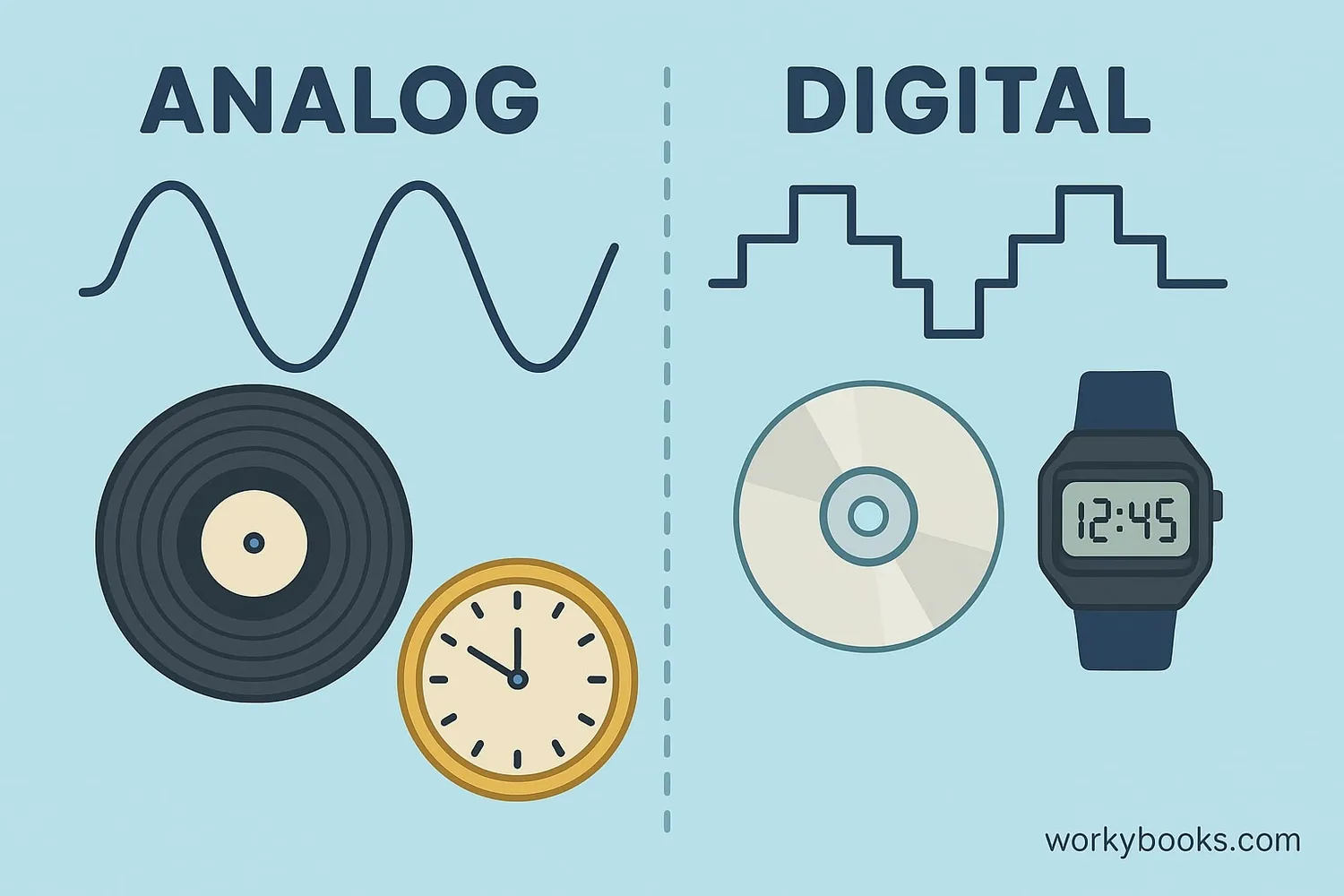
An analog signal is a continuous wave that changes smoothly over time. It can have any value within a range and directly represents information, like the grooves on a vinyl record that match the sound waves of music. In contrast, a digital signal is made up of discrete pulses, usually represented as 1s and 0s (on and off states). This binary system allows digital signals to be easily processed by computers. For example, an MP3 music file stores sound as a series of numbers, not as a smooth wave. Analog signals are sensitive to noise, which is unwanted interference that can distort the information. Digital signals, because they only use two distinct values, are more resistant to noise. This means digital information is less likely to be changed by static or weak signals.
Real-World Examples and Applications
One clear example is the difference between a vinyl record and an MP3 player. Vinyl records use analog signals, so scratches or dust can cause pops and hisses in the sound. MP3 players use digital signals, making the music clearer and more reliable. Another example is television broadcasting. Older TV antennas received analog signals, which could become blurry or fuzzy if the signal was weak. Modern streaming services use digital signals, delivering sharper images and sound because the system can correct errors. In fact, digital signals allow for compression, which reduces the amount of data needed to store and send information. This makes it easier to transmit large files, like movies or video games, over the internet.
Advantages, Challenges, and Broader Connections
Digital signals are widely used because they are easier to store, copy, and transmit over long distances without degrading. They also allow for advanced features, such as encryption for security and error correction for accuracy. Analog systems, while sometimes preferred for their natural sound or image quality, are less common in new technology. The shift from analog to digital is an example of how science and engineering respond to the need for better, more efficient ways to communicate. This trend connects to larger scientific principles, such as the use of energy to transfer information and the importance of reliable data in society. Still, some people argue that analog signals can provide richer detail in certain situations, like professional audio recording, showing that both systems have their place.
In summary, understanding analog and digital signals helps us see how technology has improved our ability to share information. It also shows the importance of reducing noise, increasing reliability, and making communication systems more efficient. As technology evolves, digital systems will likely continue to shape the way we send, receive, and store information in our daily lives.
Interesting Fact: The first digital audio CD was released in 1982, completely changing how people listened to music and starting the digital music revolution!
Comprehension quiz (10 questions)
1. What type of signal is made up of continuous waves that directly represent information?
2. Which of the following is more resistant to noise and interference?
3. What real-world example uses an analog signal to store music?
4. What is the main advantage of digital signals over analog signals in technology?
5. What does the word 'compression' mean as used in the passage?
6. In the context of the passage, what is 'noise'?
7. Why do streaming services use digital signals instead of analog signals?
8. If a vinyl record gets scratched, what happens to the signal?
9. Digital signals can be stored and copied without losing quality. (True/False)
10. Analog signals are always better than digital signals for all uses. (True/False)
Perfect for the way you teach
- Build comprehension skills
- Auto-graded quiz
- Differentiated reading
- Read together at home
- Improve fluency
- Quiet reading time
- Reading curriculum support
- Independent practice
- Track Lexile growth