Sound and Technology
Interactive passage with audio narration, comprehension questions, and printable PDF.
By completing this purchase you agree to our Terms of Use and Privacy Policy. Your subscription renews automatically until you cancel. You can cancel anytime from your account settings. All sales are final and non-refundable. Digital content is available for download in your account immediately upon purchase.
What's included
Sound and Technology preview and details
About this printable Sound and Technology science reading passage, NGSS-aligned (Grades 5-8)
Sample passage and quiz from Sound and Technology
Reading passage and comprehension quiz preview
Sound and Technology
Sound is a form of energy that travels through air, water, or solids as waves. These waves carry information and allow us to communicate, enjoy music, and detect important signals in our environment. In today’s world, sound technology is essential for everything from recording music to helping people hear. By understanding how sound waves interact with matter and energy, scientists and engineers have invented devices that change, transmit, and improve sound in ways that shape our daily lives.
Changing Sound into Signals: Microphones and Speakers
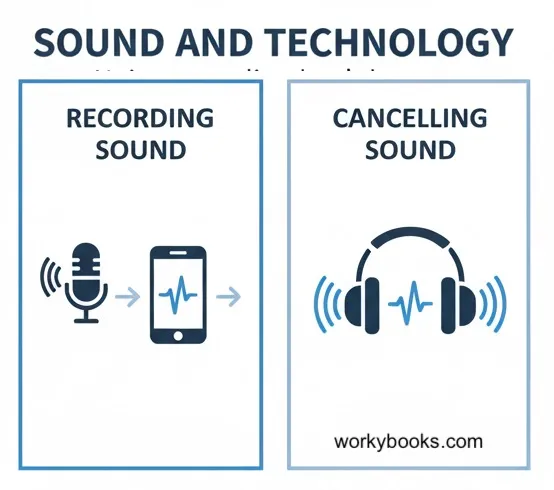
Microphones are devices that convert sound waves into electrical signals. When you speak into a microphone, sound waves make a thin material inside vibrate, which changes the flow of electricity. These signals can then be sent through wires, stored in digital form, or broadcast over radio waves. Speakers do the opposite: they take electrical signals and turn them back into sound waves you can hear. The speaker uses a magnet and coil to move a cone, pushing air to create vibrations. This system allows your voice to travel across the world in a phone call, or for music to be played from a digital file. In both cases, the key is the transformation between sound energy and electrical energy.
Modern Sound Technologies: Recording, Cancelling, and Recognizing Sound
Digital recording captures sound by measuring the amplitude of sound waves thousands of times per second, turning them into binary code (ones and zeros) that can be stored and played back without losing quality. Noise-canceling headphones use a process called destructive interference. These headphones have built-in microphones that detect unwanted noise. The system creates a new sound wave with the same amplitude but the opposite phase, which cancels out the original noise and creates a quieter listening experience. Ultrasound imaging uses high-frequency sound waves to create pictures of the inside of the body. By analyzing how these waves bounce back, doctors can see organs and tissues without surgery.
Helping People Hear and Communicate: Voice Recognition, Hearing Aids, and File Formats
Voice recognition technology uses computer algorithms to analyze sound patterns, allowing devices to understand spoken commands. This technology uses large databases and machine learning to improve accuracy. Hearing aids amplify certain frequencies of sound to help people with hearing loss, while cochlear implants convert sound directly into electrical impulses that stimulate the auditory nerve. Finally, audio file formats like MP3 and WAV use different methods to compress and store sound data, balancing quality and file size for various uses. All of these systems use our knowledge of sound waves and their properties to solve real-world problems and improve lives.
In summary, sound and technology are closely connected. By converting sound to electrical signals and back, filtering noise, and using high-frequency waves, we can communicate, record, diagnose, and assist in ways that were impossible before. Advances in sound technology continue to shape society, making life safer, healthier, and more connected.
Interesting Fact: Some noise-canceling headphones can reduce unwanted sounds by up to 90%, making them especially useful in loud environments like airplanes!
Comprehension quiz (10 questions)
1. What is the main function of a microphone?
2. Which device uses destructive interference to reduce unwanted noise?
3. Digital recording stores sound by...
4. What do cochlear implants do for people with hearing loss?
5. In the passage, what does the term 'destructive interference' mean?
6. What is the role of a speaker in a sound system?
7. Why are audio file formats like MP3 and WAV important?
8. Which of these technologies uses high-frequency sound waves for medical images?
9. True or False: Speakers and microphones both convert sound waves into electrical signals.
10. True or False: Voice recognition technology can only be used for music playback.
Perfect for the way you teach
- Build comprehension skills
- Auto-graded quiz
- Differentiated reading
- Read together at home
- Improve fluency
- Quiet reading time
- Reading curriculum support
- Independent practice
- Track Lexile growth