Tools and Technology in Earth Science
Interactive passage with audio narration, comprehension questions, and printable PDF.
By completing this purchase you agree to our Terms of Use and Privacy Policy. Your subscription renews automatically until you cancel. You can cancel anytime from your account settings. All sales are final and non-refundable. Digital content is available for download in your account immediately upon purchase.
What's included
Tools and Technology in Earth Science preview and details
About this printable Tools and Technology in Earth Science science reading passage, NGSS-aligned (Grades 5-8)
Sample passage and quiz from Tools and Technology in Earth Science
Reading passage and comprehension quiz preview
Tools and Technology in Earth Science
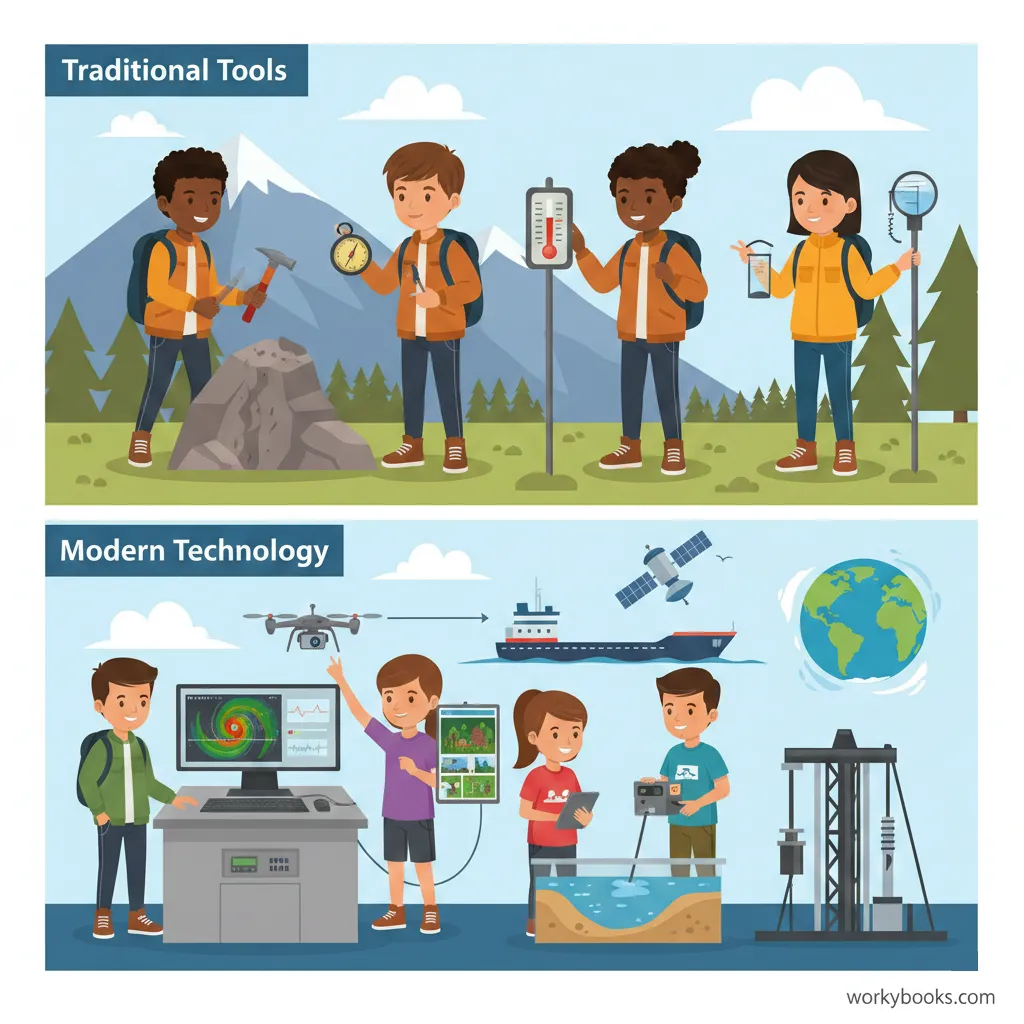
Earth science relies on a combination of traditional tools and advanced technology to investigate the planet’s systems and changes. These instruments help scientists collect accurate data, solve problems, and make predictions about Earth’s future. Understanding the capabilities and limitations of these tools is essential for interpreting scientific findings and improving our knowledge of natural processes.
Traditional Tools in Earth Science
For centuries, earth scientists have used simple, reliable tools to study rocks, weather, and landscapes. A rock hammer allows geologists to split rocks and collect samples for closer examination. The hand lens magnifies minerals, fossils, and soil particles, revealing details invisible to the naked eye. Measuring direction and position is possible with a compass, while instruments like the barometer and thermometer record air pressure and temperature. A rain gauge measures the amount of precipitation over a certain period. Although these tools may seem basic, they provide crucial data for understanding Earth’s surface and atmosphere.
Modern Technology Revolutionizes Earth Science
In recent decades, technology has transformed the way scientists observe and study Earth. Devices like the seismograph detect vibrations caused by earthquakes, allowing scientists to measure their strength and pinpoint their origins. Doppler radar tracks storms and rainfall, improving weather forecasting accuracy. Satellites in orbit capture high-resolution images, monitor climate patterns, and provide GPS data for mapping. Sonar systems use sound waves to map the ocean floor, while core drilling retrieves samples from deep within rocks and ice. These modern tools produce enormous amounts of data, which scientists analyze using computer modeling to simulate processes such as volcanic eruptions, sea-level rise, and climate change.
Remote Sensing and Citizen Science
Remote sensing refers to gathering information from a distance, often through satellites, drones, or aircraft. This method allows scientists to monitor large, hard-to-reach areas, tracking forest loss, glacier retreat, and changes in land use. Technology has also made it possible for ordinary people to contribute to science. Citizen science projects let people use weather stations, earthquake apps, and online platforms to submit observations. This shared data improves the accuracy of research and helps scientists detect patterns or hazards more quickly.
Advances in Earth science tools and technology have made it possible to see inside the planet, monitor global changes, and predict natural hazards before they happen. These innovations save lives, protect property, and help us make better decisions about managing Earth’s resources. As technology continues to evolve, our understanding of the planet will grow, leading to new discoveries and solutions for future challenges.
Interesting Fact: The first weather satellite, TIROS-1, launched in 1960, sent back images that changed how meteorologists forecast storms and track hurricanes worldwide.
Comprehension quiz (10 questions)
1. Which tool helps a geologist break open rocks to study them?
2. What is the main purpose of a rain gauge?
3. How do satellites help earth scientists?
4. What is remote sensing?
5. Which tool detects and records vibrations from earthquakes?
6. What does 'core drilling' allow scientists to do?
7. What is an example of citizen science mentioned in the passage?
8. Computer modeling helps scientists by:
9. True or False: Traditional tools like the hand lens have no value in modern Earth science.
10. True or False: The first weather satellite was launched in the year 1960.
Perfect for the way you teach
- Build comprehension skills
- Auto-graded quiz
- Differentiated reading
- Read together at home
- Improve fluency
- Quiet reading time
- Reading curriculum support
- Independent practice
- Track Lexile growth