This learning resource is available in interactive and printable formats. The interactive worksheet can be played online and assigned to students. The Printable PDF version can be downloaded and printed for completion by hand.
This engaging science passage aligns with NGSS standard 4-PS3-1 and helps Grade 4-5 students understand how starting height affects potential energy and kinetic energy. Through clear explanations and relatable examples, students discover why objects dropped from higher positions gain more speed as they fall to the ground. The passage connects scientific concepts to real-world applications like roller coasters, explaining why these rides start with big hills to provide energy for the entire journey. Audio-integrated features support diverse learners by providing multiple ways to access the content. Students explore the relationship between height, stored energy, and motion through concrete analogies and everyday examples. The material includes differentiated versions, Spanish translations, comprehension activities, and graphic organizers to support various learning styles and language needs.
CONTENT PREVIEW
Expand content preview
Potential energy is stored energy that an object has because of its position or height. When you lift an object higher, you give it more potential energy. This stored energy is important because it determines how fast the object will move when it falls or rolls down.
The higher an object starts, the more potential energy it has. Think about holding a ball at different heights. If you hold it at your waist and drop it, it falls at a certain speed. If you hold the same ball above your head and drop it, it falls faster and hits the ground harder. The ball dropped from the higher position has more stored energy to begin with, so it can move faster as it falls.
When an object falls, its potential energy changes into kinetic energy, which is the energy of motion. As the object drops, it speeds up or accelerates. An object falling from a greater height has more time and distance to speed up, so it gains more kinetic energy before hitting the ground. This is why a ball dropped from a roof moves much faster than one dropped from a table.
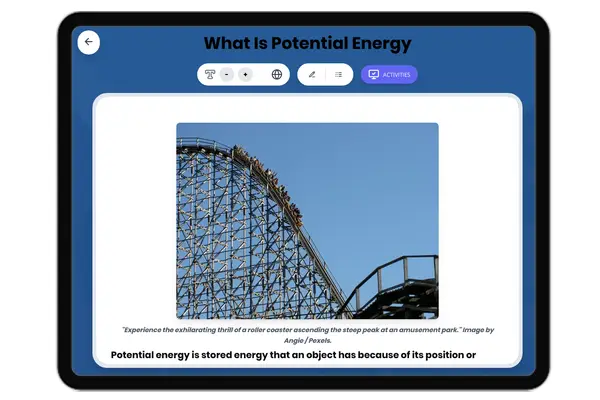
Roller coasters use this principle to create exciting rides. Engineers design roller coasters with very tall first hills because the higher the cars climb, the more potential energy they gain. When the cars rush down that first big hill, all that stored energy converts into kinetic energy, making them zoom fast. This speed from the tall starting height gives the cars enough energy to complete loops, curves, and smaller hills throughout the rest of the ride.
You can observe this relationship between height and speed on a playground slide. Climbing to the top of a tall slide gives you more potential energy than sitting at the top of a short slide. When you slide down, that stored energy becomes motion, and you reach the bottom going faster on the taller slide.
Understanding how height affects speed helps us see that potential energy and kinetic energy are connected. The higher something starts, the more energy it has available to move faster. This scientific principle explains everything from falling raindrops to thrilling amusement park rides.
What is potential energy?
Energy of motionStored energy from positionEnergy from the sunEnergy from eating food
What happens when an object falls?
It loses all energyPotential energy becomes kinetic energyIt gains potential energyNothing changes with energy
Why do roller coasters have tall first hills?
To look more excitingTo scare riders moreTo give cars more potential energyTo make them taller
A ball dropped from higher up will move faster.
TrueFalse
An object falling from higher gains more what?
WeightColorKinetic energySize
What does kinetic energy mean?
Energy from heightEnergy of motionEnergy from lightEnergy from heat
Why does a tall slide make you go faster?
It is made of different materialIt has more potential energy at topIt is steeper alwaysIt has less friction
What does accelerate mean in the passage?
To slow downTo stay the same speedTo speed upTo stop moving
Perfect For:
👩🏫 Teachers
• Reading comprehension practice
• Auto-graded assessments
• Literacy skill development
👨👩👧👦 Parents
• Reading practice at home
• Comprehension improvement
• Educational reading time
🏠 Homeschoolers
• Reading curriculum support
• Independent reading practice
• Progress monitoring
Reading Features:
📖
Reading Passage
Engaging fiction or nonfiction text
❓
Comprehension Quiz
Auto-graded questions
📊
Instant Feedback
Immediate results and scoring
📄
Printable Version
Download for offline reading
🔊
Read Aloud
Voice-over with word highlighting
Reviews & Ratings
No reviews yet. Be the first to share your experience!
Related Content
Forms of Energy
Energy Is Everywhere is an engaging science reading passage aligned with NGSS standard 4-PS3-1, designed for Grade 4-5 s...
NGSS 4-PS3-1
Faster Objects Have More Energy
This engaging 350-word passage explores the fundamental relationship between speed and kinetic energy, perfectly aligned...
NGSS 4-PS3-1
How to Measure Speed
This engaging 350-word science passage teaches Grade 4-5 students how to measure speed by calculating distance divided b...
NGSS 4-PS3-1
What Is Kinetic Energy
This engaging 250-word reading passage introduces fourth and fifth grade students to the concept of potential energy as ...