This learning resource is available in interactive and printable formats. The interactive worksheet can be played online and assigned to students. The Printable PDF version can be downloaded and printed for completion by hand.
This engaging 350-word science passage teaches Grade 4-5 students how to measure speed by calculating distance divided by time. Aligned with NGSS standard 4-PS3-1, the passage explains how scientists use units like miles per hour and meters per second to describe and compare object speeds. Students explore real-world applications including car speedometers, racing, and animal movement. The audio-integrated content includes a simplified differentiated version for struggling readers, Spanish translations, a comprehensive glossary of key terms, multiple-choice questions testing recall and comprehension, writing activities connecting science to everyday life, and graphic organizers for deeper understanding. The passage uses concrete analogies and familiar experiences to make abstract concepts accessible, helping students understand how speed measurements help us describe motion in the world around us.
CONTENT PREVIEW
Expand content preview
Speed is a measurement that tells us how fast something is moving. Scientists measure speed to understand and compare the motion of different objects, from walking people to speeding rockets. Knowing how to measure speed helps us plan trips, design vehicles, and study how things move in our world.
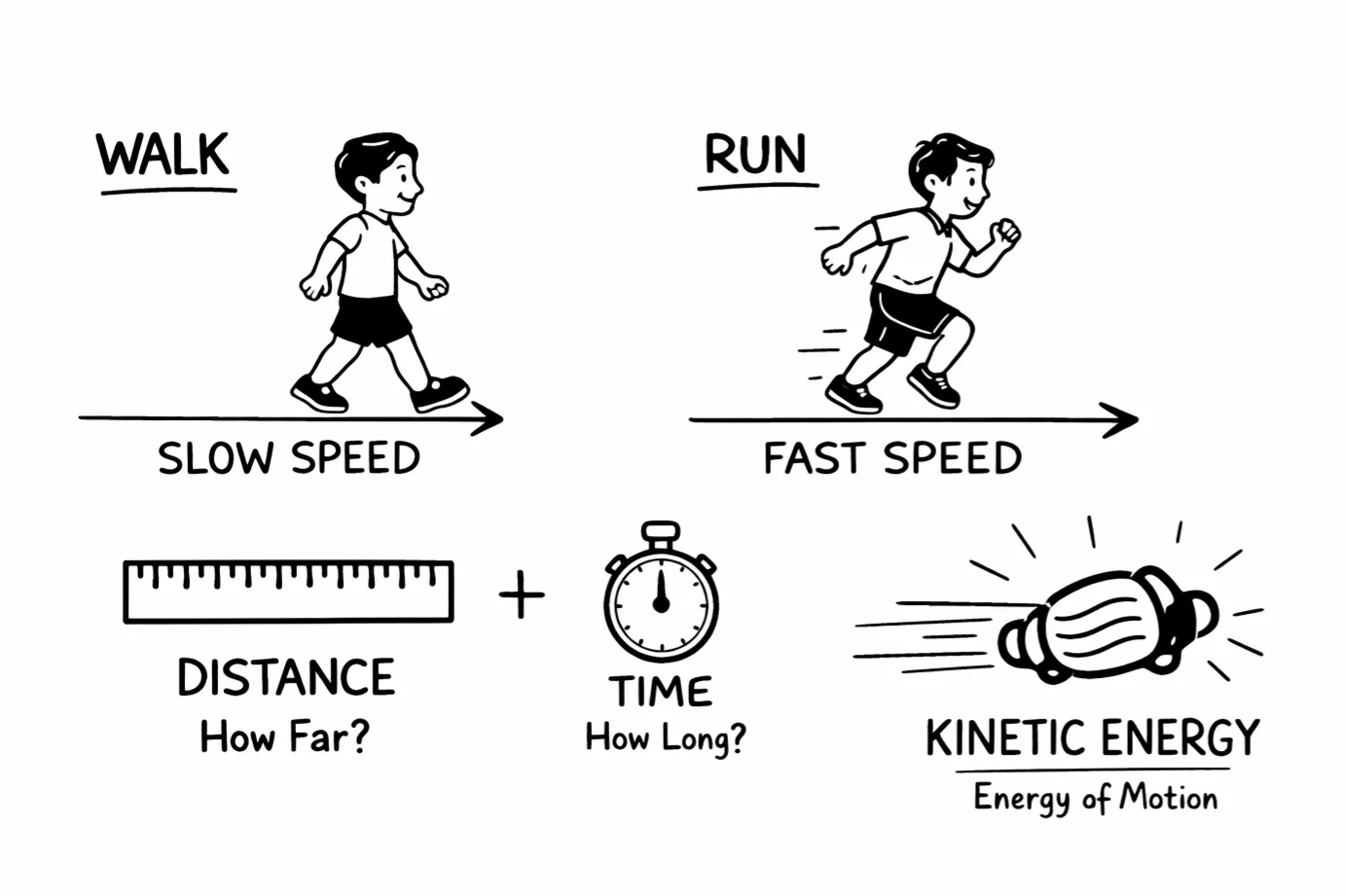
To measure speed, scientists use a simple calculation. Speed equals the distance an object travels divided by the time it takes to travel that distance. Distance is how far something moves, measured in units like miles or meters. Time is how long the movement takes, measured in units like hours or seconds. If a car travels 60 miles in 1 hour, its speed is 60 miles divided by 1 hour, which equals 60 miles per hour.
Scientists use standard units to describe speed so everyone can understand the measurements. In the United States, people often measure speed in miles per hour, which we write as mph. Scientists around the world also use meters per second, written as m/s. A person walking might move at about 3 miles per hour, while a race car might zoom at 200 miles per hour. Using the same units lets us compare these different speeds easily.
You can see speed measurement in action when you ride in a car. The speedometer on the car's dashboard shows how fast the car is traveling in miles per hour. When the speedometer shows 30, the car is moving 30 miles per hour. If you drove at that speed for one hour, you would travel 30 miles. The speedometer constantly calculates the car's speed by measuring how far the wheels turn in a certain amount of time.
Understanding speed helps us in many practical ways. Traffic signs use miles per hour to tell drivers how fast they can safely travel. Weather forecasters measure wind speed to predict storms. Athletes track their running speed to improve their performance. Even animals have different speeds—a cheetah can run 70 miles per hour, while a garden snail moves at just 0.03 miles per hour!
Measuring speed by calculating distance divided by time is a fundamental skill in science. This simple formula helps us describe motion accurately, compare how fast different objects move, and make predictions about travel time. Whether you're watching a speedometer in a car or timing how fast you can run across the playground, you're using the same scientific method that helps us understand motion throughout the universe.
What do scientists divide to calculate speed?
Distance by timeTime by distanceMiles by metersHours by seconds
What does a car's speedometer show?
How far you have traveledHow fast you are movingHow much gas you haveWhat time it is
About how fast does a person walk?
30 miles per hour70 miles per hour3 miles per hour200 miles per hour
Why do scientists use standard units?
To make calculations harderSo everyone can understand measurementsTo confuse other scientistsBecause rulers are expensive
If a car goes 60 miles in 1 hour, what is its speed?
30 miles per hour60 miles per hour120 miles per hour61 miles per hour
How does a speedometer calculate car speed?
By measuring how far wheels turnBy counting the trees you passBy checking the gas tankBy listening to the engine
Speed can be measured in meters per second.
TrueFalse
What does the term 'distance' mean?
How long movement takesHow fast something movesHow far something movesThe weight of an object
Perfect For:
👩🏫 Teachers
• Reading comprehension practice
• Auto-graded assessments
• Literacy skill development
👨👩👧👦 Parents
• Reading practice at home
• Comprehension improvement
• Educational reading time
🏠 Homeschoolers
• Reading curriculum support
• Independent reading practice
• Progress monitoring
Reading Features:
📖
Reading Passage
Engaging fiction or nonfiction text
❓
Comprehension Quiz
Auto-graded questions
📊
Instant Feedback
Immediate results and scoring
📄
Printable Version
Download for offline reading
🔊
Read Aloud
Voice-over with word highlighting
Reviews & Ratings
No reviews yet. Be the first to share your experience!
Related Content
Forms of Energy
Energy Is Everywhere is an engaging science reading passage aligned with NGSS standard 4-PS3-1, designed for Grade 4-5 s...
NGSS 4-PS3-1
Height Affects Speed
This engaging science passage aligns with NGSS standard 4-PS3-1 and helps Grade 4-5 students understand how starting hei...
NGSS 4-PS3-1
Faster Objects Have More Energy
This engaging 350-word passage explores the fundamental relationship between speed and kinetic energy, perfectly aligned...
NGSS 4-PS3-1
What Is Kinetic Energy
This engaging 250-word reading passage introduces fourth and fifth grade students to the concept of potential energy as ...