How Do Trees Affect the Weather? — Reading Comprehension
Rate this
Premium Resource
Present
Present in classroom. No work saved
Assign
Classroom with student accounts, Track progress
Quick Play
No student accounts, assign with a link
Grades
3
4
5
6
7
PRINT+DIGITAL RESOURCE
This learning resource is available in interactive and printable formats. The interactive worksheet can be played online and assigned to students. The Printable PDF version can be downloaded and printed for completion by hand.
This NGSS-aligned science reading passage explores how trees affect weather and climate. Students will learn about the role of trees in transpiration, temperature regulation, humidity, and wind patterns. The passage explains how forests like the Amazon can influence rainfall and how planting trees in cities can reduce the urban heat island effect. This reading is ideal for middle school students studying the water cycle, Earth's systems, or environmental science. It supports NGSS standard MS-ESS2-6 and builds science literacy through engaging, real-world examples of how living things interact with the environment.
CONTENT PREVIEW
Expand content preview
Trees do much more than provide shade and beauty—they actually help shape the weather around us. Trees are an important part of Earth’s natural systems. They interact with the atmosphere, the water cycle, and even the temperature in ways that scientists can measure and observe.
One major way trees affect the weather is through transpiration. Transpiration is when water moves from a tree’s roots, up through the trunk and leaves, and then evaporates into the air as water vapor. This process adds moisture to the atmosphere, which can increase humidity and help form clouds. In large forests like the Amazon Rainforest, transpiration can even affect rainfall patterns hundreds of miles away.
Trees also help cool the air through shade and evaporation. When the sun heats the ground, it warms the air around it. But trees block some of that sunlight with their leaves. At the same time, transpiration helps lower temperatures by releasing water vapor, which absorbs heat. This is why forests and parks are often cooler than cities or open fields.
In urban areas, planting trees can reduce the urban heat island effect, which happens when cities become much warmer than nearby countryside. Tree-lined streets, parks, and green roofs can all help regulate temperatures and reduce the need for air conditioning.
Trees also play a role in wind and air movement. A row of trees can act like a windbreak, slowing down strong winds and protecting soil from erosion. At the same time, forests can influence air pressure and circulation patterns, which can impact weather on a larger scale.
In these ways, trees aren’t just part of nature—they help create the conditions that shape our weather and climate.
Fun Fact: A single large tree can release over 100 gallons of water into the air each day through transpiration!
What is transpiration?
Water flowing into tree rootsLeaves turning into waterWater vapor released from trees into the airRainfall falling directly on trees
How do trees add moisture to the air?
By catching raindropsThrough transpirationBy cooling the groundThrough photosynthesis
What weather effect can large forests like the Amazon create?
HurricanesStrong windsRainfall patterns far awayOcean currents
Why are forests cooler than open fields?
They have darker soilTrees produce heatTrees block sunlight and release water vaporAir doesn’t move through trees
What is the urban heat island effect?
When trees grow faster in citiesWhen cities are warmer than the surrounding countrysideWhen city trees attract more sunlightWhen it rains more in cities
How do trees affect wind?
They create tornadoesThey cause wind to blow fasterThey slow wind and protect the soilThey trap wind underground
What is the main idea of this passage?
Trees only grow in forestsTrees control all weather patternsTrees help shape local and global weatherTrees are not important in cities
If a city plants more trees, what might happen to local temperatures?
They might increaseThey will stay the sameThey might decreaseThey might cause more snow
Perfect For:
👩🏫 Teachers
• Reading comprehension practice
• Auto-graded assessments
• Literacy skill development
👨👩👧👦 Parents
• Reading practice at home
• Comprehension improvement
• Educational reading time
🏠 Homeschoolers
• Reading curriculum support
• Independent reading practice
• Progress monitoring
Reading Features:
📖
Reading Passage
Engaging fiction or nonfiction text
❓
Comprehension Quiz
Auto-graded questions
📊
Instant Feedback
Immediate results and scoring
📄
Printable Version
Download for offline reading
🔊
Read Aloud
Voice-over with word highlighting
Reviews & Ratings
No reviews yet. Be the first to share your experience!
Related Content
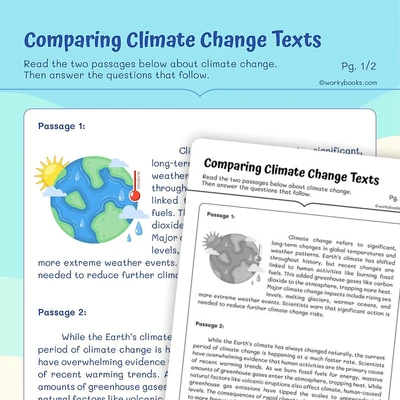
Comparing Weather and Climate Texts
This reading comprehension worksheet has 5th graders read two informational texts about Weather and Climate. Students th...
RI.5.9
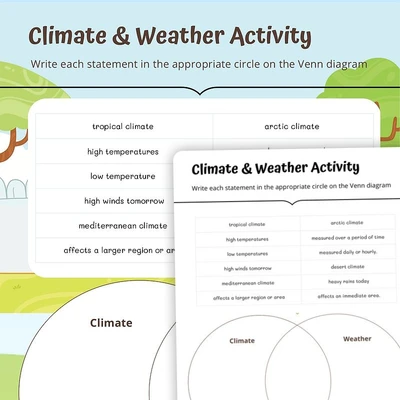
Climate and weather activity
This worksheet is perfect for understanding the differences between climate and weather. Students will read the phrases ...
What Is Space Weather and How Does It Affect the Earth?
This NGSS-aligned science passage for middle school explains what space weather is and how it affects Earth. Students le...
MS-ESS2-2
What's The Main Idea?
These short science texts are a great way to practice main idea. Students will read the paragraphs and then choose the m...
RI.2.6
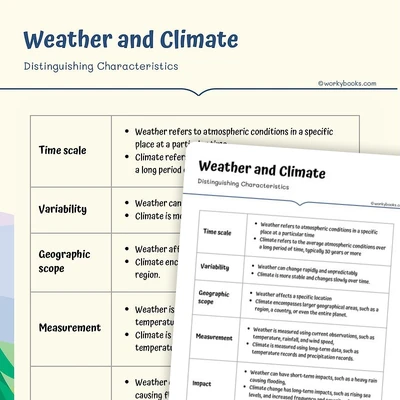
Climate and Weather — Distinguishing Characterstics
This worksheet highlights the differences between climate and weather. The chart format makes comparing and contrasting ...
Reading for Main Details—Birds
This informational text on birds is a great way to practice main idea. Students will read the passage, then give the mai...
RI.2.6RI.2.8
Koi Fish—What’s the Main Idea?
This informational text on koi fish is a great introduction to teaching main idea. Students will be asked, in multiple c...
RI.3.2RF.3.4RI.3.1
Spider—Main Idea
This informational text on spiders is a great introduction to teaching main idea. Students will be asked, in multiple ch...
RI.3.2RF.3.4RI.3.1RI.2.6
Reading for Main Details—Beavers Teeth
This informational text on beavers is a great way to practice main idea. Students will read the passage, then give the m...
RI.2.6RI.2.10
Reading for Main Details—Veternarians
Practie summarizing paragraphs with this fun informational text on veternarians! Students will give the main idea of eac...
RI.2.2RI.2.10
Tools and Technology in Earth Science
This middle school science reading passage explores the wide range of tools and technologies used in Earth science, from...
MS-ESS2-2MS-ESS3-2MS-ETS1-1MS-PS4-3
Main Idea and Supporting Details in Informational Text
RI.3.1RI.3.2RI.3.8
What Is Earth Science?
This engaging middle school science passage introduces students to the field of Earth science, aligning with NGSS standa...
MS-ESS1MS-ESS2MS-ESS3SEP
Polar Bears and Climate
This informational text on polar bears is a great way to practice reading comprehension. Students will read the passage ...
RI.4.1W.4.72-LS4-1RF.4.4
Main Idea and Details Graphic Organizer
This graphic organizer on main idea includes space to write the main idea and three supporting details.
RI.1.2RI.2.2RI.3.2RI.4.2
Main Idea and Suporting Details Graphic Organizer
This graphic organizer on main idea includes space to write the main idea and three supporting details.
RI.1.2RI.2.2RI.3.2RI.4.2
Bats and Butterflies—Informational Text
This informational text on bats and butterflies is a great way to practice spotting similarities between texts. Students...
RI.K.3
Penguins— Main Purpose
This informational text on penguins with comprehension questions is a great way to practice reading fluency and main ide...
RI.1.2RI.1.10RF.1.4.ARF.1.4.B
Informational Text — Astronauts
Practice this second grade context clues worksheet with this informational text on astronauts. Students will read the te...