Humidity: A Key Weather Variable
Interactive passage with audio narration, comprehension questions, and printable PDF.
By completing this purchase you agree to our Terms of Use and Privacy Policy. Your subscription renews automatically until you cancel. You can cancel anytime from your account settings. All sales are final and non-refundable. Digital content is available for download in your account immediately upon purchase.
What's included
Humidity: A Key Weather Variable preview and details
About this printable Humidity: A Key Weather Variable science reading passage, NGSS-aligned (Grades 5-8)
Sample passage and quiz from Humidity: A Key Weather Variable
Reading passage and comprehension quiz preview
Humidity: A Key Weather Variable
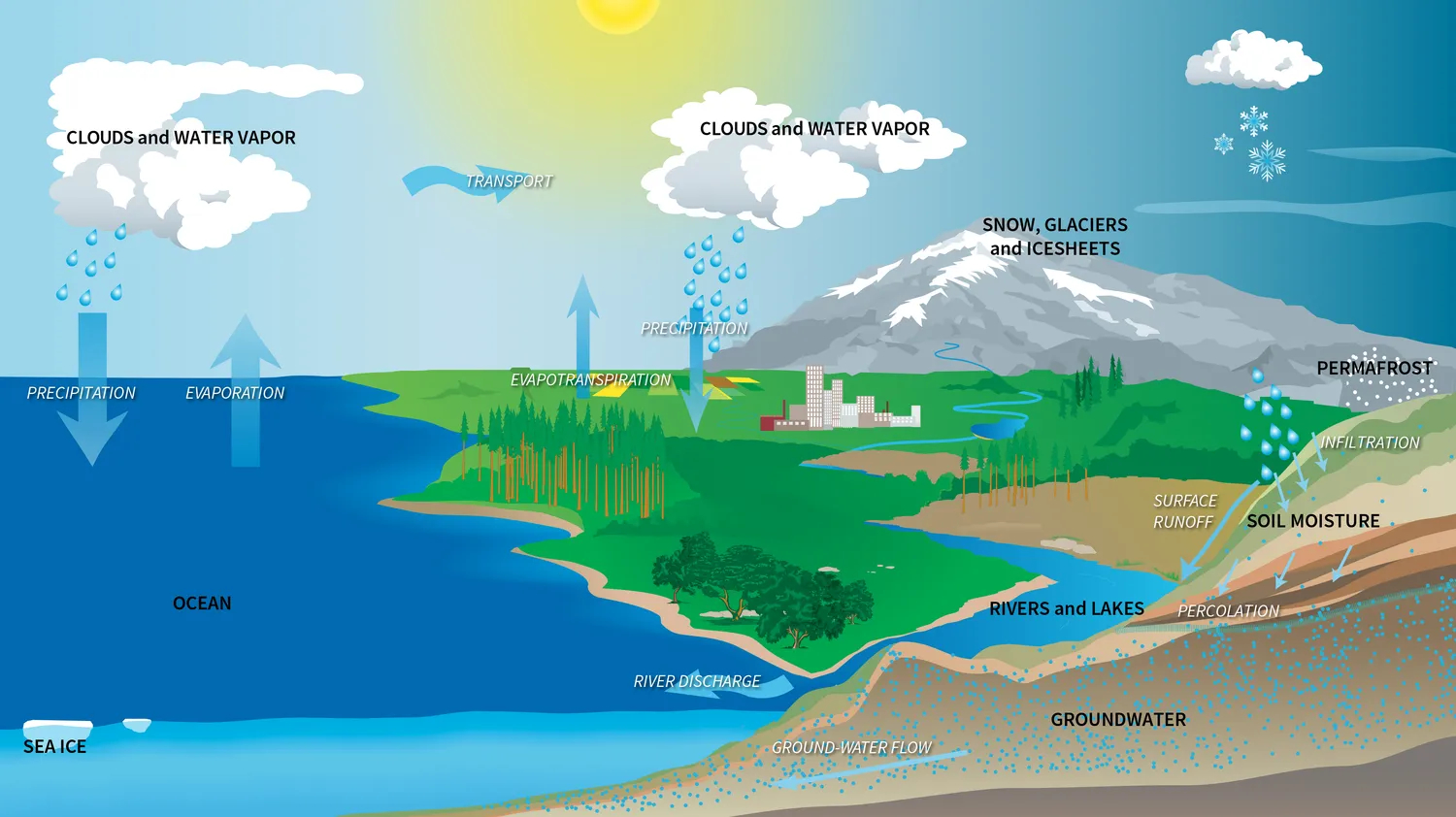
"The Water Cycle (SVS30580)" by NASA's Scientific Visualization Studio - Marit Jentoft-Nilsen, Global Science and Technology, Inc./Deborah McLean / Wikimedia Commons.
Humidity is the amount of water vapor present in the air. It is a key weather variable that affects how comfortable we feel and plays a role in weather patterns like rain, fog, and dew.
Humidity is caused by the evaporation of water from oceans, lakes, rivers, and plants. When water evaporates, it turns into water vapor, which mixes with the air. The warmer the air, the more water vapor it can hold.
Humidity is measured using a hygrometer. There are different types of hygrometers, including mechanical ones that use human hair (which expands and contracts with humidity) and electronic ones that use sensors.
The most common unit for humidity is grams of water vapor per cubic meter of air (g/m³). However, humidity is often expressed as relative humidity, which is a percentage of the maximum amount of water vapor the air can hold at a given temperature.
High humidity can make the air feel hotter because sweat evaporates more slowly, reducing the body’s ability to cool down. Low humidity, on the other hand, can cause dry skin and respiratory issues.
Fun fact: The highest humidity levels are often found in tropical regions, where warm air holds large amounts of water vapor.
Comprehension quiz (8 questions)
1. What is humidity?
2. What causes humidity?
3. What instrument is used to measure humidity?
4. What is the most common unit for humidity?
5. What is relative humidity?
6. How does high humidity affect how we feel?
7. What is the fun fact mentioned in the passage?
8. What is one effect of low humidity?
Perfect for the way you teach
- Build comprehension skills
- Auto-graded quiz
- Differentiated reading
- Read together at home
- Improve fluency
- Quiet reading time
- Reading curriculum support
- Independent practice
- Track Lexile growth