This learning resource is available in interactive and printable formats. The interactive worksheet can be played online and assigned to students. The Printable PDF version can be downloaded and printed for completion by hand.
This reading passage examines the enduring legacy of Renaissance art in world history, focusing on key techniques such as perspective, realism, and oil painting. It explores how artists like Leonardo da Vinci and Raphael revolutionized artistic expression by introducing secular themes and highlighting individual uniqueness. Students will learn about the historical context of the Renaissance, the impact of new artistic methods, and the ways these advancements continue to influence modern art. The passage is aligned with CA HSS 7.8.3 and CCSS RH.6-8.2, and includes a glossary, comprehension quiz, writing activities, graphic organizers, timeline, and Spanish translation to support diverse learners. This resource is ideal for students seeking to analyze the causes and effects of cultural innovation in world history and understand the human impact of artistic developments. Read aloud audio and Spanish translation available.
CONTENT PREVIEW
Expand content preview
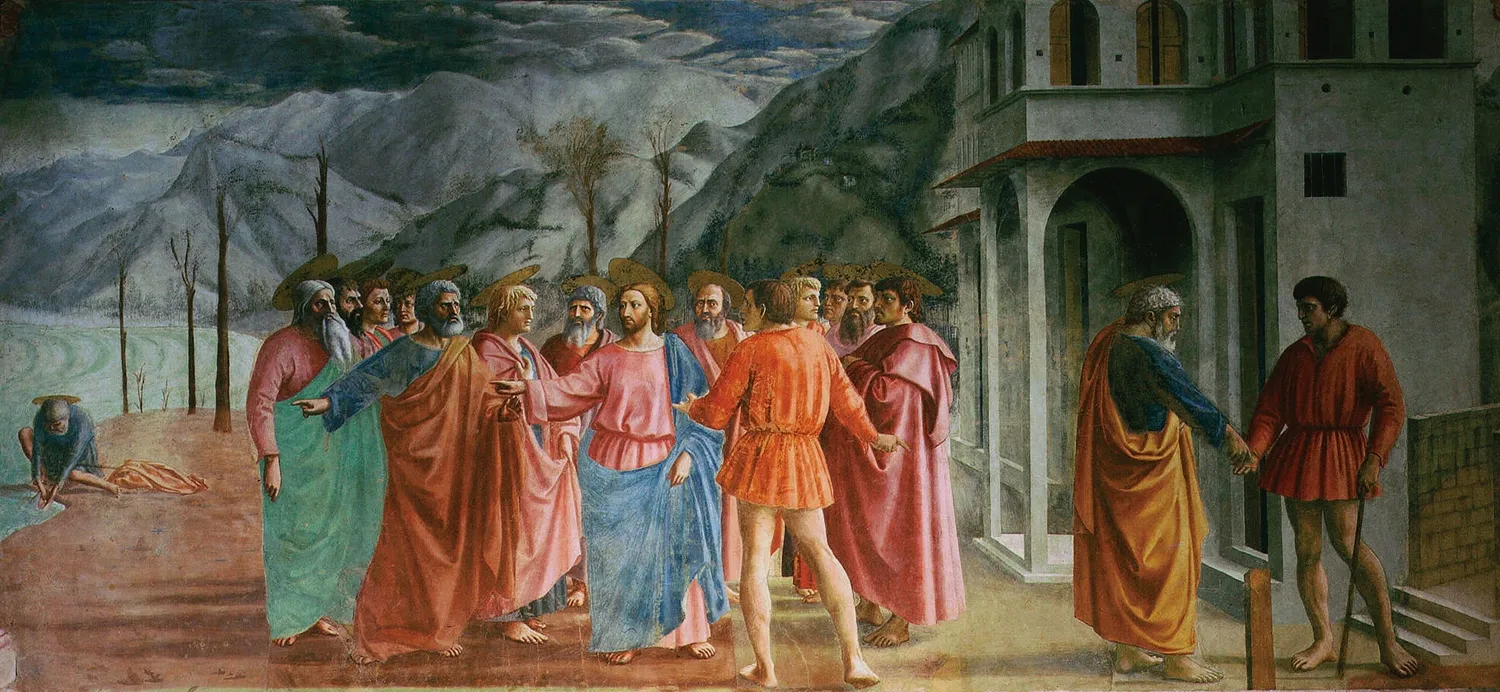
"The Tribute Money by Masaccio" by Masaccio / Wikimedia Commons.
The Renaissance, a cultural movement that began in Italy in the 14th century, permanently changed the way artists created and understood art. This period, lasting until the 17th century, introduced new techniques and ideas that influenced not only Europe but the entire world. During this era, artists developed methods that gave paintings greater depth, realism, and emotional impact, marking a major shift from medieval traditions.
One of the most important innovations was the use of perspective. Perspective is a technique that creates the illusion of three-dimensional space on a flat surface. Artists like Filippo Brunelleschi and Leon Battista Alberti first used mathematical principles to design buildings and paintings that appeared more lifelike. For example, Masaccio’s fresco "The Tribute Money" (c. 1425) uses linear perspective to guide the viewer’s eye through the scene, making figures appear as if they exist in real space. This advancement allowed artists to create more convincing and dynamic compositions.
Another key development was the pursuit of realism. Renaissance artists studied the human body, nature, and light to make their work as accurate as possible. Leonardo da Vinci, for example, dissected cadavers to better understand anatomy, which he then applied to masterpieces like the "Mona Lisa" (1503–1506). The use of oil painting, first adopted in Northern Europe by Jan van Eyck, also helped artists achieve greater detail and vivid color. Oil paints dried slowly, allowing for blending and corrections, which gave portraits and landscapes a lifelike quality.
Renaissance art also broadened its subjects. While medieval artists focused mainly on religious themes, Renaissance artists began to paint secular subjects, such as portraits, scenes from daily life, and landscapes. This reflected the rise of humanism, an intellectual movement that valued individual achievement and the study of classical antiquity. Paintings like Raphael’s "School of Athens" (1511) show philosophers, scientists, and artists, celebrating human knowledge and creativity. Artists also expressed their own unique styles, emphasizing individual expression in their work—a trend that continues in modern art today.
The legacy of Renaissance art is seen in the way artists today use perspective, realism, and oil paints to capture the world around them. Its influence is visible in everything from classroom drawings to digital design. The Renaissance’s focus on observing the real world, celebrating individuals, and exploring new ideas has shaped the development of art across centuries and cultures.
These artistic innovations connect to the broader history of human creativity and progress. The Renaissance demonstrates how advances in knowledge and technique can transform society and inspire generations.
Interesting Fact: The word "Renaissance" means "rebirth" in French, reflecting the period’s revival of interest in the art and ideas of ancient Greece and Rome.
Where did the Renaissance begin?
ItalyFranceEnglandGermany
Who painted the Mona Lisa?
Leonardo da VinciRaphaelJan van EyckMasaccio
What is perspective in art?
Showing depth on a flat surfacePainting only religious themesMixing oil paints quicklyUsing only bright colors
How did oil painting help artists?
Allowed for blending and detailsMade paintings dry instantlyLimited color optionsPrevented corrections
Why did Renaissance artists paint secular subjects?
Because of humanismTo follow medieval rulesFor religious ceremonies onlyBecause oil paint required it
Which painting uses perspective to guide the viewer?
"The Tribute Money""The Last Supper""Starry Night""The Scream"
Renaissance artists only painted religious topics. True or false?
TrueFalse
What does 'secular' mean?
Non-religiousReligiousAncientFamous
Perfect For:
👩🏫 Teachers
• Reading comprehension practice
• Auto-graded assessments
• Literacy skill development
👨👩👧👦 Parents
• Reading practice at home
• Comprehension improvement
• Educational reading time
🏠 Homeschoolers
• Reading curriculum support
• Independent reading practice
• Progress monitoring
Reading Features:
📖
Reading Passage
Engaging fiction or nonfiction text
❓
Comprehension Quiz
Auto-graded questions
📊
Instant Feedback
Immediate results and scoring
📄
Printable Version
Download for offline reading
🔊
Read Aloud
Voice-over with word highlighting
Reviews & Ratings
No reviews yet. Be the first to share your experience!
Related Content
Invention of Paper
This passage examines the revolutionary invention of paper making during the Han Dynasty in ancient China, highlighting ...
CA HSS 6.6.7CCSS RH.6-8.2CCSS RH.6-8.4
Life in the Neolithic Age
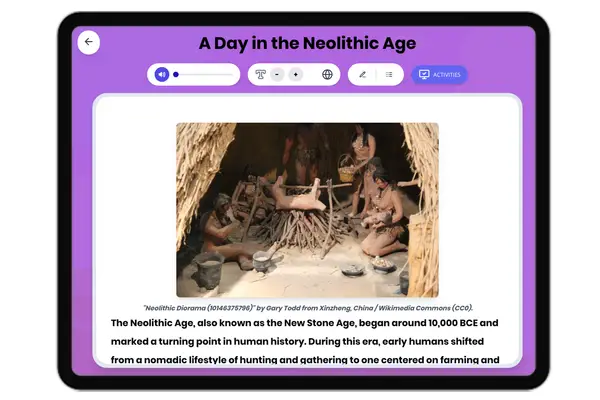
This engaging passage explores what life was like during a typical day in the Neolithic Age, a pivotal era in ancient hi...
CA HSS 6.1CCSS RH.6-8.2CCSS RH.6-8.4
Neolithic Revolution
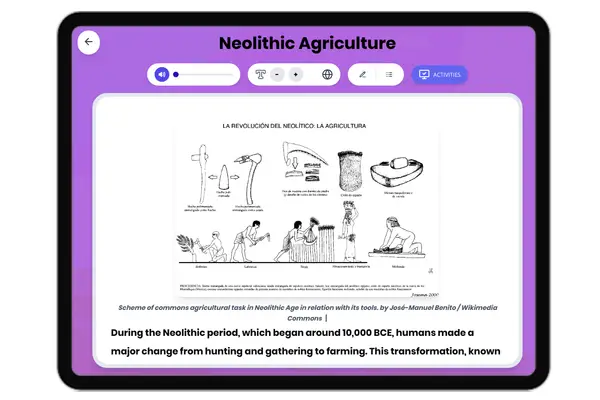
This comprehensive history reading passage explores the Neolithic Revolution, focusing on how early humans transitioned ...
CA HSS 6.1CCSS RH.6-8.2CCSS RH.6-8.4CCSS RH.6-8.7
Introduction to the Paleolithic Age
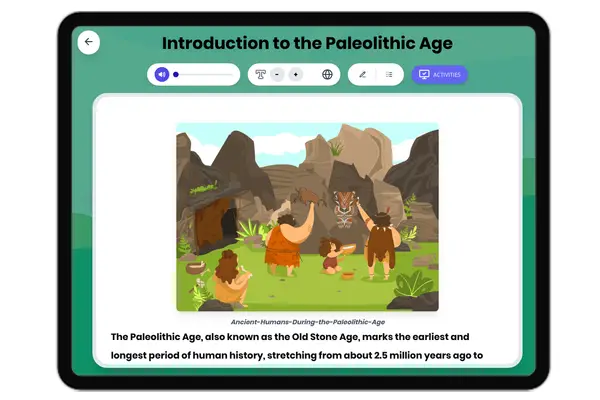
This engaging passage explores the lives and achievements of ancient humans during the Paleolithic Age, focusing on thei...
CA HSS 6.1.1CCSS RH.6-8.1CCSS RH.6-8.2CCSS RH.6-8.4
Early Humans in Europe and Asia
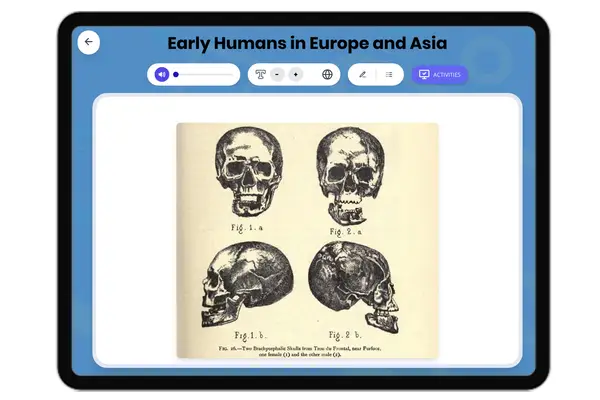
This passage explores the arrival of early humans in Europe and Asia around 40,000 BCE, highlighting their migration, ad...
CA HSS 6.1.1CCSS RH.6-8.1CCSS RH.6-8.2CCSS RH.6-8.4
First Americans
This comprehensive history reading passage explores how the first humans migrated to the Americas over 12,000 years ago,...
CA HSS 6.1CCSS RH.6-8.1CCSS RH.6-8.2CCSS RH.6-8.4
Nomads to Farmers
This engaging passage explores the two major ways of life practiced by early humans: nomadic hunter-gathering and settle...