Density of Water
Interactive passage with audio narration, comprehension questions, and printable PDF.
By completing this purchase you agree to our Terms of Use and Privacy Policy. Your subscription renews automatically until you cancel. You can cancel anytime from your account settings. All sales are final and non-refundable. Digital content is available for download in your account immediately upon purchase.
What's included
Density of Water preview and details
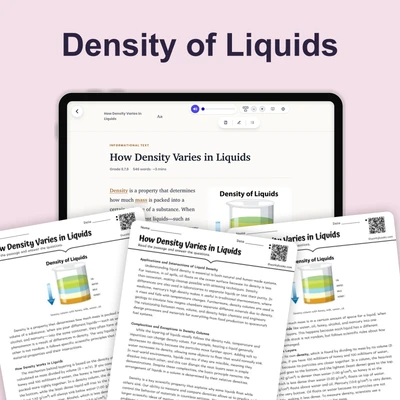
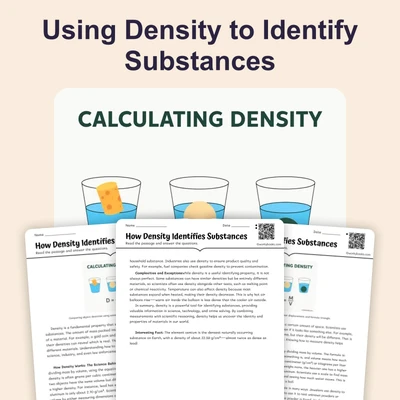
About this printable Density of Water science reading passage, NGSS-aligned (Grades 5-8)
Sample passage and quiz from Density of Water
Reading passage and comprehension quiz preview
The Density of Water

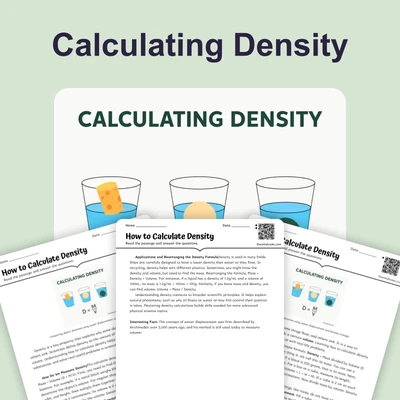
Water is one of the most important substances on Earth, and its density is a key reason why it behaves the way it does. Density is the amount of mass in a given volume. It is usually measured in grams per cubic centimeter (g/cm³). The density of pure water is 1.0 g/cm³ at room temperature. This means that one cubic centimeter of water has a mass of one gram. Understanding water’s density helps scientists explain many natural phenomena.
One of the most interesting things about water is that it behaves differently than most substances when it freezes. Usually, when a liquid freezes into a solid, it becomes denser. However, water is an exception. As water cools down and turns into ice, its molecules spread out and form a structure that takes up more space. This makes ice less dense than liquid water, which is why ice floats. This floating ice acts as insulation for lakes and ponds in winter, allowing life to survive beneath the frozen surface.
Another important example of water’s density is in oceans and lakes. Water layers based on temperature and salt levels. Cold water is denser than warm water, and salty water is denser than fresh water. These differences create layers in the ocean called thermoclines and haloclines, which affect ocean currents and marine life. Scientists study these layers to understand climate patterns and the movement of nutrients in water ecosystems.
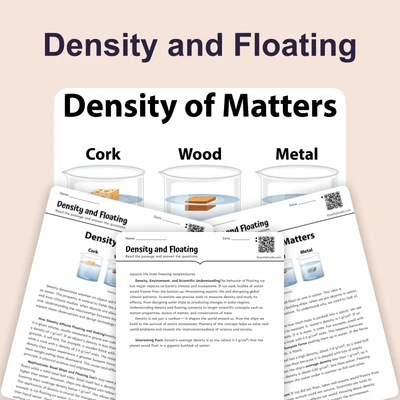
In everyday life, water’s density is important for floating and sinking. Objects that are less dense than water will float, like a wooden log or a plastic bottle. Objects that are more dense, like a rock or a coin, will sink. Engineers use this knowledge to design ships, submarines, and other floating structures.
The density of water plays a big role in Earth’s systems. It helps explain why ice floats, how oceans work, and what materials sink or float. By understanding water’s density, scientists and engineers can solve problems and design better tools.
Fun Fact: Water is one of the only substances that is less dense as a solid than as a liquid!
Comprehension quiz (8 questions)
1. What is the density of water?
2. Why does ice float on water?
3. What happens to water molecules when frozen?
4. Which object would sink in water?
5. What do thermoclines represent?
6. Why is ice important in lakes?
7. What is the main idea of the passage?
8. What happens to water's density with salt?
Perfect for the way you teach
- Build comprehension skills
- Auto-graded quiz
- Differentiated reading
- Read together at home
- Improve fluency
- Quiet reading time
- Reading curriculum support
- Independent practice
- Track Lexile growth