How Many Valence Electrons Does Oxygen Have? — Reading Comprehension
Rate this|
1
Present
Present in classroom. No work saved
Assign
Classroom with student accounts, Track progress
Quick Play
No student accounts, assign with a link
Grades
5
6
7
8
Standards
MS-PS1-2
MS-PS1-4
PRINT+DIGITAL RESOURCE
This learning resource is available in interactive and printable formats. The interactive worksheet can be played online and assigned to students. The Printable PDF version can be downloaded and printed for completion by hand.
This NGSS-aligned science reading passage teaches middle school students about the number of valence electrons in oxygen and how these electrons determine chemical behavior. The passage explains that oxygen has 6 valence electrons in its outer shell, which is why it often forms bonds with other elements, like hydrogen. It also connects the concept to the periodic table, highlighting oxygen's place in Group 16. Students build vocabulary and comprehension skills through a clear, engaging explanation supported by real-world examples such as water. This resource supports NGSS standard MS-PS1-1 and includes multiple-choice questions to reinforce key concepts in atomic structure and chemical bonding. Ideal for classrooms or self-guided science learners.
CONTENT PREVIEW
Expand content preview
Every atom has electrons that orbit around its nucleus. These electrons are arranged in layers called energy levels or shells. The electrons in the outermost shell are called valence electrons, and they are very important. They help determine how an element reacts with other elements.
Oxygen has eight electrons in total. These electrons are arranged in two energy levels. The first level holds 2 electrons. The second level can hold up to 8, but oxygen has only 6 in its outer shell. That means oxygen has 6 valence electrons.
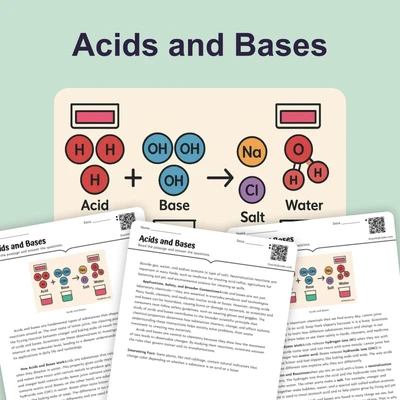
Why does this matter? Valence electrons are the ones involved in chemical bonding. Oxygen needs 2 more electrons to fill its outer shell and become stable. That’s why oxygen often forms bonds with other elements, like hydrogen. In water (H₂O), each hydrogen shares one electron with oxygen, helping it complete its shell.
The number of valence electrons also helps determine an element’s group in the periodic table. Oxygen is in Group 16, also known as the chalcogen group, and all the elements in this group have 6 valence electrons.
Fun Fact: Oxygen doesn’t just help us breathe—it’s also one of the most reactive nonmetals because of those 6 valence electrons!
How many total electrons does an oxygen atom have?
68162
What are valence electrons?
Electrons in the nucleusElectrons in the first energy levelElectrons in the outermost shellElectrons that never move
How many valence electrons does oxygen have?
2468
Why does oxygen bond with other elements?
To become heavierTo gain 2 more protonsTo fill its outer shell with 8 electronsTo lose all its electrons
What is the maximum number of electrons the second energy level can hold?
2468
Which element is mentioned as bonding with oxygen in water?
NitrogenCarbonHydrogenHelium
What group on the periodic table is oxygen in?
Group 8Group 2Group 16Group 6
If an element has 6 valence electrons, what group is it likely in?
Group 1Group 10Group 16Group 6
Perfect For:
👩🏫 Teachers
• Reading comprehension practice
• Auto-graded assessments
• Literacy skill development
👨👩👧👦 Parents
• Reading practice at home
• Comprehension improvement
• Educational reading time
🏠 Homeschoolers
• Reading curriculum support
• Independent reading practice
• Progress monitoring
Reading Features:
📖
Reading Passage
Engaging fiction or nonfiction text
❓
Comprehension Quiz
Auto-graded questions
📊
Instant Feedback
Immediate results and scoring
📄
Printable Version
Download for offline reading
🔊
Read Aloud
Voice-over with word highlighting
Reviews & Ratings
No reviews yet. Be the first to share your experience!
Related Content
Biological Weathering: Types and Examples
This passage details biological weathering processes, connecting to NGSS MS-ESS2-1 (Earth's systems) and LS2.B (ecosyste...
MS-ESS2-1MS-PS1-2RST.6-8.3
The Melting Point of Substances
This middle school science reading passage, titled 'The Melting Point of Substances', explores the physical property kno...
5-PS1MS-PS1-4RI.6.3RI.7.1
The Melting Point of Steel
This engaging science passage, 'The Melting Point of Steel,' explains a key physical property of steel—its melting point...
5-PS1MS-PS1-4RI.6.3RI.7.1
The Melting Point of Aluminum
This science reading passage, 'The Melting Point of Aluminum,' introduces middle school students to the physical propert...
5-PS1MS-PS1-4RI.6.3RI.7.1
The Melting Point of Copper
This reading passage, 'The Melting Point of Copper,' introduces middle school students to an important physical property...
5-PS1MS-PS1-4RI.6.3RI.7.1
The Boiling Point of Water
This passage, 'The Boiling Point of Water,' introduces students to the physical property of boiling point through one of...
5-PS1MS-PS1-4RI.6.3RI.7.1
Is Sublimation Endothermic or Exothermic?
This NGSS-aligned science passage for middle school explains the thermodynamic nature of sublimation, showing how a soli...
MS-PS1-4HS-PS1
How Many Valence Electrons Does Chlorine Have?
This NGSS-aligned science reading passage explains how many valence electrons chlorine has and why that makes it such a ...
MS-PS1-2MS-PS1-4
The Density of Water
"This NGSS-aligned science passage explains the density of water in a way that is clear and engaging for middle school s...
MS-PS1-2
What Is Vapor Pressure?
This NGSS-aligned science passage explains the concept of vapor pressure in an age-appropriate, engaging way for middle ...
MS-PS1-4MS-LS1-2
What is Freezing Point Depression
This passage, 'Freezing Point Depression,' introduces students to the physical science concept of how adding substances ...
5-PS1MS-PS1-4RI.6.3RI.7.1
Chemical Properties of Matter
This engaging middle school science passage explores the chemical properties of matter, focusing on how these properties...
MS-PS1-2
Solids, Liquids, and Gases
This comprehensive middle school science passage explains the scientific concepts behind the three common states of matt...
MS-PS1-4
Behavior of Gases
This comprehensive reading passage explores the behavior of gases for middle school students, aligned with NGSS standard...
MS-PS1-4
Physical Changes: Evaporation
This middle school science passage examines the process of evaporation, a fundamental physical change where a liquid tur...
MS-PS1-4
Physical Changes: Condensation
This middle school science passage explores the process of condensation, the physical change where a gas becomes a liqui...
MS-PS1-4
Physical Changes: Sublimation
This educational passage for grades 6-8 explores the science of sublimation—a physical change where a solid transforms d...
MS-PS1-4
Signs of Chemical Change
This comprehensive passage for grades 6-8 explores the key signs that indicate a chemical change, such as color change, ...
MS-PS1-2
Physical Changes: Deposition
This middle school science passage explores the concept of deposition, a type of physical change where matter transition...