Thermal Insulators and Conductors
Interactive passage with audio narration, comprehension questions, and printable PDF.
By completing this purchase you agree to our Terms of Use and Privacy Policy. Your subscription renews automatically until you cancel. You can cancel anytime from your account settings. All sales are final and non-refundable. Digital content is available for download in your account immediately upon purchase.
What's included
Thermal Insulators and Conductors preview and details
About this printable Thermal Insulators and Conductors science reading passage, NGSS-aligned (Grades 5-8)
Sample passage and quiz from Thermal Insulators and Conductors
Reading passage and comprehension quiz preview
Thermal Insulators and Conductors
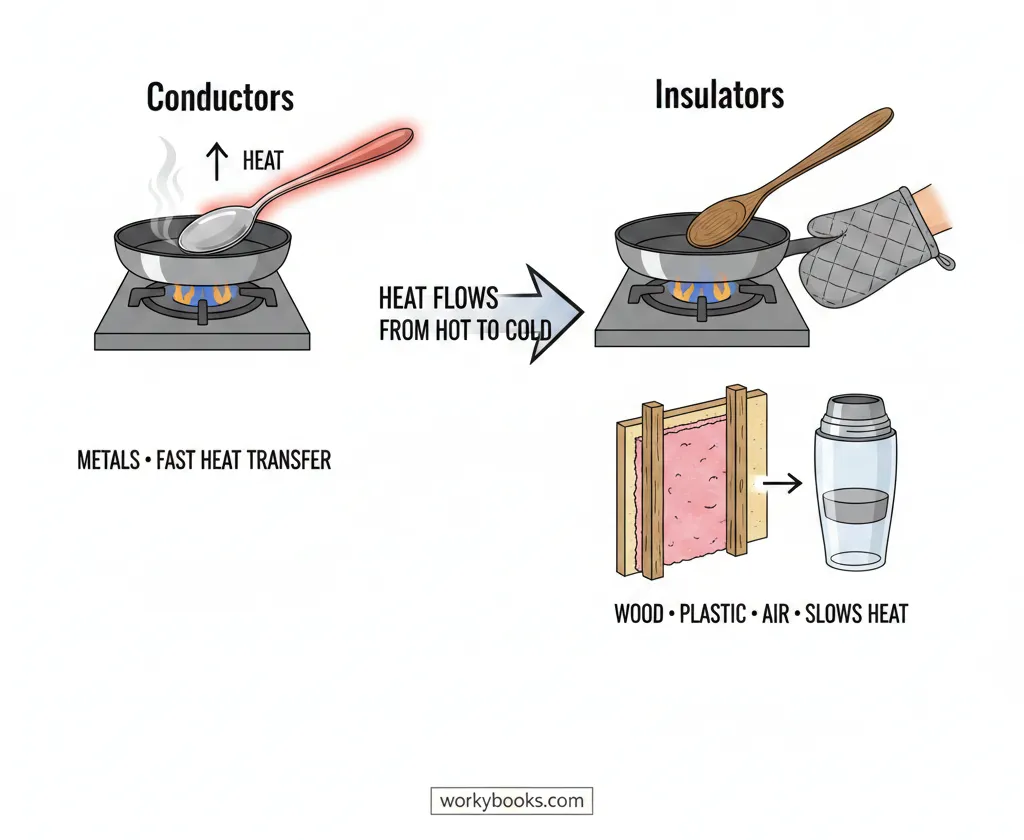
Thermal insulators and thermal conductors are essential in controlling how heat moves in our world. When you touch a metal spoon left in a hot pan, it feels hot quickly, but a wooden spoon does not. This difference happens because of the way materials transfer heat energy. Understanding these properties helps us design safer and more comfortable environments, from kitchens to homes and even into space exploration.
How Heat Moves: The Science of Conductors and Insulators
Heat is a form of energy that flows from warmer objects to cooler ones. Materials called conductors, such as copper and aluminum, let heat pass through them easily. This happens because the particles in metals are packed closely and can quickly transfer energy by bumping into each other. For example, when the handle of a metal pot gets hot while cooking, it is because metal is an efficient conductor. In contrast, insulators like wood, plastic, air, and foam have particles that do not move energy as easily. Their structure creates barriers that slow down how fast heat travels. That is why a foam cup can keep your drink hot or cold for longer. Quantitatively, metals can conduct heat hundreds of times faster than air or plastic.
Applications and Interactions in Daily Life
We use conductors and insulators in strategic ways. Pot handles are often made from plastic or wood to protect hands from burns, while the cooking surface is metal to transfer heat efficiently to food. Oven mitts are made from thick, insulating fabrics to protect against high temperatures. In buildings, insulation such as fiberglass or foam panels is installed in walls and attics to slow down heat loss in winter and heat gain in summer. A thermos uses both a vacuum (an excellent insulator) and reflective surfaces to minimize heat transfer, keeping drinks hot or cold for hours. These examples show how careful choices of materials can improve safety, comfort, and energy efficiency.
Exceptions and Complexities
Sometimes, the situation demands a balance. For example, in electronics, components that get hot need metal “heat sinks” to conduct heat away, but the device’s outer shell is made from plastic to protect users. Air, though an insulator, can become a poor barrier if it moves (like a draft). Engineers must consider many factors, including the thickness and arrangement of materials, when designing products. Scientists test materials in labs, measuring thermal conductivity to compare their effectiveness in different environments.
Thermal insulators and conductors are not only important in science but are essential for modern technology and daily safety. By understanding the mechanisms behind heat transfer, we can make smarter decisions about the materials we use, saving energy and making our lives more comfortable.
Interesting Fact: Aerogel, one of the best insulators known, is 99% air and can protect a flower from a blowtorch flame!
Comprehension quiz (10 questions)
1. What is the main role of a thermal insulator?
2. Which material is commonly used for pot handles to prevent burns?
3. Oven mitts are made from thick fabric because:
4. What does the term 'thermal conductivity' mean?
5. In the passage, what is the main reason that foam cups keep drinks hot or cold longer?
6. Why do engineers use both conductors and insulators in electronics?
7. What is one main difference between conductors and insulators?
8. Which of the following is NOT an example of an insulator?
9. True or False: Metal is a good insulator.
10. True or False: Air can act as an insulator unless it moves.
Perfect for the way you teach
- Build comprehension skills
- Auto-graded quiz
- Differentiated reading
- Read together at home
- Improve fluency
- Quiet reading time
- Reading curriculum support
- Independent practice
- Track Lexile growth