This learning resource is available in interactive and printable formats. The interactive worksheet can be played online and assigned to students. The Printable PDF version can be downloaded and printed for completion by hand.
This comprehensive passage explores the concept of thermal energy, aligning with NGSS standards MS-PS3-3 and MS-PS3-4. Students will learn that thermal energy is the total kinetic energy of all particles in a substance, and they will distinguish this from temperature, which is the average kinetic energy. The passage provides mechanistic explanations, real-world examples like comparing a swimming pool to a cup of hot water, and links thermal energy to changes in states of matter. Students will also examine how thermal energy transfer affects everyday phenomena, technology, and the environment. The resource includes a glossary, quizzes, writing prompts, and graphic organizers for deep engagement. Audio integration supports various learning styles. This resource is ideal for Grades 6-8 science classrooms focusing on energy systems, particle motion, and scientific thinking.
CONTENT PREVIEW
Expand content preview
Thermal energy is a crucial concept in science that helps explain why objects feel hot or cold and how energy moves in the world around us. In every substance, from ice cubes to boiling water, countless tiny particles are constantly moving. The total kinetic energy of all these moving particles in a substance is known as its thermal energy. Understanding thermal energy allows us to explain everyday phenomena, from why ice melts to how engines work.
How Thermal Energy Works
At the microscopic level, all matter is made of particles—atoms and molecules—that are always in motion. When these particles move faster, the substance has more kinetic energy. The temperature of a substance measures the average kinetic energy of its particles, while thermal energy is the total kinetic energy of all the particles. This means that an object with more particles can have more thermal energy, even if its temperature is lower. For example, a swimming pool of cool water contains much more thermal energy than a small cup of hot water, because the pool has many more water molecules. When two objects at different temperatures come into contact, heat flows from the hotter object to the cooler one, transferring thermal energy. This transfer continues until both objects reach the same temperature, a process known as thermal equilibrium.
Thermal Energy, Temperature, and States of Matter
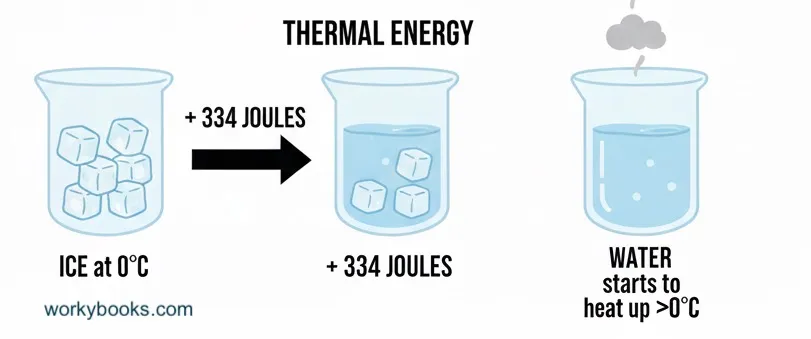
Thermal energy is closely linked to the state of matter—whether a substance is a solid, liquid, or gas. When a solid is heated, its particles vibrate faster, increasing its thermal energy. If enough energy is added, the particles can break free from their positions, and the solid melts into a liquid. Adding even more thermal energy can turn the liquid into a gas. This process is not just about temperature; it’s about how much total energy the particles have.
Understanding thermal energy has many real-world applications. Engineers use knowledge of heat transfer and thermal energy to design refrigerators, heating systems, and engines. Environmental scientists study how thermal energy from the sun drives weather patterns and ocean currents. In health care, doctors use thermal imaging to detect temperature differences in the human body. The principles of thermal energy also connect to broader scientific ideas, such as the conservation of energy and the laws of thermodynamics. These principles help us predict how energy will flow and how systems will change over time.
Thermal energy is fundamental to understanding not only physical science, but also how energy interacts within living systems, the environment, and technology. Recognizing the difference between temperature and thermal energy allows us to analyze cause-and-effect relationships in everything from weather to engines.
Interesting Fact: Some chemical reactions absorb so much thermal energy that they feel cold to the touch, like the instant cold packs used in sports medicine!
What is the definition of thermal energy according to the passage?
The total kinetic energy of all the particles in a substance.The average temperature of an object.The amount of heat needed to boil water.The change from a solid to a gas.
Which of the following objects has more thermal energy: a small cup of hot water or a large pool of cool water?
The large pool of cool water.The small cup of hot water.Both have the same thermal energy.Neither has thermal energy.
What does temperature measure in a substance?
The total number of particles.The average kinetic energy of the particles.The weight of the object.The amount of heat transferred.
What happens when two objects at different temperatures touch each other?
Heat flows from the hotter object to the cooler one.The cooler object becomes smaller.The hotter object freezes.No energy is transferred.
In the context of the passage, what is 'thermal equilibrium'?
When two objects reach the same temperature.When an object melts.When particles stop moving.When heat is created.
What does the word 'kinetic' mean as used in the passage?
Related to movement or motion.Related to temperature.Related to size.Related to color.
Which scientific principle states that energy cannot be created or destroyed?
Conservation of energy.Thermal equilibrium.Heat transfer.State of matter.
Why do scientists say it takes 334 joules to melt one gram of ice?
Because energy is required to change the state from solid to liquid.Because temperature always rises when ice melts.Because heat flows from cold to hot.Because kinetic energy is lost when ice melts.
True or False: Temperature and thermal energy are exactly the same thing.
TrueFalse
True or False: Adding thermal energy to a solid can cause it to melt into a liquid.
TrueFalse
Perfect For:
👩🏫 Teachers
• Reading comprehension practice
• Auto-graded assessments
• Literacy skill development
👨👩👧👦 Parents
• Reading practice at home
• Comprehension improvement
• Educational reading time
🏠 Homeschoolers
• Reading curriculum support
• Independent reading practice
• Progress monitoring
Reading Features:
📖
Reading Passage
Engaging fiction or nonfiction text
❓
Comprehension Quiz
Auto-graded questions
📊
Instant Feedback
Immediate results and scoring
📄
Printable Version
Download for offline reading
🔊
Read Aloud
Voice-over with word highlighting
Reviews & Ratings
No reviews yet. Be the first to share your experience!
Related Content
Heat and Temperature
This comprehensive passage for grades 6-8 explores the important differences between heat and temperature, emphasizing t...
MS-PS3-3MS-PS3-4
Thermal Insulators and Conductors
This passage for grades 6-8 explores the science of thermal insulators and conductors, aligning with NGSS MS-PS3-3. Stud...
MS-PS3-3
Geographic Information Systems (GIS)
This engaging middle school science passage introduces students to Geographic Information Systems (GIS), aligning with N...
MS-ESS3-3MS-ETS1-1MS-ETS1-2MS-ETS1-3
What Is an Endothermic Reaction?
This engaging science passage introduces middle school readers to the concept of endothermic reactions, aligned with NGS...
MS-PS3-44-PS3-34-PS3-2
What Is an Exothermic Reaction?
This science passage introduces students to the idea of exothermic reactions—chemical changes that release heat or light...
MS-PS3-44-PS3-34-PS3-2
Is Freezing Endothermic or Exothermic?
This clear and accessible passage helps students understand why freezing is an exothermic process, even though frozen ob...
MS-PS3-44-PS3-34-PS3-2
What Is Thermal Contraction?
This middle school science passage introduces the concept of thermal contraction, aligned with NGSS standard MS-PS1-4. I...
MS-PS3-44-PS3-34-PS3-2
What Is Gravitational Energy?
This engaging science passage for middle school students explores the concept of gravitational energy, a form of potenti...
MS-PS3-44-PS3-34-PS3-2
What Is Kinetic Energy?
This NGSS-aligned reading passage introduces 6th–8th grade students to the concept of kinetic energy—energy that an obje...
MS-PS3-44-PS3-34-PS3-2
Understanding Mechanical Energy
This science passage is crafted for 6th–8th grade students and focuses on mechanical energy—specifically the combination...
MS-PS3-44-PS3-34-PS3-2
Chemical Energy
This informational science passage on chemical energy is designed for middle school students and aligns with the NGSS st...
MS-PS3-44-PS3-34-PS3-2
Sublimation: The Solid-to-Gas Magic
This engaging NGSS-aligned reading passage explores the science of sublimation, a unique phase change where a solid turn...
MS-PS3-44-PS3-34-PS3-2
Scientific Theories
This reading passage for grades 6-8 introduces students to the concept of scientific theories, emphasizing that these ar...
MS-PS1-1MS-PS1-4MS-PS3-4SCIENCE AND ENGINEERING PRACTICES
Heat and Changes of State
This grade 6-8 science passage explores the relationship between heat and changes of state, aligning with NGSS standard ...
MS-PS3-4
Specific Heat
This comprehensive middle school science passage explores the concept of specific heat, the amount of energy required to...
MS-PS3-4
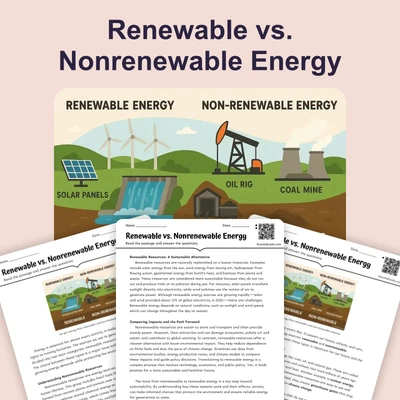
Renewable vs. Nonrenewable Energy
This engaging passage, aligned with NGSS standards MS-PS3-4, MS-ESS3-3, and MS-ESS3-4, helps middle school students diff...
MS-PS3-4MS-ESS3-3MS-ESS3-4
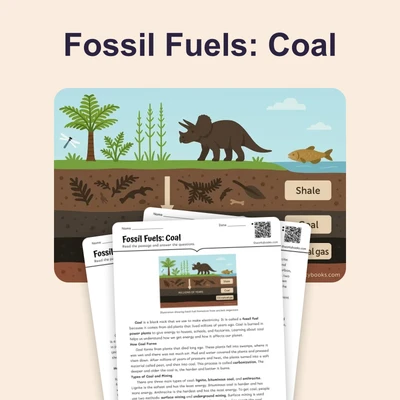
Fossil Fuels: Coal
This middle school science reading passage explores the science behind coal, a major fossil fuel. Students will learn ho...
MS-PS3-4MS-ESS3-3MS-ESS3-4
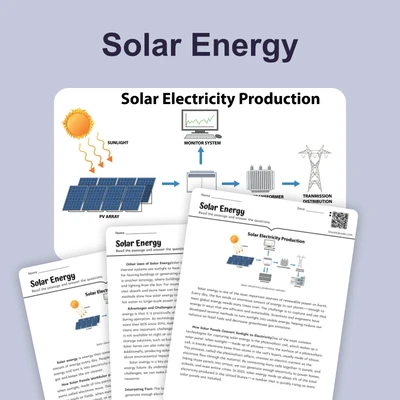
Solar Energy
This engaging passage for grades 6-8 explores the science of solar energy, focusing on how sunlight is converted into el...
MS-PS3-4MS-ESS3-3MS-ESS3-4
Wind Energy
This comprehensive middle school science passage explores the scientific principles behind wind energy and how wind turb...