What Are Nimbostratus Clouds Made Of? — Reading Comprehension
Rate this
Premium Resource
Present
Present in classroom. No work saved
Assign
Classroom with student accounts, Track progress
Quick Play
No student accounts, assign with a link
Grades
3
4
5
6
7
PRINT+DIGITAL RESOURCE
This learning resource is available in interactive and printable formats. The interactive worksheet can be played online and assigned to students. The Printable PDF version can be downloaded and printed for completion by hand.
This NGSS-aligned reading passage explains what nimbostratus clouds are made of and how they form. Students will learn that these rain-bringing clouds consist of tiny water droplets or ice crystals formed when warm, moist air rises and cools. The passage describes how these thick, dark clouds create long-lasting precipitation without thunder or lightning. It supports NGSS standard MS-ESS2-6 and helps students understand cloud types, weather patterns, and the science behind cloudy skies.
CONTENT PREVIEW
Expand content preview
Nimbostratus clouds are thick, dark clouds that cover the sky like a heavy blanket. These clouds are responsible for steady, long-lasting rain or snow. But what exactly are they made of?
Like all clouds, nimbostratus clouds are made of tiny water droplets or ice crystals, depending on the temperature. When the air is warmer, these clouds are mostly made of liquid water droplets. When the air is cold, especially higher up in the atmosphere, they may contain ice crystals instead—or a mix of both.
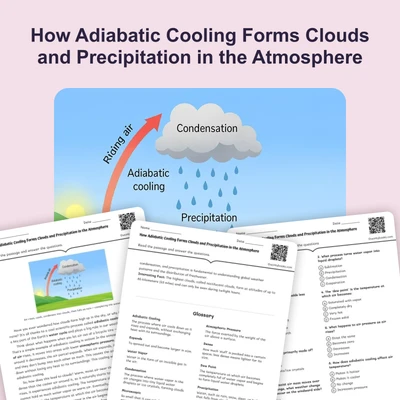
Nimbostratus clouds form when warm, moist air rises slowly over a large area. As this air cools, the water vapor inside it begins to condense around tiny particles in the air, such as dust or pollen. This process creates millions of small droplets that group together and form a thick, wide-spreading cloud.
These clouds are found at low to middle altitudes, but they can grow tall enough to stretch up into higher parts of the atmosphere. Because they are so full of moisture and block a lot of sunlight, they often appear dark grey and bring hours of dull, rainy weather.
Unlike towering storm clouds like cumulonimbus, nimbostratus clouds don’t produce lightning or thunder. Instead, they create gentle, continuous precipitation that can last for many hours or even days.
Fun Fact: The name “nimbostratus” comes from Latin—“nimbus” means rain and “stratus” means layer—so it literally means “rainy layer cloud.”
What kind of weather do nimbostratus clouds bring?
Thunderstorms and lightningLong-lasting rain or snowWindy and sunny skiesSnowstorms with hail
What are nimbostratus clouds made of?
Only iceDust and windTiny water droplets or ice crystalsLightning and thunder
When do nimbostratus clouds contain ice crystals?
On warm daysOnly at the equatorWhen they are high and coldWhen the sun shines
What causes water vapor to condense into a cloud?
Sunlight hitting the groundAir speeding upCooling of warm, moist airWater evaporating into the air
What kind of cloud is nimbostratus?
A layered cloud that brings rainA tall cloud with thunderA fluffy, fair-weather cloudA foggy ground-level cloud
Why do nimbostratus clouds look dark?
They are made of smokeThey block sunlight and are full of moistureThey are closer to the groundThey absorb heat from the Earth
What is the main idea of the passage?
Nimbostratus clouds help create snowstormsNimbostratus clouds are thick and bring steady precipitationNimbostratus clouds are shaped like thunderheadsNimbostratus clouds only form in summer
What does the word “nimbostratus” mean?
Rain stormThunder cloudPuffy white cloudRainy layer cloud
Perfect For:
👩🏫 Teachers
• Reading comprehension practice
• Auto-graded assessments
• Literacy skill development
👨👩👧👦 Parents
• Reading practice at home
• Comprehension improvement
• Educational reading time
🏠 Homeschoolers
• Reading curriculum support
• Independent reading practice
• Progress monitoring
Reading Features:
📖
Reading Passage
Engaging fiction or nonfiction text
❓
Comprehension Quiz
Auto-graded questions
📊
Instant Feedback
Immediate results and scoring
📄
Printable Version
Download for offline reading
🔊
Read Aloud
Voice-over with word highlighting
Reviews & Ratings
No reviews yet. Be the first to share your experience!
Related Content
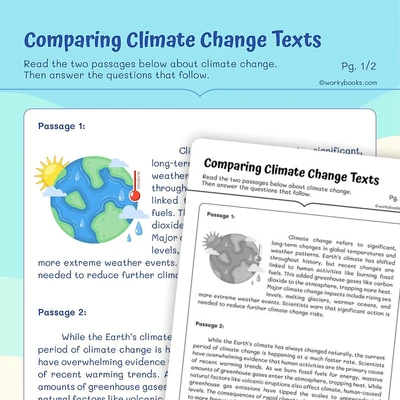
Comparing Weather and Climate Texts
This reading comprehension worksheet has 5th graders read two informational texts about Weather and Climate. Students th...
RI.5.9
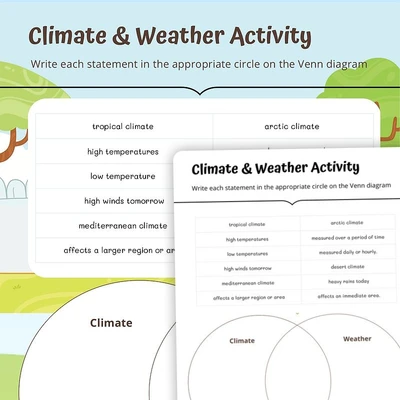
Climate and weather activity
This worksheet is perfect for understanding the differences between climate and weather. Students will read the phrases ...
What Is Space Weather and How Does It Affect the Earth?
This NGSS-aligned science passage for middle school explains what space weather is and how it affects Earth. Students le...
MS-ESS2-2
What's The Main Idea?
These short science texts are a great way to practice main idea. Students will read the paragraphs and then choose the m...
RI.2.6
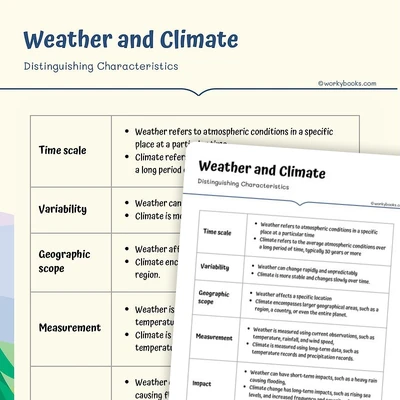
Climate and Weather — Distinguishing Characterstics
This worksheet highlights the differences between climate and weather. The chart format makes comparing and contrasting ...
Reading for Main Details—Birds
This informational text on birds is a great way to practice main idea. Students will read the passage, then give the mai...
RI.2.6RI.2.8
Koi Fish—What’s the Main Idea?
This informational text on koi fish is a great introduction to teaching main idea. Students will be asked, in multiple c...
RI.3.2RF.3.4RI.3.1
Spider—Main Idea
This informational text on spiders is a great introduction to teaching main idea. Students will be asked, in multiple ch...
RI.3.2RF.3.4RI.3.1RI.2.6
Reading for Main Details—Beavers Teeth
This informational text on beavers is a great way to practice main idea. Students will read the passage, then give the m...
RI.2.6RI.2.10
Reading for Main Details—Veternarians
Practie summarizing paragraphs with this fun informational text on veternarians! Students will give the main idea of eac...
RI.2.2RI.2.10
Main Idea and Supporting Details in Informational Text
RI.3.1RI.3.2RI.3.8
Tools and Technology in Earth Science
This middle school science reading passage explores the wide range of tools and technologies used in Earth science, from...
MS-ESS2-2MS-ESS3-2MS-ETS1-1MS-PS4-3
What Is Earth Science?
This engaging middle school science passage introduces students to the field of Earth science, aligning with NGSS standa...
MS-ESS1MS-ESS2MS-ESS3SEP
Main Idea and Details Graphic Organizer
This graphic organizer on main idea includes space to write the main idea and three supporting details.
RI.1.2RI.2.2RI.3.2RI.4.2
Polar Bears and Climate
This informational text on polar bears is a great way to practice reading comprehension. Students will read the passage ...
RI.4.1W.4.72-LS4-1RF.4.4
Main Idea and Suporting Details Graphic Organizer
This graphic organizer on main idea includes space to write the main idea and three supporting details.
RI.1.2RI.2.2RI.3.2RI.4.2
Bats and Butterflies—Informational Text
This informational text on bats and butterflies is a great way to practice spotting similarities between texts. Students...
RI.K.3
Penguins— Main Purpose
This informational text on penguins with comprehension questions is a great way to practice reading fluency and main ide...
RI.1.2RI.1.10RF.1.4.ARF.1.4.B
Informational Text — Astronauts
Practice this second grade context clues worksheet with this informational text on astronauts. Students will read the te...