This learning resource is available in interactive and printable formats. The interactive worksheet can be played online and assigned to students. The Printable PDF version can be downloaded and printed for completion by hand.
This middle school science reading passage introduces students to the concept of conductivity, explaining how materials allow heat and electricity to move through them. Aligned with NGSS MS-PS3 standards for energy and matter, it uses simple examples like copper wires and metal spoons to make the topic relatable and clear. Students learn about conductors, insulators, and how engineers use these properties when designing everyday tools and structures. The passage also builds important reading comprehension skills by reinforcing key science vocabulary like electrons, materials, and energy transfer. Ideal for NGSS-aligned classrooms, it supports students' understanding of science practices and concepts while engaging them with real-world examples of
CONTENT PREVIEW
Expand content preview
Have you ever wondered why some things heat up quickly while others stay cool? Or why metal wires are used to carry electricity? The answer has to do with a property called conductivity.
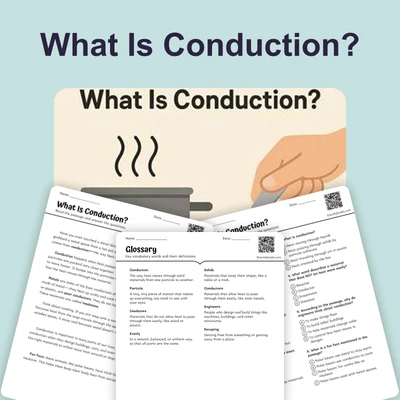
Conductivity is the ability of a material to let heat or electricity pass through it. Materials that let heat or electricity move through them easily are called good conductors. Materials that do not let them move through easily are called insulators.
Metals like copper, aluminum, and silver are great conductors. That’s why metal pots heat up fast and why copper wires are used in electronics and power lines. These materials have particles (called electrons) that move freely, making it easy for energy to flow.
On the other hand, materials like rubber, plastic, wood, and glass are poor conductors. They are good insulators. Insulators are important too! They keep us safe by stopping the flow of unwanted heat or electricity. For example, the plastic covering on wires keeps you from getting shocked.
Conductivity is important in many areas of science and engineering. When people design buildings, machines, or even clothing, they have to think about how well materials conduct heat or electricity.
You can test conductivity with simple tools. For example, to test thermal conductivity, you can place different materials in hot water and see which one gets warm first. For electrical conductivity, a circuit tester can show whether electricity flows through a material.
Fun Fact: Silver is the best conductor of electricity, but it’s too expensive for most wires—so we usually use copper instead!
What is the main idea of the passage?
How to cook with metal potsWhy plastic is bad for electronicsWhat conductivity is and why it mattersHow to make electricity at home
What does conductivity mean?
The ability to float on waterThe ability to block heat or electricityThe ability to let heat or electricity pass throughThe power to stop energy from moving
Which of the following is a good conductor?
RubberWoodCopperGlass
Why is copper used in wires instead of silver?
Copper is a better conductorCopper is heavier than silverSilver melts too easilyCopper is cheaper than silver
What is an insulator?
A material that holds electricityA material that blocks or slows down heat or electricityA tool that measures heatA type of wire used in buildings
What does the passage say about the plastic covering on wires?
It makes wires look nicerIt stops the wire from meltingIt helps heat move fasterIt protects us from getting shocked
What is one way to test thermal conductivity?
Use a magnet on a wirePut different materials in hot waterShine a light through materialsFreeze the materials
What kind of particles help metals conduct energy?
ProtonsNeutronsAtomsElectrons
Perfect For:
👩🏫 Teachers
• Reading comprehension practice
• Auto-graded assessments
• Literacy skill development
👨👩👧👦 Parents
• Reading practice at home
• Comprehension improvement
• Educational reading time
🏠 Homeschoolers
• Reading curriculum support
• Independent reading practice
• Progress monitoring
Reading Features:
📖
Reading Passage
Engaging fiction or nonfiction text
❓
Comprehension Quiz
Auto-graded questions
📊
Instant Feedback
Immediate results and scoring
📄
Printable Version
Download for offline reading
🔊
Read Aloud
Voice-over with word highlighting
Reviews & Ratings
No reviews yet. Be the first to share your experience!
Related Content
Understanding Specific Heat
This passage, 'Understanding Specific Heat,' explains the concept of specific heat to middle school students in an acces...
MS-PS3HS-PS3RI.6.3RI.7.1
The Specific Heat Capacity of Water
This middle school science reading passage, 'The Specific Heat Capacity of Water,' explains how water's high specific he...
MS-PS3HS-PS3RI.6.3RI.7.1
The Specific Heat of Ice
This middle school science passage, 'The Specific Heat of Ice,' explains how ice has a lower specific heat than liquid w...
MS-PS3HS-PS3RI.6.3RI.7.1
The Specific Heat of Copper
This middle school reading passage, 'The Specific Heat of Copper,' explores how copper responds to heat due to its low s...
MS-PS3HS-PS3RI.6.3RI.7.1
What Is Thermal Energy?
This middle school science passage, 'What Is Thermal Energy?', introduces students to the concept of energy from particl...
MS-PS3HS-PS3RI.6.3RI.7.1
What Is the Difference Between Thermal Energy and Heat?
This passage, 'What Is the Difference Between Thermal Energy and Heat?', helps middle school students understand the key...
MS-PS3HS-PS3RI.6.3RI.7.1
How Does Heat Move?
This engaging middle school science passage introduces students to the basic principles of heat transfer, aligning with ...
MS-PS3HS-PS3RI.6.3RI.7.1
What Is Conduction?
This middle school science passage explains the concept of conduction, focusing on how heat moves through solids. Aligne...
MS-PS3HS-PS3RI.6.3RI.7.1
What Is an Example of Conduction?
This middle school science reading passage explains conduction through everyday examples, such as a hot metal spoon in s...
MS-PS3HS-PS3RI.6.3RI.7.1
What Is a Temperature Gradient?
This engaging science passage introduces students to the concept of a temperature gradient, a key idea aligned with the ...
MS-PS3HS-PS3RI.6.3RI.7.1
Heat Transfer Rate
This passage introduces students to the concept of heat transfer rate, aligned with NGSS standard MS-PS3-3. It explains ...
MS-PS3HS-PS3RI.6.3RI.7.1
What Is Entropy in Energy?
This passage introduces the concept of entropy in the context of energy, aligning with NGSS standard MS-PS3-4. It explai...
MS-PS3HS-PS3RI.6.3RI.7.1
What is Deforestation?
Deforestation is the large-scale removal of forests, primarily caused by human activities like agriculture, logging, and...
RI.5.3RI.6.3RI.7.3
Cold Fronts and Warm Fronts: A Comparison
Cold fronts bring thunderstorms and cooler temperatures, while warm fronts bring light rain and warmer temperatures. Bot...
7.RI.7.3RI.5.3RI.5.5RI.6.9
The Great Pacific Garbage Patch
The Great Pacific Garbage Patch is a massive collection of plastic waste in the North Pacific Ocean. It harms marine lif...
RI.5.3RI.6.3RI.7.3
Surface Water Runoff
Surface water runoff replenishes rivers and lakes but can cause flooding and pollution. Solutions like rain gardens and ...
RI.5.3RI.6.3RI.7.3
The Mississippi River
The Mississippi River is one of the longest rivers in North America, stretching 2,340 miles from Lake Itasca to the Gulf...
RI.5.3RI.6.3RI.7.3
The Mekong River
The Mekong River flows 2,700 miles through six countries in Southeast Asia, ending in the fertile Mekong Delta. It suppo...
RI.5.3RI.6.3RI.7.3
Freshwater and Its Sources
Freshwater is a limited resource, with most stored in glaciers and aquifers. Rivers, lakes, and groundwater are key sour...