What Is North Star
Interactive passage with audio narration, comprehension questions, and printable PDF.
By completing this purchase you agree to our Terms of Use and Privacy Policy. Your subscription renews automatically until you cancel. You can cancel anytime from your account settings. All sales are final and non-refundable. Digital content is available for download in your account immediately upon purchase.
What's included
What Is North Star preview and details
About this printable What Is North Star science reading passage, NGSS-aligned (Grades 4-6)
Sample passage and quiz from What Is North Star
Reading passage and comprehension quiz preview
What Is North Star
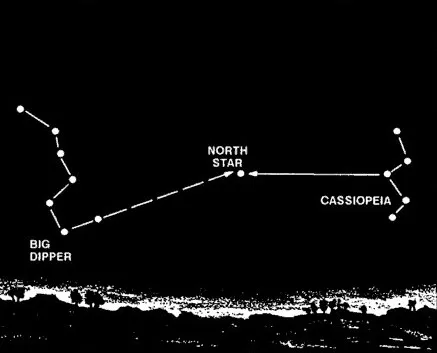
"North Star, Big Dipper and Cassiopeia" by United States Army / Wikimedia Commons
The North Star, also called Polaris, is a bright star that appears to stay in one place in the night sky. A star is a giant ball of hot, glowing gas in space. While all other stars seem to move across the sky during the night, the North Star looks like it stays still. This special characteristic has made it one of the most important stars for finding direction.
The North Star appears stationary because of Earth's position and movement. Earth spins on an imaginary line called an axis, which is like an invisible rod running through the planet from the North Pole to the South Pole. Think of Earth as a spinning top—the axis is the stick in the middle that the top spins around. Earth's axis points almost directly at Polaris. Because of this alignment, Polaris appears to stay in the same spot while Earth rotates beneath it.
As Earth spins, all the other stars appear to move in circles around the North Star. This happens because we are on Earth looking up as our planet turns. It's similar to sitting on a merry-go-round and watching the playground spin around you—you're actually the one moving, but it looks like everything else is rotating. The stars aren't really moving around Polaris; we are moving as Earth rotates.
People have used the North Star for navigation, which means finding their way from one place to another, for thousands of years. Navigation is the process of determining direction and position. Sailors crossing oceans looked for the North Star to know which direction was north. Travelers walking through deserts or forests at night used it as a guide. Even today, hikers and campers learn to find the North Star to help them navigate when they don't have a compass or GPS.
The North Star is easy to locate in the northern sky. It is part of a group of stars called the Little Dipper, and it marks the end of the dipper's handle. To find it, people often look for the Big Dipper first, which is easier to spot. Two stars on the outer edge of the Big Dipper's cup point directly toward Polaris. Once you find the North Star, you know exactly which direction is north, and you can figure out south, east, and west from there.
Interesting Fact: Polaris hasn't always been Earth's North Star, and it won't be forever! Because Earth's axis slowly wobbles like a spinning top, it points to different stars over thousands of years—in about 12,000 years, a star called Vega will become our North Star instead.
Comprehension quiz (8 questions)
1. What is another name for North Star?
2. What is Earth's axis?
3. Which group contains the North Star?
4. Why does North Star appear stationary?
5. How have people used the North Star?
6. Why do other stars appear to move?
7. Polaris will always be Earth's North Star.
8. What does navigation mean?
Perfect for the way you teach
- Build comprehension skills
- Auto-graded quiz
- Differentiated reading
- Read together at home
- Improve fluency
- Quiet reading time
- Reading curriculum support
- Independent practice
- Track Lexile growth