This learning resource is available in interactive and printable formats. The interactive worksheet can be played online and assigned to students. The Printable PDF version can be downloaded and printed for completion by hand.
This engaging science passage introduces Grade 4-5 students to the Andromeda Galaxy, our closest large galactic neighbor. Aligned with NGSS standards 5-ESS1-1 and 5-ESS1-2, it covers key facts about Andromeda, including its distance from Earth, its spiral structure, and its future collision with the Milky Way. The passage explains scientific concepts such as galaxies, light-years, and cosmic scale, and highlights the history of Andromeda's discovery. Audio integration supports diverse learners, while included activities like a reading quiz, writing prompts, and graphic organizers reinforce comprehension and critical thinking. This resource helps students understand Earth's place in the universe and connects them with the excitement of astronomical discovery.
CONTENT PREVIEW
Expand content preview
Meet the Andromeda Galaxy
The Andromeda Galaxy is the nearest large galaxy to our own, the Milky Way. Astronomers also call it M31. Andromeda is about 2.5 million light-years away from us. That means the light we see from Andromeda started its journey before there were humans on Earth! When you look at Andromeda, you are seeing ancient history.
A Galaxy Full of Stars
Andromeda is huge. It contains about one trillion stars—even more than our Milky Way Galaxy! It is a spiral galaxy, which means it has arms that twist out from a bright center, just like a pinwheel. Andromeda got its name from a princess in Greek mythology.
What Does Andromeda Look Like?
On a clear, dark night, Andromeda can be seen as a faint, fuzzy smudge in the sky, in the constellation called Andromeda. It is the farthest object most people can see with just their eyes—no telescope needed! With a telescope, you can see its spiral arms and bright center.
The Milky Way and Andromeda: A Cosmic Collision
Andromeda and the Milky Way are moving toward each other. In about 4 to 5 billion years, they will collide and merge into one giant galaxy, which scientists call 'Milkomeda.' But don’t worry! Galaxies are mostly empty space, so stars probably won’t crash into each other. When they merge, the night sky will look amazing!
Discovery and History
The first known description of Andromeda was by Persian astronomer Al-Sufi in 964 AD, who called it a 'small cloud.' In 1924, Edwin Hubble proved that Andromeda was a galaxy outside the Milky Way. This discovery showed that the universe is much bigger than anyone had thought.
Interesting Fact: Andromeda is like seeing your neighbor’s house from across a giant canyon—it looks small and fuzzy, but it’s actually bigger than our own and slowly moving closer!
What is Andromeda also called?
M31MilkomedaHubblePinwheel
How far away is Andromeda?
2.5 million light-years1,000 light-years5 billion miles100 light-years
What shape is Andromeda?
SpiralTriangleSquareCircle
Why won't stars crash when Andromeda and the Milky Way collide?
Galaxies are mostly empty spaceStars are too heavyStars move slowlyStars are too small
What happens in about 4-5 billion years?
Andromeda and Milky Way will mergeNew stars will formAndromeda will disappearMilky Way will shrink
Who proved Andromeda was a separate galaxy?
Edwin HubbleAl-SufiIsaac NewtonAlbert Einstein
Andromeda is the closest large galaxy. True or false?
TrueFalse
What does 'light-year' mean?
Distance light travels in a yearA year on AndromedaA star's lifetimeThe speed of a star
Perfect For:
👩🏫 Teachers
• Reading comprehension practice
• Auto-graded assessments
• Literacy skill development
👨👩👧👦 Parents
• Reading practice at home
• Comprehension improvement
• Educational reading time
🏠 Homeschoolers
• Reading curriculum support
• Independent reading practice
• Progress monitoring
Reading Features:
📖
Reading Passage
Engaging fiction or nonfiction text
❓
Comprehension Quiz
Auto-graded questions
📊
Instant Feedback
Immediate results and scoring
📄
Printable Version
Download for offline reading
🔊
Read Aloud
Voice-over with word highlighting
Reviews & Ratings
No reviews yet. Be the first to share your experience!
Related Content
What is Milky Way
This engaging passage introduces Grade 4-5 students to the Milky Way, our home galaxy. Students will learn that the Milk...
5-ESS1-15-ESS1-2RI.3.1RI.3.4
How Scientists Know How Far Stars Are
This engaging 400-word reading passage introduces fifth-grade students to the concept of stellar distances and helps the...
5-ESS1-1
What Is Star Brightness
This comprehensive 400-word reading passage helps Grade 5 students understand star brightness as outlined in NGSS standa...
5-ESS1-1
Why Is Sun the Brightest Star in the Sky
This 400-word reading passage is designed for Grade 5 students and aligns with NGSS standard 5-ESS1-1. The passage expla...
5-ESS1-1
How Scientists Measure Star Brightness
This comprehensive 5th grade science reading passage explores how scientists measure star brightness, aligned with NGSS ...
5-ESS1-1
What Is Full Moon
This engaging 400-word science passage introduces fifth-grade students to the concept of a full moon and helps them unde...
5-ESS1-2
Informational Text on Holi
This informational text on Holi is a great way to teach about this holiday and the story of Prahlad. Comprehension quest...
RI.3.10RF.3.4RF.3.4.ARI.3.1
Informational Text —Meet the Governors
This worksheet will get your students thinking about their state governnor. Included is an informational text on the res...
RI.3.10RF.3.4RF.3.4.ARI.3.1
Informational Text on Goods and Services
This short informational text on goods and services will get your students familliar with this concept. Students will re...
RI.3.10RF.3.4RF.3.4.ARI.3.1
Sharks—Informational Text
This informational text on the sharks will teach your students all about these incredible, ancient animals! Free respons...
RI.3.1RI.3.10RF.3.4RI.3.1
Spider—Main Idea
This informational text on spiders is a great introduction to teaching main idea. Students will be asked, in multiple ch...
RI.3.2RF.3.4RI.3.1RI.2.6
Koi Fish—What’s the Main Idea?
This informational text on koi fish is a great introduction to teaching main idea. Students will be asked, in multiple c...
RI.3.2RF.3.4RI.3.1
Informational Text — Cloud Gazing
This informational text teaches students how different types of clouds are formed. A page with pictures of the different...
RI.3.10RF.3.4RF.3.4.ARI.3.1
Informational Text —Bioluminescence
This informational text on bioluminescence will teach your students about this phenomenon. Examples in nature are provid...
RI.3.10RF.3.4RF.3.4.ARI.3.1
Informational Text —Learn About Dinosaurs
This informational text on dinosaurs with comprehension questions to follow is perfect for teaching main idea. Students ...
RF.3.4RF.3.4.ARF.3.4.CRI.3.2
Informational Text —Volcanoes
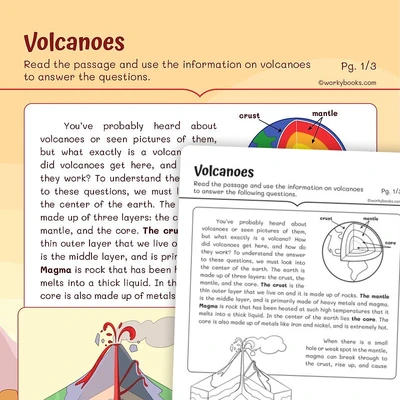
This informational text teaches students about the formation and eruptions of volcanoes. Comprehension questions follow ...
RI.3.7RI.3.1RI.3.3RI.3.10
Informational Text —Snowflakes
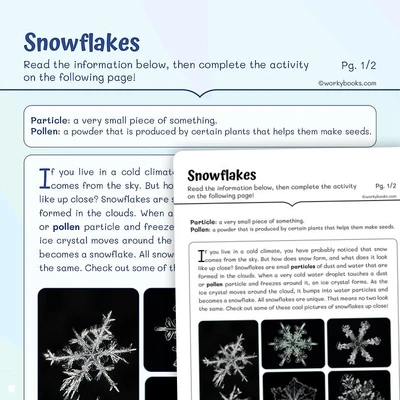
This informational text on snowflakes will teach your students how snowflakes are formed. Images of several different fl...
RI.3.10RF.3.4RF.3.4.ARI.3.1
Reading Comprehension: The Grand Canyon
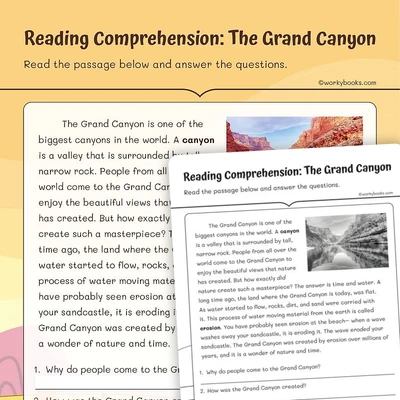
This informational text on the Grand Canyon will teach your students all about this incredible wonder of the world! Free...
RI.3.1RI.3.10RI.3.4RF.3.4
The Butterfly Life Cycle
This informational text on the butterfly lifecycle is perfect for learning how to follow steps in a scientific text. Stu...