This learning resource is available in interactive and printable formats. The interactive worksheet can be played online and assigned to students. The Printable PDF version can be downloaded and printed for completion by hand.
This audio integrated passage introduces the idea of relative motion in simple, student-friendly language. Relative motion means how movement looks different depending on the observer’s position. Students learn about reference points, such as the ground or a seat, to compare and describe motion. Real-world examples, including a moving bus and astronauts in space, make the idea clear and fun. The passage also highlights how predicting and explaining motion requires both the observer’s view and the reference point, supporting NGSS PS2.A: Forces and Motion. A fun fact about astronauts floating while traveling 17,500 mph helps spark curiosity. The passage includes 8 multiple-choice questions at different Depth of Knowledge levels to check comprehension and application. Perfect for teachers, parents, and homeschooling, this text is audio integrated, making learning accessible. Keywords include relative motion, NGSS PS2.A, reference point, and forces and motion to support strong SEO and help educators quickly find the material.
CONTENT PREVIEW
Expand content preview
What is Relative Motion?
Relative motion is how movement looks different depending on where you are watching from. When you see something moving, you are called the observer. The place you are watching from is your reference point. What you see depends on your reference point and perspective.
For example, when you sit in a car and look out the window, the trees seem to move backward quickly. But you feel like you are sitting still in your seat. That’s because your reference point is the car seat. Compared to the car, you are not moving. But compared to the trees or the ground, you are moving forward!
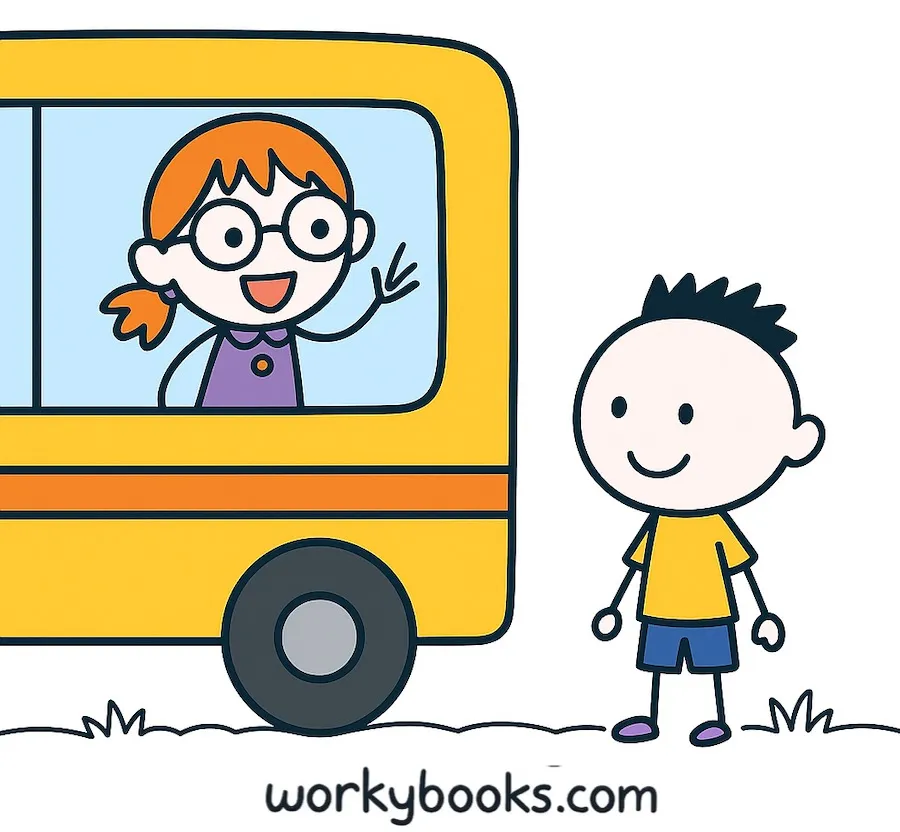
If you walk up the aisle on a moving bus, you are moving compared to the bus seats. But to someone outside the bus, you are moving much faster because the bus is moving and you are walking at the same time. This shows how motion depends on what you compare it to.
Think about two kids swinging next to each other. To each other, they don’t seem to move much. But to someone standing on the playground, both kids are swinging back and forth. The way motion looks changes based on who is watching and from where.
Even on Earth, relative motion is happening. The Earth spins and moves through space, but we don’t feel it because everything around us is moving together. So, if you ask, “Are you moving right now?” the answer is yes! You are moving with the Earth, even if you feel still.
It’s like being on an escalator. You are moving compared to the floor. But compared to the person standing next to you on the escalator, you seem still. This is why understanding comparison and frame of reference is important in science.
Next time you’re on the playground, try watching your friends move from different spots. You’ll notice that motion looks different, depending on your perspective and reference point!
Interesting Fact: Even though we don’t feel it, Earth spins around once every 24 hours and travels around the Sun at about 67,000 miles per hour!
What is an observer?
Someone who watches somethingA moving busA car seatA playground swing
What is your reference point in a car?
The car seatThe treesThe roadThe sky
What does motion depend on?
Reference pointEarth onlyJust the objectOnly the air
How do swings look to each other?
Not moving muchMoving fastStanding stillGoing in circles
Why don't we feel Earth's motion?
Everything moves togetherEarth doesn't moveWe are too smallAir keeps us still
What happens if you walk on a moving bus?
You move faster to people outsideYou stand stillYou move slowerThe bus stops
Earth moves through space. True or false?
TrueFalse
What is 'perspective' in this passage?
How you see thingsFast motionA moving treeSpinning Earth
Perfect For:
👩🏫 Teachers
• Reading comprehension practice
• Auto-graded assessments
• Literacy skill development
👨👩👧👦 Parents
• Reading practice at home
• Comprehension improvement
• Educational reading time
🏠 Homeschoolers
• Reading curriculum support
• Independent reading practice
• Progress monitoring
Reading Features:
📖
Reading Passage
Engaging fiction or nonfiction text
❓
Comprehension Quiz
Auto-graded questions
📊
Instant Feedback
Immediate results and scoring
📄
Printable Version
Download for offline reading
🔊
Read Aloud
Voice-over with word highlighting
Reviews & Ratings
No reviews yet. Be the first to share your experience!
Related Content
What's The Main Idea?
These short science texts are a great way to practice main idea. Students will read the paragraphs and then choose the m...
RI.2.6
Reading for Main Details—Birds
This informational text on birds is a great way to practice main idea. Students will read the passage, then give the mai...
RI.2.6RI.2.8
Koi Fish—What’s the Main Idea?
This informational text on koi fish is a great introduction to teaching main idea. Students will be asked, in multiple c...
RI.3.2RF.3.4RI.3.1
Spider—Main Idea
This informational text on spiders is a great introduction to teaching main idea. Students will be asked, in multiple ch...
RI.3.2RF.3.4RI.3.1RI.2.6
Reading for Main Details—Beavers Teeth
This informational text on beavers is a great way to practice main idea. Students will read the passage, then give the m...
RI.2.6RI.2.10
Reading for Main Details—Veternarians
Practie summarizing paragraphs with this fun informational text on veternarians! Students will give the main idea of eac...
RI.2.2RI.2.10
Main Idea and Supporting Details in Informational Text
RI.3.1RI.3.2RI.3.8
Penguins— Main Purpose
This informational text on penguins with comprehension questions is a great way to practice reading fluency and main ide...
RI.1.2RI.1.10RF.1.4.ARF.1.4.B
Informational Text —Learn About Dinosaurs
This informational text on dinosaurs with comprehension questions to follow is perfect for teaching main idea. Students ...
RF.3.4RF.3.4.ARF.3.4.CRI.3.2
Reading for Main Details—Orcas
Practie summarizing paragraphs with this fun science informational text on orcas! Students will give the main idea of ea...
RI.2.2RI.2.10
Informational Text — Habitats
This short informational text on habitats will teach your students what a habitat is, as well as provide some examples o...
RF.3.4.A
Informational Text —Elephants Facts
This informational text on elephants with comprehension questions to follow is perfect for teaching main idea. Students ...
RF.2.4.ARI.2.1RI.2.2RI.2.6
Informational Text — Astronauts
Practice this second grade context clues worksheet with this informational text on astronauts. Students will read the te...
RI.2.4RI.2.10RI.3.4RI.3.10
Informational Text —Importance of Sound
This Reading Informational Text Common Core standards calls for 4th graders to be able to effectively describe and analy...
RI.4.5
Informational Text — Penguins
This informational text on penguins is a great way to practice reading comprehension. Students will read the short passa...
RI.2.1RI.2.10
Informational Text — Armadillos
This informational text on armadillos is a great way to practice reading comprehension. Students will read the short pas...
RI.2.1RI.2.10
Informational Text —Sea Stars
Use this second grade worksheet on context clues with this informational text on sea stars. Students will read the text ...
RI.2.4RI.2.10RI.3.4RI.3.10
Informational Text —Bioluminescence
This informational text on bioluminescence will teach your students about this phenomenon. Examples in nature are provid...
RI.3.10RF.3.4RF.3.4.ARI.3.1
Informational Text —Snowflakes
This informational text on snowflakes will teach your students how snowflakes are formed. Images of several different fl...
RI.3.10RF.3.4RF.3.4.ARI.3.1
Bats and Butterflies—Informational Text
This informational text on bats and butterflies is a great way to practice spotting similarities between texts. Students...