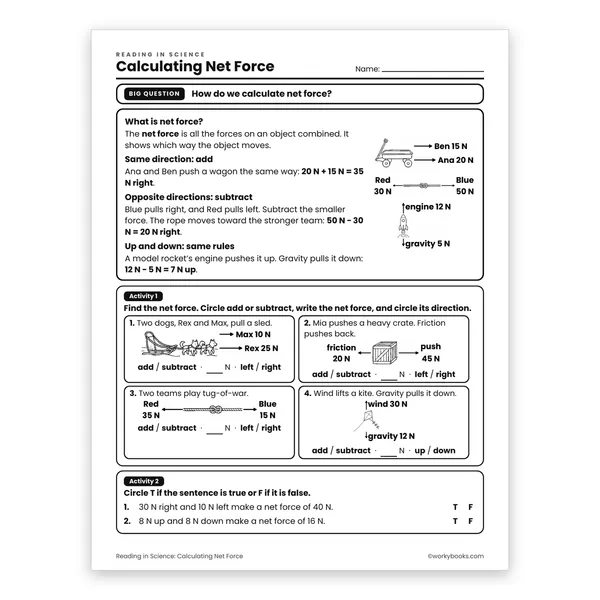
This learning resource is available in interactive and printable formats. The interactive worksheet can be played online and assigned to students. The Printable PDF version can be downloaded and printed for completion by hand.
This NGSS-aligned 4th grade science passage introduces the concept of speed in simple, easy-to-understand terms. Speed tells us how fast something moves and is explained using distance and time. The passage uses examples from daily life, such as walking, running, cars, and trains, as well as animals like snails and cheetahs, to make learning fun and relatable. It also clarifies that speed is different from direction and connects the concept to reference points, such as being on a moving train. A fun fact about cheetahs adds excitement. This passage aligns with NGSS PS2.A: Forces and Motion and helps students build prediction and comparison skills by understanding how to measure and describe speed. Eight multiple-choice questions across different Depth of Knowledge levels test recall, inference, and application. The passage is audio integrated, making it accessible to diverse learners. Keywords include speed, NGSS PS2.A, 4th grade science, distance and time, and forces and motion to support SEO and ensure the material is easy for teachers and parents to find.
CONTENT PREVIEW
Expand content preview
What is Speed?
Speed tells us how fast or slow something moves. It is a way to measure how much distance an object travels in a certain amount of time. The faster something moves, the more distance it covers in less time. The slower it moves, the less distance it covers in the same time.
We can use a simple formula to find speed: Speed = Distance ÷ Time. This means we divide the distance traveled by the time it took. For example, if you walk 2 miles in 1 hour, your speed is 2 miles per hour, or 2 mph. If you run 10 feet in 2 seconds, your speed is 5 feet per second.
Different things move at different speeds. A cheetah is the fastest land animal and can run up to 70 mph! A car on the highway usually goes about 65 mph. A kid running might reach 10 mph. A turtle walks very slowly at 0.2 mph, and a snail moves even slower—only about 0.03 mph.
We measure speed using units like miles per hour (mph) or feet per second. Speed is like asking, “How many steps do you take while your friend counts to ten?”
Speed can change. When you start moving, you might go slow, then speed up, or slow down, and finally stop. Cars have a tool called a speedometer that shows how fast they are going. You can measure your own speed on the playground by timing how long it takes to walk or run across it, and then comparing your speeds.
Knowing speed helps us in races, planning trips, and staying safe. It is a helpful way to understand how objects move in our world.
Interesting Fact: The fastest speed ever recorded for a human is about 27.8 mph, set by sprinter Usain Bolt!
What does speed measure?
How fast something movesHow heavy something isHow tall something isHow old something is
Which is the fastest land animal?
CheetahTurtleSnailCar
What tool shows speed in a car?
SpeedometerThermometerBarometerOdometer
If you run 10 feet in 2 seconds, what is your speed?
5 feet per second10 feet per second2 feet per second20 feet per second
Why do we measure speed on the playground?
To compare walking and runningTo find northTo make it rainTo catch animals
What unit measures speed in miles per hour?
mphkgcmliter
Speed can never change. True or false?
TrueFalse
What does 'distance' mean?
How far something travelsHow fast you runHow loud something isHow much something weighs
Perfect For:
👩🏫 Teachers
• Reading comprehension practice
• Auto-graded assessments
• Literacy skill development
👨👩👧👦 Parents
• Reading practice at home
• Comprehension improvement
• Educational reading time
🏠 Homeschoolers
• Reading curriculum support
• Independent reading practice
• Progress monitoring
Reading Features:
📖
Reading Passage
Engaging fiction or nonfiction text
❓
Comprehension Quiz
Auto-graded questions
📊
Instant Feedback
Immediate results and scoring
📄
Printable Version
Download for offline reading
🔊
Read Aloud
Voice-over with word highlighting
Reviews & Ratings
No reviews yet. Be the first to share your experience!
Related Content
What's The Main Idea?
These short science texts are a great way to practice main idea. Students will read the paragraphs and then choose the m...
RI.2.6
Reading for Main Details—Birds
This informational text on birds is a great way to practice main idea. Students will read the passage, then give the mai...
RI.2.6RI.2.8
Koi Fish—What’s the Main Idea?
This informational text on koi fish is a great introduction to teaching main idea. Students will be asked, in multiple c...
RI.3.2RF.3.4RI.3.1
Spider—Main Idea
This informational text on spiders is a great introduction to teaching main idea. Students will be asked, in multiple ch...
RI.3.2RF.3.4RI.3.1RI.2.6
Reading for Main Details—Beavers Teeth
This informational text on beavers is a great way to practice main idea. Students will read the passage, then give the m...
RI.2.6RI.2.10
Reading for Main Details—Veternarians
Practie summarizing paragraphs with this fun informational text on veternarians! Students will give the main idea of eac...
RI.2.2RI.2.10
Main Idea and Supporting Details in Informational Text
RI.3.1RI.3.2RI.3.8
Penguins— Main Purpose
This informational text on penguins with comprehension questions is a great way to practice reading fluency and main ide...
RI.1.2RI.1.10RF.1.4.ARF.1.4.B
Informational Text —Learn About Dinosaurs
This informational text on dinosaurs with comprehension questions to follow is perfect for teaching main idea. Students ...
RF.3.4RF.3.4.ARF.3.4.CRI.3.2
Reading for Main Details—Orcas
Practie summarizing paragraphs with this fun science informational text on orcas! Students will give the main idea of ea...
RI.2.2RI.2.10
Informational Text — Habitats
This short informational text on habitats will teach your students what a habitat is, as well as provide some examples o...
RF.3.4.A
Informational Text —Elephants Facts
This informational text on elephants with comprehension questions to follow is perfect for teaching main idea. Students ...
RF.2.4.ARI.2.1RI.2.2RI.2.6
Informational Text — Astronauts
Practice this second grade context clues worksheet with this informational text on astronauts. Students will read the te...
RI.2.4RI.2.10RI.3.4RI.3.10
Informational Text —Importance of Sound
This Reading Informational Text Common Core standards calls for 4th graders to be able to effectively describe and analy...
RI.4.5
Informational Text — Penguins
This informational text on penguins is a great way to practice reading comprehension. Students will read the short passa...
RI.2.1RI.2.10
Informational Text — Armadillos
This informational text on armadillos is a great way to practice reading comprehension. Students will read the short pas...
RI.2.1RI.2.10
Informational Text —Sea Stars
Use this second grade worksheet on context clues with this informational text on sea stars. Students will read the text ...
RI.2.4RI.2.10RI.3.4RI.3.10
Informational Text —Bioluminescence
This informational text on bioluminescence will teach your students about this phenomenon. Examples in nature are provid...
RI.3.10RF.3.4RF.3.4.ARI.3.1
Informational Text —Snowflakes
This informational text on snowflakes will teach your students how snowflakes are formed. Images of several different fl...
RI.3.10RF.3.4RF.3.4.ARI.3.1
Bats and Butterflies—Informational Text
This informational text on bats and butterflies is a great way to practice spotting similarities between texts. Students...