This learning resource is available in interactive and printable formats. The interactive worksheet can be played online and assigned to students. The Printable PDF version can be downloaded and printed for completion by hand.
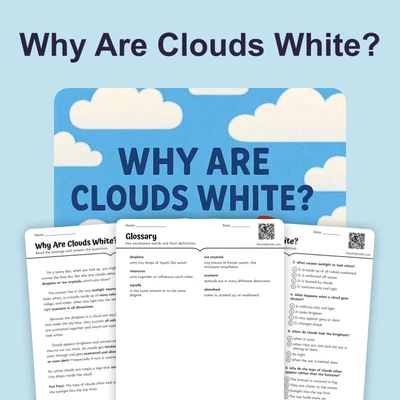
This NGSS-aligned reading passage explains why clouds appear grey when they become dense with water droplets and block sunlight. Students will learn about light scattering, cloud thickness, and how shadows and sunlight angles affect cloud color. The passage also explores how darker clouds are signs of possible rain. It supports NGSS standard MS-ESS2-6 and helps students build science literacy by connecting everyday weather observations with key Earth science concepts.
CONTENT PREVIEW
Expand content preview
Clouds don’t start out grey—they’re usually white when they form. But sometimes, especially before it rains, they turn darker and look grey or even black. So why does this happen?
Clouds are made of tiny water droplets or ice crystals that scatter sunlight. When clouds are thin, the sunlight passes through easily and gets scattered in all directions, making the cloud appear white. This is similar to how sunlight scatters to make the sky look blue.
As clouds grow thicker and hold more water, they block more sunlight from passing through. The light can't reach the bottom of the cloud as easily, so the base appears darker. The more water a cloud contains, the less light it lets through—and the greyer it looks.
Sometimes, the grey look is also caused by shadows. If clouds are stacked high or if sunlight is weak (like in the evening), the lower parts of the cloud don’t get much light. That’s why storm clouds look especially dark—they’re big, thick, and full of moisture.
In short, grey clouds mean the cloud is dense and full of water, which often means rain is coming soon.
Fun Fact: Clouds aren’t actually colored grey or white—they just appear that way based on how light passes through or around them!
What are clouds made of?
Cotton and airDust and smokeTiny water droplets or ice crystalsSnow and wind
Why do thin clouds look white?
They are close to the sunThey reflect the color of the skyThey scatter sunlight in all directionsThey contain more rain
What happens when clouds grow thicker?
They float higherThey let more light throughThey block more sunlightThey reflect blue light
Why do the bottoms of clouds often look darker?
They are colderThey reflect the color of the groundLess light reaches the bottom of the cloudThey are full of thunder
What is a common sign of a cloud turning grey?
The cloud is getting smallerRain may be coming soonThe cloud is turning into snowWind is slowing down
What else can make clouds appear grey?
Air pollutionToo much oxygenShadows from stacked clouds or weak sunlightLightning inside the cloud
What is the main idea of the passage?
All clouds are made of fogGrey clouds happen when they fill with water and block lightClouds turn grey because they are dirtyClouds are always the same color
Why do clouds only appear white or grey?
They reflect the oceanThey absorb sunlightThey don't have any color; light makes them appear that wayThey are painted by air pressure
Perfect For:
👩🏫 Teachers
• Reading comprehension practice
• Auto-graded assessments
• Literacy skill development
👨👩👧👦 Parents
• Reading practice at home
• Comprehension improvement
• Educational reading time
🏠 Homeschoolers
• Reading curriculum support
• Independent reading practice
• Progress monitoring
Reading Features:
📖
Reading Passage
Engaging fiction or nonfiction text
❓
Comprehension Quiz
Auto-graded questions
📊
Instant Feedback
Immediate results and scoring
📄
Printable Version
Download for offline reading
🔊
Read Aloud
Voice-over with word highlighting
Reviews & Ratings
No reviews yet. Be the first to share your experience!
Related Content
Comparing Weather and Climate Texts
This reading comprehension worksheet has 5th graders read two informational texts about Weather and Climate. Students th...
RI.5.9
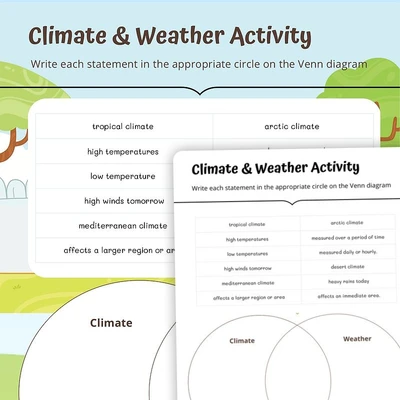
Climate and weather activity
This worksheet is perfect for understanding the differences between climate and weather. Students will read the phrases ...
What Is Space Weather and How Does It Affect the Earth?
This NGSS-aligned science passage for middle school explains what space weather is and how it affects Earth. Students le...
MS-ESS2-2
What's The Main Idea?
These short science texts are a great way to practice main idea. Students will read the paragraphs and then choose the m...
RI.2.6
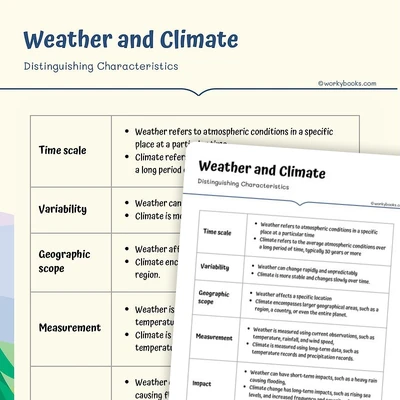
Climate and Weather — Distinguishing Characterstics
This worksheet highlights the differences between climate and weather. The chart format makes comparing and contrasting ...
Reading for Main Details—Birds
This informational text on birds is a great way to practice main idea. Students will read the passage, then give the mai...
RI.2.6RI.2.8
Koi Fish—What’s the Main Idea?
This informational text on koi fish is a great introduction to teaching main idea. Students will be asked, in multiple c...
RI.3.2RF.3.4RI.3.1
Spider—Main Idea
This informational text on spiders is a great introduction to teaching main idea. Students will be asked, in multiple ch...
RI.3.2RF.3.4RI.3.1RI.2.6
Reading for Main Details—Beavers Teeth
This informational text on beavers is a great way to practice main idea. Students will read the passage, then give the m...
RI.2.6RI.2.10
Reading for Main Details—Veternarians
Practie summarizing paragraphs with this fun informational text on veternarians! Students will give the main idea of eac...
RI.2.2RI.2.10
Main Idea and Supporting Details in Informational Text
RI.3.1RI.3.2RI.3.8
Tools and Technology in Earth Science
This middle school science reading passage explores the wide range of tools and technologies used in Earth science, from...
MS-ESS2-2MS-ESS3-2MS-ETS1-1MS-PS4-3
What Is Earth Science?
This engaging middle school science passage introduces students to the field of Earth science, aligning with NGSS standa...
MS-ESS1MS-ESS2MS-ESS3SEP
Main Idea and Details Graphic Organizer
This graphic organizer on main idea includes space to write the main idea and three supporting details.
RI.1.2RI.2.2RI.3.2RI.4.2
Polar Bears and Climate
This informational text on polar bears is a great way to practice reading comprehension. Students will read the passage ...
RI.4.1W.4.72-LS4-1RF.4.4
Main Idea and Suporting Details Graphic Organizer
This graphic organizer on main idea includes space to write the main idea and three supporting details.
RI.1.2RI.2.2RI.3.2RI.4.2
Bats and Butterflies—Informational Text
This informational text on bats and butterflies is a great way to practice spotting similarities between texts. Students...
RI.K.3
Penguins— Main Purpose
This informational text on penguins with comprehension questions is a great way to practice reading fluency and main ide...
RI.1.2RI.1.10RF.1.4.ARF.1.4.B
Informational Text — Astronauts
Practice this second grade context clues worksheet with this informational text on astronauts. Students will read the te...