Land Ecosystems
Interactive worksheet with auto-grading, instant feedback, and printable PDF.
By completing this purchase you agree to our Terms of Use and Privacy Policy. Your subscription renews automatically until you cancel. You can cancel anytime from your account settings. All sales are final and non-refundable. Digital content is available for download in your account immediately upon purchase.
What's included
Land Ecosystems preview and details
About this worksheet
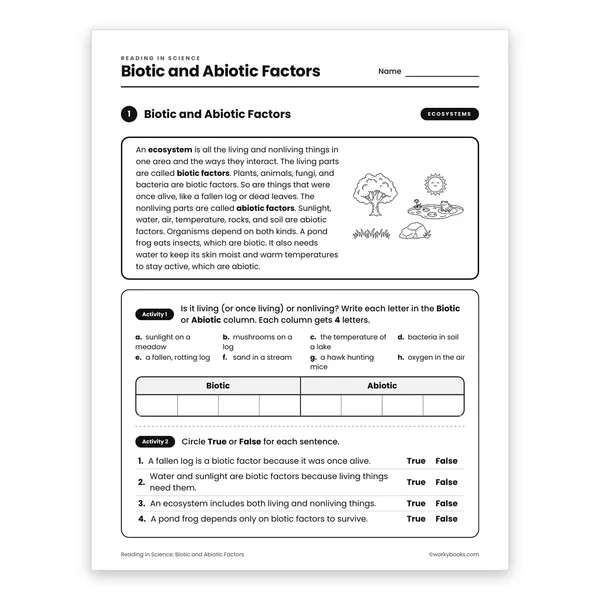
Take your sixth graders on a quick tour of four land ecosystems! In this one-page worksheet, students read about the desert, tundra, grassland, and forest, name the ecosystem for six clues, and then match three organisms to where they most likely live.
The passage explains that land ecosystems are different because their abiotic factors are different. A desert gets less than 10 inches of rain a year, so plants like cactus store water and many animals come out at night. The tundra is very cold with a short summer, and permafrost, soil that stays frozen all year, keeps tall trees from growing, so mosses, lichens, and caribou live there. A grassland gets enough rain for grasses but not for many trees, and bison and prairie dogs graze there. A forest gets plenty of rain, so tall trees grow and shade the ground. In the first activity, students write D, T, G, or F for six clues, such as frozen soil or a cactus storing water. In the second activity, students read about a shade plant, a white fox, and a lizard that hunts at night, then circle the ecosystem where each most likely lives. The sheet is written to Texas TEKS 6.12A and also fits NGSS MS-LS2-1.
What's inside:
- A short passage with a wide picture and key words in bold
- 6 ecosystem letter rows
- 3 short clue questions
- A visual answer key with every answer marked in red
How teachers use it:
- As an introduction to biomes after lessons on biotic and abiotic factors
- For bell work, stations, or an exit ticket
- As homework or sub plans, with no prep needed
It takes about 5 to 10 minutes and prints clearly in black and white. This worksheet is part of our Reading in Science series for grade 6.
Perfect for the way you teach
- Assign in one click
- Track progress per student
- Auto-graded results
- Practice at home
- Print or do on-screen
- Build skill mastery
- Standards-aligned
- Self-paced
- Ready-to-use today