
Rock Layers and Superposition
Interactive worksheet with auto-grading, instant feedback, and printable PDF.
By completing this purchase you agree to our Terms of Use and Privacy Policy. Your subscription renews automatically until you cancel. You can cancel anytime from your account settings. All sales are final and non-refundable. Digital content is available for download in your account immediately upon purchase.
What's included
Rock Layers and Superposition preview and details
About this worksheet
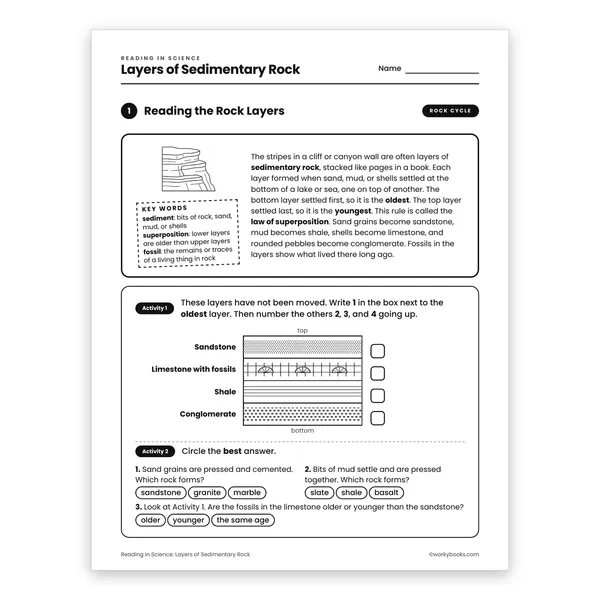
Rock Layers and Superposition Worksheet for 7th Grade Science (TEKS 7.10A)
How can a cliff tell us which rock is older? Students learn the law of superposition with a clear line drawing of a cliff. Five layers hold five fossils, from a trilobite at the bottom to a mammal skull at the top.
Activities
- Read the Cliff: write the letter of the oldest layer, the youngest layer, and two layers in between
- Model it: draw an arrow from the oldest layer to the youngest
- Older or Younger: circle the correct words to compare the fossils
- Main idea: the oldest layer is on the bottom
Key Words
Sediment, sedimentary rock, law of superposition, relative age.
Answer Key
The key shows the arrow in red and every answer. The teacher note uses a stack of newspapers to fix the idea that the deepest layer is the newest. Class Talk asks why the rule says "layers that have not been moved."
Standards
TEKS 7.10A asks students to describe the evidence that supports that Earth has changed over time, including fossil evidence, plate tectonics, and superposition. Superposition is named in the standard. Supports NGSS MS-ESS1-4.
Perfect for the way you teach
- Assign in one click
- Track progress per student
- Auto-graded results
- Practice at home
- Print or do on-screen
- Build skill mastery
- Standards-aligned
- Self-paced
- Ready-to-use today