Why I love teaching Little Red Riding Hood: Printable Worksheets for Teachers and Homeschoolers
Every year, I come back to Little Red Riding Hood, and every year it works. My young readers walk in already knowing the story, so they feel confident before we even open the book. That confidence matters, especially for kids who are still building their reading stamina.
The story is also a teacher’s dream. It is short, the plot is simple, and the characters are easy to picture. Even better, it has a clear beginning, middle and end, which makes it perfect for practicing story order. And then there are those famous lines, “Grandma, what big eyes you have!” Kids can’t resist reading them with expression.
So in this post, I’m sharing everything I use for a Little Red Riding Hood unit: a gentle short story you can read aloud, six printable worksheets, and the simple week plan I follow. Whether you teach a full class or homeschool at the kitchen table, these Little Red Riding Hood activities are ready to print today.
A Little Red Riding Hood short story to read aloud
I always start with a read-aloud. This is the gentle version I use with my younger readers. Grandma hides, the Woodcutter saves the day, and nobody gets eaten, so it never scares anyone. It also matches all six worksheets below.
Once upon a time, a little girl lived near the woods. She always wore a red cape with a hood, so everyone called her Little Red Riding Hood.
One morning, Mom packed a basket with bread, a cake, a jar of jam and some milk. “Please take this to Grandma,” she said. “Stay on the path!”
On the way, Red met a Wolf. “Where are you going, little girl?” he asked. Red told him about Grandma. Then the Wolf pointed to some pretty flowers, and Red stopped to pick a few.
Meanwhile, the Wolf ran to Grandma’s house first. Grandma saw him coming and hid in the closet. The Wolf put on her nightcap and glasses and jumped into bed.
When Red arrived, something looked strange. “Grandma, what big eyes you have!” she said. “All the better to see you with!” said the Wolf. “What big ears you have!” “All the better to hear you with!”
Just then, a Woodcutter walked by. “Go away, Wolf! Leave Red alone!” he shouted. The Wolf ran off into the woods and never came back.
Finally, Grandma came out of the closet. She gave Red a big hug, and they shared the treats together.
When we finish reading, I ask three quick questions. Who are the characters? Where does the story happen? How did Red feel when she saw the Wolf in Grandma’s bed? These questions get kids talking, and they lead right into the worksheets.
6 Little Red Riding Hood activities my students love
Here is what I look for in a worksheet for young readers: one big picture, large text and a task they can finish in 5 to 10 minutes. These six pages check every box. They print clearly in black and white, and each one has a visual answer key, so checking work is quick. They are written for 2nd grade, but I also use them with strong 1st grade readers and as review in 3rd grade.
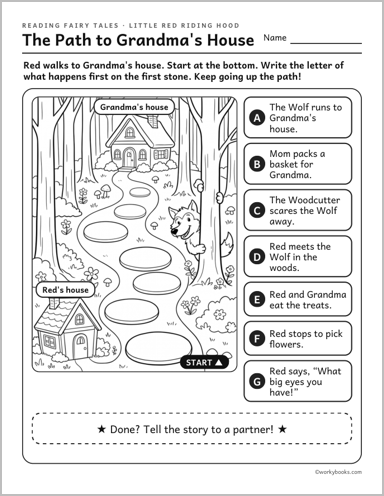
1. Little Red Riding Hood sequencing activity: The Path to Grandma’s House
This is the page I reach for first. A winding path leads from Red’s house to Grandma’s house, and kids write the letter of each event on the stepping stones in order. It turns retelling into a walk through the woods, and it shows me right away who understands the beginning, middle and end.
Get The Path to Grandma’s House
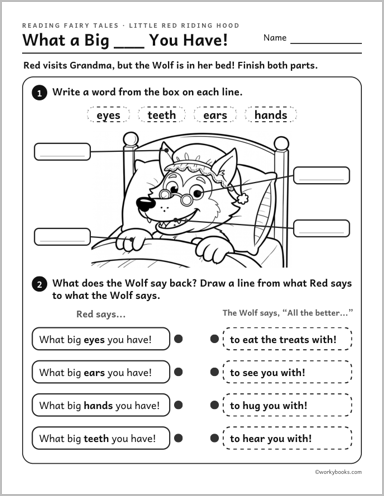
2. What big eyes you have activity: What a Big ___ You Have!
Kids giggle the moment they see this silly wolf in Grandma’s nightcap. First, they label his eyes, ears, hands and teeth with a word bank. Then they match each thing Red says to the Wolf’s answer. It is fun, not scary, and it quietly builds key detail skills.
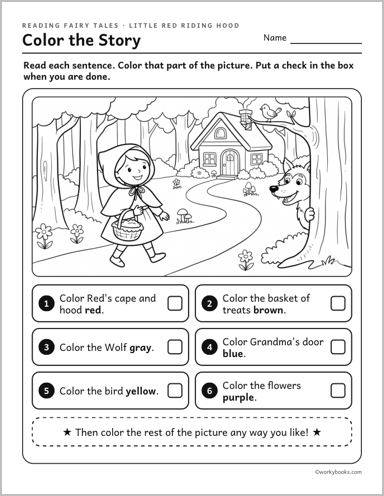
3. Coloring activity: Little Red Riding Hood Color the Story
I love a coloring page that sneaks in reading. Kids read six short directions, like “Color Red’s cape and hood red,” and color that part of the big story picture. After that, they can color the rest of the scene however they like. I use it for centers, early finishers and calm Friday afternoons.
4. Red Riding Hood characters worksheet: Who Said It?
This one feels like putting on a play. Students meet Red, the Wolf, Grandma and the Woodcutter, then write the number of the character who said each speech bubble. Finally, they read every line in that character’s voice. My quiet readers often surprise me with their best Wolf voice.
5. Reading for details: Pack the Basket
Red is packing a basket for Grandma, and your students get to help. They read a short note from Mom and draw a line from each food on the note to the basket. Because the extra foods are real picnic foods too, kids have to read the note carefully. It is a great little lesson in rereading.
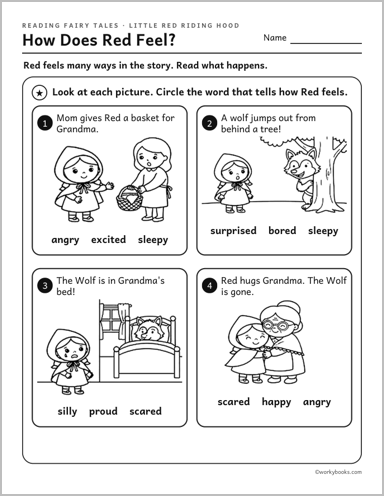
6. Character feelings: How Does Red Riding Hood Feel?
I also love this story for social emotional learning, or SEL. Red goes through so many feelings in one short story. She feels excited when Mom hands her the basket, surprised when the Wolf jumps out, scared when she sees him in Grandma’s bed, and happy and safe when she hugs Grandma at the end. That gives young kids a safe way to name big feelings and talk about them.
When we do the How Does Red Feel? page, I ask a few simple questions:
- How can you tell how Red feels? Look at her face.
- Have you ever felt surprised or scared like Red? What did you do?
- What helped Red feel safe again?
- Who can you go to when you feel scared?
The story also opens the door to an important safety talk. Red stopped to chat with a stranger and left the path. So I ask, “What would you do if someone you don’t know asked where you were going?” Kids usually have great answers, like “Tell a grown-up” or “Stay with my family.”
Best of all, these talks take only a few minutes, and they fit right into your reading block. In other words, you build reading skills and kindness, empathy and self-awareness at the same time.
My Little Red Riding Hood week plan
When I have a full week, this is how I lay it out. Each day takes about 20 minutes, including a quick reread.
| Day | Read and talk | Worksheet |
|---|---|---|
| Monday | Read the story aloud. Meet the characters. | Who Said It? |
| Tuesday | Reread the beginning. What did Red carry? | Pack the Basket |
| Wednesday | Act out the bedroom scene with a partner. | What a Big ___ You Have! |
| Thursday | Retell the story with first, next, then and last. | The Path to Grandma’s House |
| Friday | Talk about how Red felt. Then relax and color. | How Does Red Feel? and Color the Story |
Short on time? I pick two or three pages instead. For example, the sequencing page and the feelings page make a great quick lesson, and the coloring activity can wait for a center day.
Tips for homeschool families
If you homeschool, these Little Red Riding Hood activities fit right into your day. Here are a few easy ways to make them extra fun at home:
- Act it out. Grab a red towel for a cape and a blanket for Grandma’s bed. Then read the Who Said It? lines in your silliest voices.
- Pack a real basket. After Pack the Basket, let your child pack a snack basket for someone in the family.
- Mix the ages. Younger kids can work on the coloring activity while older siblings tackle the sequencing page.
- Compare versions. Once your child knows this story, borrow a different Little Red Riding Hood book from the library and talk about what changed.
Best of all, every page comes with an answer key, so you can check work in about a minute.
Questions teachers often ask me
What grade is Little Red Riding Hood for? I’ve seen it work from kindergarten through 2nd grade. These worksheets are written for 2nd grade, and they also work well as 1st grade reading worksheets for confident readers.
Is this version scary? Not at all. In this Little Red Riding Hood short story, Grandma hides in the closet and the Woodcutter chases the Wolf away. Nobody gets hurt.
What skills do the pages cover? Story order, key details, characters, feelings and reading with expression. They line up with Common Core standards RL.2.1, RL.2.2, RL.2.3, RL.2.5, RL.2.6 and RL.2.7.
Will they print in black and white? Yes. Every page prints clearly on a regular school printer.
How long does each page take? About 5 to 10 minutes, so each one fits easily into a reading block or a center rotation.
Ready to walk the path to Grandma’s house?
Little Red Riding Hood is a story kids already love, and that makes it one of the easiest ways I know to practice real reading skills. With a short story to read aloud and six ready-to-print pages, you have everything you need for a fun lesson or a full week of fairy tale activities for kids.
So pick a page, print it and enjoy watching your readers light up. You can find all six Little Red Riding Hood worksheets on Workybooks, along with lots more reading worksheets for grades K to 8. Happy teaching!
Related Posts
Rosa Parks Day Resources

8 Collision Worksheets — Grade 4 NGSS 4-PS3-3 | Workybooks