
Prokaryotic vs. Eukaryotic Cells Reading Passages + Activities
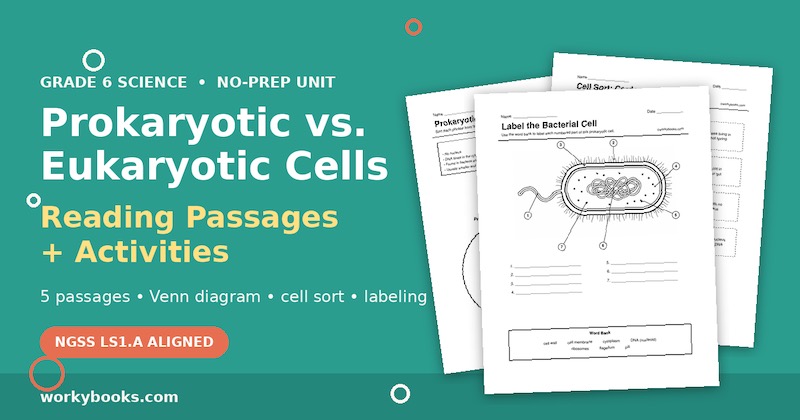
If you teach cell structure in grade 6 science, you know the challenge: students can memorize that prokaryotic cells have no nucleus, but ask them whether an amoeba is a prokaryote and half the class gets it wrong. This complete Prokaryotic vs. Eukaryotic Cells unit was built to fix exactly that — combining five reading comprehension passages with three hands-on activities. All teaching resources are aligned to NGSS LS1.A: Structure and Function.
What’s Inside the Prokaryotic vs. Eukaryotic Cells Unit
Five Reading Comprehension Passages
Each passage is a complete lesson on its own. Every title includes the reading passage, a student-friendly glossary, 8 multiple-choice questions, constructed-response writing prompts, full answer keys with sample responses — plus a Spanish version for ELL support.
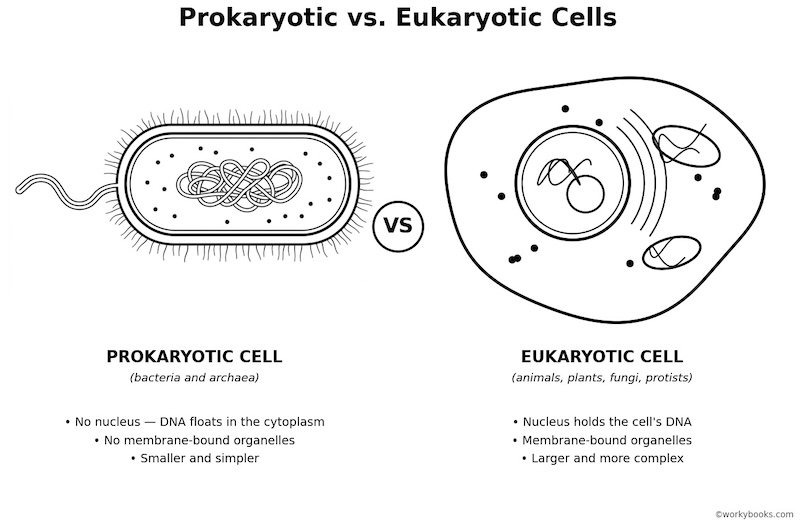
- What Are Prokaryotic Cells? — Students meet bacteria and archaea, the simple cells with no nucleus whose DNA floats freely in the cytoplasm.
- What Are Eukaryotic Cells? — Introduces membrane-bound organelles and the eukaryotic organisms: animals, plants, fungi, and protists.
- Prokaryotic vs. Eukaryotic Cells — The head-to-head comparison passage, focusing on the presence of a nucleus as the key distinction.
- Bacteria: Prokaryotic Cell Structure — A closer look at cell structure: the cell wall, cell membrane, cytoplasm, flagella, and pili that let bacteria thrive everywhere from your gut to hot springs.
- How Do Bacteria Use Acids to Spoil Food? — Real-world science connecting bacterial metabolism to food spoilage. Students learn how lactic acid and acetic acid change the pH level of foods. This answers and why that sour milk smells the way it does.
Three Ready-to-Print Activities
Passages build knowledge; activities make it stick. The unit includes three black-and-white, copier-friendly worksheets:
- Venn Diagram Sort — Students place 12 characteristics into a prokaryotic/eukaryotic Venn diagram, including the “both” traits (DNA, cell membrane, cytoplasm).
- Cut-and-Paste Cell Sort — A kinesthetic sorting activity mixing organism cards (oak tree, mushroom, E. coli, amoeba) with cell-feature clues. It directly targets the #1 misconception: that all single-celled organisms are prokaryotes.
- Label the Bacterial Cell Diagram — Students label seven structures on an original line-art bacterium: cell wall, cell membrane, cytoplasm, DNA (nucleoid), ribosomes, flagellum, and pili.
Every activity comes with an answer key.
Why Teachers Love This Format
It’s genuinely no-prep. Because each passage already has its comprehension questions attached, and the three activities print straight from the file, this is a true no-prep unit — reading + activities you can photocopy and teach the same morning.
It confronts real misconceptions. Middle school students consistently assume “single-celled” means “prokaryotic.” The amoeba and paramecium cards in the sorting activity force students to reason from cell structure — does it have a nucleus? — rather than from size or cell count.
It’s built for the NGSS classroom. The unit supports MS-LS1-1 and the LS1.A disciplinary core idea: all living things are made of cells, and cells have internal structures that carry out life functions.
NGSS Alignment: Middle School LS1.A — Structure and Function
Every resource in this sequence maps to the NGSS middle school life science disciplinary core idea LS1.A: Structure and Function. The standard states that all living things are made up of cells, that a cell is the smallest unit that can be said to be alive. Within cells, special structures are responsible for particular functions.
Here’s how the units line up against the related performance expectations:
MS-LS1-1 — Conduct an investigation to provide evidence that living things are made of cells; either one cell or many different numbers and types of cells. The Cell Theory unit anchors this standard through the microscope investigations of Hooke and Leeuwenhoek, while the prokaryotic vs. eukaryotic passages give students the one-celled and many-celled examples the standard calls for.
MS-LS1-2 — Develop and use a model to describe the function of a cell as a whole and ways parts of cells contribute to the function. The bacterial cell labeling diagram and the plant vs. animal cell comparisons are exactly the kind of cell models this performance expectation describes — students identify the cell wall, cell membrane, cytoplasm, nucleoid, and organelles and connect each structure to its function.
Additionally, the bacteria and food spoilage passage adds a phenomena-based hook. It makes an abstract topic concrete — the kind of real-world anchor NGSS lessons are built around. It supports every reader. Glossaries, Spanish passage versions, and a mix of multiple-choice and written-response questions mean you can hand the same unit to your ELL students, your struggling readers, and your honors kids.
How to Teach Prokaryotic vs. Eukaryotic Cells: A 5-Day Sequence
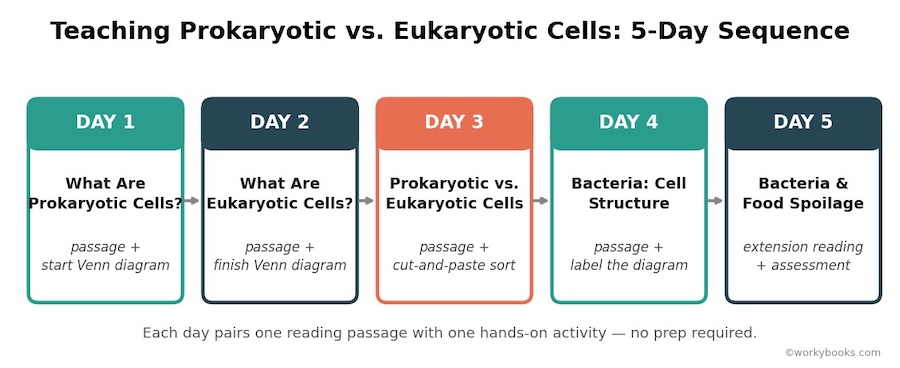
- Day 1: First, the What Are Prokaryotic Cells? passage + start the Venn diagram
- Day 2: Next, the What Are Eukaryotic Cells? passage + complete the Venn diagram
- Day 3: Then, the Prokaryotic vs. Eukaryotic comparison passage + cut-and-paste cell sort
- Day 4: After that, the Bacteria: Prokaryotic Cell Structure passage + label the bacterial cell diagram
- Day 5: Finally, the How Do Bacteria Use Acids to Spoil Food? passage as an assessment-day anchor or extension reading
Frequently Asked Questions
What grade level is this prokaryotic vs. eukaryotic cells unit for? It’s written for middle school science, primarily science grade 6. However, it also works for grades 5–8 depending on your students’ reading levels.
What is the main difference between prokaryotic and eukaryotic cells? Prokaryotic cells (bacteria and archaea) have no nucleus — instead, their DNA floats freely in the cytoplasm. Eukaryotic cells, on the other hand, have a nucleus and membrane-bound organelles. That distinction is therefore the anchor concept of every passage and activity in this unit.
Does it cover cell organelles in depth? It introduces the nucleus, mitochondria, chloroplasts, and endoplasmic reticulum in context. For deep organelle study, however, pair it with a dedicated cell organelles unit.
Is it standards-aligned? Yes — specifically, NGSS LS1.A (Structure and Function), supporting MS-LS1-1.
What to Teach Before and After This Unit
The prokaryotic vs. eukaryotic comparison lands best inside a full cells unit. With that in mind, here’s how it connects to two companion resources.
Start with Introduction to Cells & Cell Theory. Before students can compare cell types, they need the big idea: all living things are made of cells. Accordingly, this unit covers the cell theory and the scientists behind it. Students meet Robert Hooke, who named the cell, and Antonie van Leeuwenhoek, who observed living microorganisms. Then Schleiden, Schwann, and Virchow complete the story: every cell comes from an existing cell. Moreover, the history of the microscope gives students a genuine science-and-engineering story. Better tools led directly to bigger discoveries. As a result, it’s the natural week-one opener for any middle school cells unit.
Follow up with Plant vs. Animal Cells. Once students can separate prokaryotes from eukaryotes, the next question follows naturally. How do eukaryotic cells differ from each other? Consequently, this unit zooms in on the structures that set plant cells apart. Those include the rigid cell wall, chloroplasts for photosynthesis, and the large central vacuole. It also tackles another stubborn misconception. Many students think plant cells lack mitochondria, or that animal cells have no cell membrane. Together, the three units form a complete cell structure sequence for grade 6 science.
Find this Prokaryotic vs. Eukaryotic Cells unit and more standards-aligned science resources at Workybooks — where reading comprehension meets hands-on science.
Related Posts
Workybooks – Interactive LMS Platform for K-8 Teachers
Weather Quiz: Introduction to Heat Domes