What are Prokaryotic Cells? — Reading Comprehension
Rate this
Premium Resource
Present
Present in classroom. No work saved
Assign
Classroom with student accounts, Track progress
Quick Play
No student accounts, assign with a link
Grades
5
6
7
8
Standards
MS-LS1-1
MS-LS1-2
PRINT+DIGITAL RESOURCE
This learning resource is available in interactive and printable formats. The interactive worksheet can be played online and assigned to students. The Printable PDF version can be downloaded and printed for completion by hand.
This NGSS-aligned science reading passage explains prokaryotic cells, the simplest type of cells found in single-celled organisms like bacteria and archaea. Supporting standard MS-LS1-1, the passage describes how prokaryotic cells lack a nucleus and organelles, but still perform all life functions. Students learn key vocabulary such as 'cytoplasm,' 'DNA,' and 'flagella,' and explore how these cells help in digestion, waste breakdown, and survival in extreme environments. Designed for middle school readers, this engaging passage supports comprehension of core life science concepts aligned to the Next Generation Science Standards.
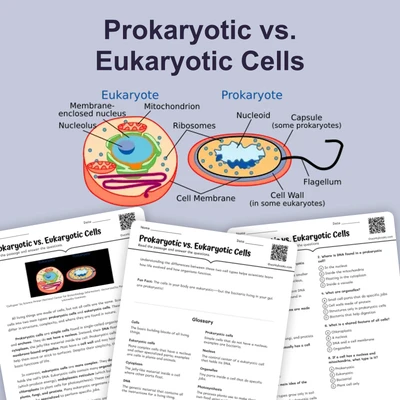
All living things are made of cells, but not all cells are the same. Scientists divide cells into two main types: prokaryotic cells and eukaryotic cells. The simpler of the two is the prokaryotic cell, which is found in single-celled organisms like bacteria and archaea.
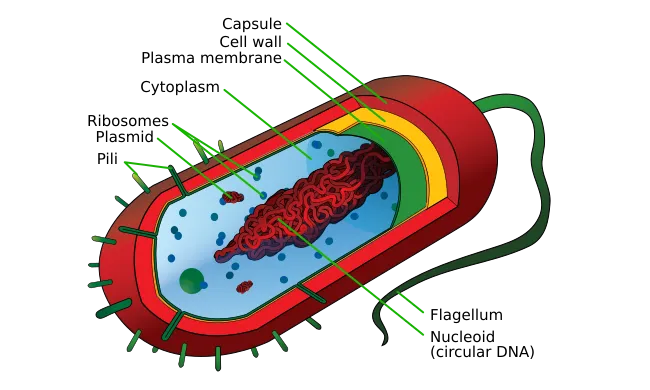
Prokaryotic cells do not have a nucleus or other membrane-bound organelles. Instead of having their DNA stored in a nucleus, their genetic material floats freely in the cytoplasm, the jelly-like fluid inside the cell. Although they are small and simple, prokaryotic cells can carry out all the basic functions of life, such as growing, reproducing, and responding to the environment.
These cells usually have a cell wall, a cell membrane, and sometimes tiny hair-like structures called flagella or pili that help them move or attach to surfaces. Since they don’t have compartments like mitochondria or chloroplasts, all their functions happen directly in the cytoplasm or along the cell membrane.
Prokaryotic cells are believed to be the first type of life to appear on Earth—over 3.5 billion years ago. They are very adaptable and can live in extreme environments like hot springs, salty lakes, or deep ocean vents. Even though they are small, they play big roles in ecosystems, such as helping us digest food or breaking down waste in the environment.
Fun Fact: The bacteria in your body outnumber your own cells—by nearly 10 to 1!
What type of organisms have prokaryotic cells?
Humans and animalsTrees and flowersBacteria and archaeaFungi and protists
What do prokaryotic cells lack?
A cell wallCytoplasmA nucleus and organellesDNA
Where is the DNA found in a prokaryotic cell?
Inside the nucleusIn the mitochondriaFloating in the cytoplasmInside the cell wall
What part of the cell helps it move or attach to things?
RibosomeFlagella or piliNucleusChloroplast
How old are prokaryotic cells estimated to be?
100 years5 million years5 billion years350 years
What is one reason prokaryotic cells are important?
They store oxygenThey create rocksThey help break down wasteThey block viruses
What is the main idea of the passage?
Prokaryotic cells are found in plantsProkaryotic cells are complex and hugeProkaryotic cells are simple cells found in single-celled organismsProkaryotic cells only exist in the ocean
If prokaryotic cells didn’t exist, what might happen?
Food would taste betterWaste might not break down properlyPlants wouldn’t need waterAll animals would have shells
Perfect For:
👩🏫 Teachers
• Reading comprehension practice
• Auto-graded assessments
• Literacy skill development
👨👩👧👦 Parents
• Reading practice at home
• Comprehension improvement
• Educational reading time
🏠 Homeschoolers
• Reading curriculum support
• Independent reading practice
• Progress monitoring
Reading Features:
📖
Reading Passage
Engaging fiction or nonfiction text
❓
Comprehension Quiz
Auto-graded questions
📊
Instant Feedback
Immediate results and scoring
📄
Printable Version
Download for offline reading
🔊
Read Aloud
Voice-over with word highlighting
Reviews & Ratings
No reviews yet. Be the first to share your experience!
Related Content
Antonie van Leeuwenhoek and the Discovery of Animalcules
This NGSS-aligned science passage explores the groundbreaking work of Antonie van Leeuwenhoek, a pioneer in microscopic ...
MS-LS1-1MS-LS1-2
Robert Hooke and the Naming of 'Cells'
This NGSS-aligned reading passage introduces middle school students to Robert Hooke's discovery and naming of 'cells' in...
MS-LS1-1MS-LS1-2
Rudolf Virchow and His Contribution to Cell Theory
This NGSS-aligned science reading passage introduces students to Rudolf Virchow, a key historical figure in cell biology...
MS-LS1-1MS-LS1-2
Matthias Schleiden and the Discovery That Plants Are Made of Cells
This NGSS-aligned science passage explains how Matthias Schleiden, a German scientist in the 1830s, discovered that all ...
MS-LS1-1MS-LS1-2
When Was the Microscope Invented?
This NGSS-aligned reading passage introduces students to the invention of the microscope, an essential scientific tool. ...
MS-LS1-1MS-LS1-2
What are Eukaryotic Cells?
This NGSS-aligned reading passage introduces middle school students to eukaryotic cells, which are complex cells found i...
MS-LS1-1MS-LS1-2
Prokaryotic vs. Eukaryotic Cells
This NGSS-aligned reading passage helps middle school students compare prokaryotic and eukaryotic cells. Supporting stan...
MS-LS1-1MS-LS1-2
What is an Organelle?
This NGSS-aligned reading passage introduces middle school students to the concept of organelles. Supporting MS-LS1-
MS-LS1-1MS-LS1-2
Chromoplast: Nature's Color Palette
This passage details chromoplast functions in pigment production, ecological signaling, and nutrition. Aligned with NGSS...
MS-LS1-1MS-LS1-2MS-LS1-6LS1.C
Parts of the Cell
This informational science passage, aligned with NGSS standard MS-LS1-1, introduces students to the parts of the cell an...
MS-LS1-1MS-LS1-2
The Nucleolus and Its Function
This NGSS-aligned reading passage focuses on the nucleolus, a key structure inside the cell’s nucleus responsible for ma...
MS-LS1-1MS-LS1-2
What Is Vapor Pressure?
This NGSS-aligned science passage explains the concept of vapor pressure in an age-appropriate, engaging way for middle ...
MS-PS1-4MS-LS1-2
Golgi Apparatus and Its Function
This NGSS-aligned reading passage introduces middle school students to the structure and function of the Golgi apparatus...
MS-LS1-1
Is a Platypus a Mammal?
This interactive science reading passage, titled "Is a Platypus a Mammal? The Monotreme Mystery!", delves into the uniqu...
MS-LS1-1
Where Do Platypus Live?
This engaging science reading passage, titled "Where Do Platypus Live? Finding Australia's Elusive Swimmer," explores th...
MS-LS1-1
The Amazing Red Panda
This engaging science reading passage, titled "The Amazing Red Panda: A Fluffy Tree Dweller," introduces students to one...
MS-LS1-1MS-LS4-D
Where Do Red Pandas Live?
This science reading passage, titled "Where Do Red Pandas Live? In the Mountain Forests," explores the specific habitat ...
MS-LS1-1
Przewalski's Horse
This engaging science reading passage, titled "Przewalski's Horse: A Wild Comeback Story," introduces students to the tr...
MS-LS4-DMS-LS1-1
The Quokka
This engaging science reading passage, titled "The Quokka: The Happiest Animal on Earth?", introduces students to one of...