Early Human Migration: How Homo sapiens Spread Across the World
Early human migration is the movement of modern humans (Homo sapiens) out of Africa and into Asia, Europe, Australia, and eventually the Americas over tens of thousands of years. It began in Africa around 300,000 years ago and reshaped life across the planet. This page explains what early human migration is, why it happened, the evidence behind it, and a full timeline — written to be clear and useful for students, teachers, and curious readers of all ages.
Understanding these journeys helps explain not only where humans came from, but also how geography, climate, technology, and culture shaped civilizations around the world.
What Is Early Human Migration?
Early human migration is the gradual spread of Homo sapiens from Africa to every inhabited continent, happening in many waves over tens of thousands of years. Rather than one big trip, small groups moved again and again as they searched for food, water, better climates, new hunting grounds, and safer places to live.
Scientists believe the major migrations began roughly 60,000 to 70,000 years ago, although smaller groups left Africa even earlier. This whole story unfolds during the Stone Age and the world of early humans, a period known as the Paleolithic.
The Out of Africa Theory
The most widely accepted explanation for where modern humans came from is the Out of Africa theory. According to this theory, Homo sapiens evolved in Africa, small groups gradually left, and humans spread across Eurasia before reaching Australia and, much later, the Americas.
The theory rests on several kinds of evidence working together: fossils, ancient DNA, stone tools, cave art, and archaeological sites. One of the oldest known Homo sapiens fossils comes from Jebel Irhoud in Morocco, dating to about 300,000 years ago. Other important finds, such as fossils from Omo Kibish in Ethiopia, further point to Africa as the birthplace of our species. You can explore more about the very first humans and where they began.
Why Did Early Humans Leave Africa?
Migration was driven by a mix of environmental change and human curiosity. Three forces stand out.
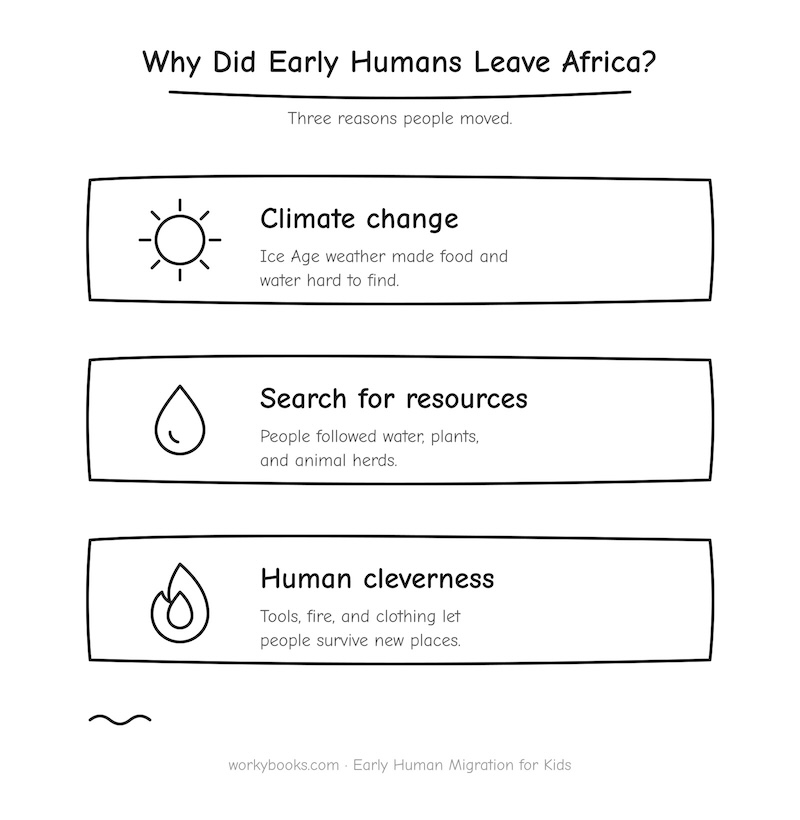
Climate change
During the Ice Ages, rainfall and temperature patterns shifted dramatically. Some regions grew hotter, colder, or drier, and food and water became scarce. As animal herds moved to find new grazing land, humans followed them.
The search for resources
Early humans were hunter-gatherers who depended directly on nature for freshwater, edible plants, game animals, and safe shelter. When those resources ran low in one place, families packed up and moved to another.
Human adaptability
Unlike most animals, humans could adapt quickly. They invented improved stone tools, learned to control fire, made clothing, built shelters, and created hunting weapons. These innovations — and the growing cognitive and symbolic thinking of early humans — let them survive in completely new environments.
Evidence of Early Human Migration
Scientists piece the story together from many kinds of clues.
Fossils
Human skeletons show where ancient populations once lived. Key fossil sites include Jebel Irhoud in Morocco, Omo Kibish in Ethiopia, and Qafzeh Cave in Israel.
Stone tools
Stone blades, hand axes, and spear points reveal how technology developed. These artifacts help map migration routes, hunting practices, and cultural change over time.
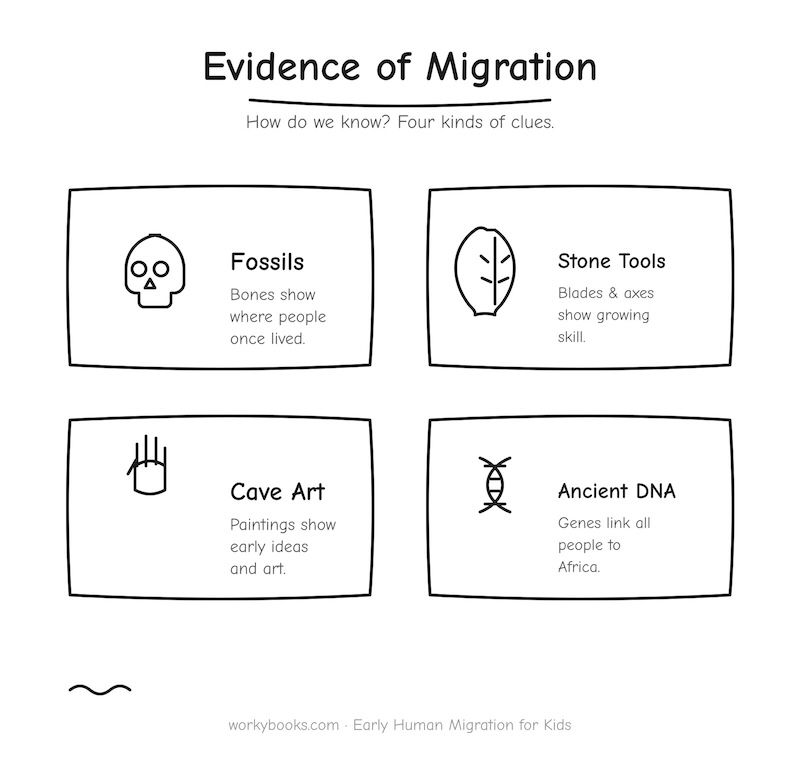
Cave art
Sites like Blombos Cave in South Africa and Chauvet Cave in France show that early humans were capable of symbolic thinking, artistic expression, and complex communication.
Ancient DNA
Modern genetic research confirms that people around the world share common African ancestry. DNA evidence has transformed how scientists understand early migrations and continues to sharpen the timeline.
Migration Into Europe and Asia
As humans entered Europe and Asia, they met environments very different from Africa — colder climates, glaciers, mountains, forests, and long winters. To survive, they made clothing from animal skins, built sturdier shelters, mastered fire, improved their hunting weapons, and cooperated in larger social groups.
You can dig deeper into how early humans settled Europe and Asia and the cultures they built there. Discoveries from sites such as Chauvet Cave and the Altai Mountains in Siberia provide strong evidence of technological innovation and artistic development during this period. For a broader look at the science, the Smithsonian’s Human Origins Program is an excellent authoritative resource.
How Humans Reached Australia
Reaching Australia was one of humanity’s greatest achievements. Unlike Europe or Asia, Australia was never connected to mainland Asia by a complete land bridge during the migration period. Instead, humans crossed stretches of open water from Southeast Asia, likely using simple boats or rafts.
Evidence from Madjedbebe in northern Australia — including ancient stone tools and charcoal — suggests humans arrived at least 65,000 years ago. These journeys required planning, navigation, cooperation, and real technological skill. Today, Aboriginal Australians represent one of the world’s oldest continuous cultures.

Early human Migration to the Americas
The Americas were among the last major regions settled by humans. During the last Ice Age, sea levels fell dramatically and exposed Beringia, a land bridge connecting Siberia and Alaska. Many researchers conclude that people entered the Americas through this region more than 15,000 years ago, and discoveries at Monte Verde in Chile show how rapidly humans spread afterward.
Recent research also explores coastal routes, with some groups possibly traveling along the Pacific shoreline by boat and living off marine resources. This complements the evidence for inland routes rather than replacing it.
How Human Adaptation Changed the World
Migration was more than travel — it was a constant process of adaptation. As humans entered new environments, they learned to make better tools, hunt different animals, build stronger shelters, cooperate in larger groups, develop languages, create art, and establish traditions. Over thousands of years, these innovations laid the foundations for agriculture, permanent settlements, and eventually civilizations.
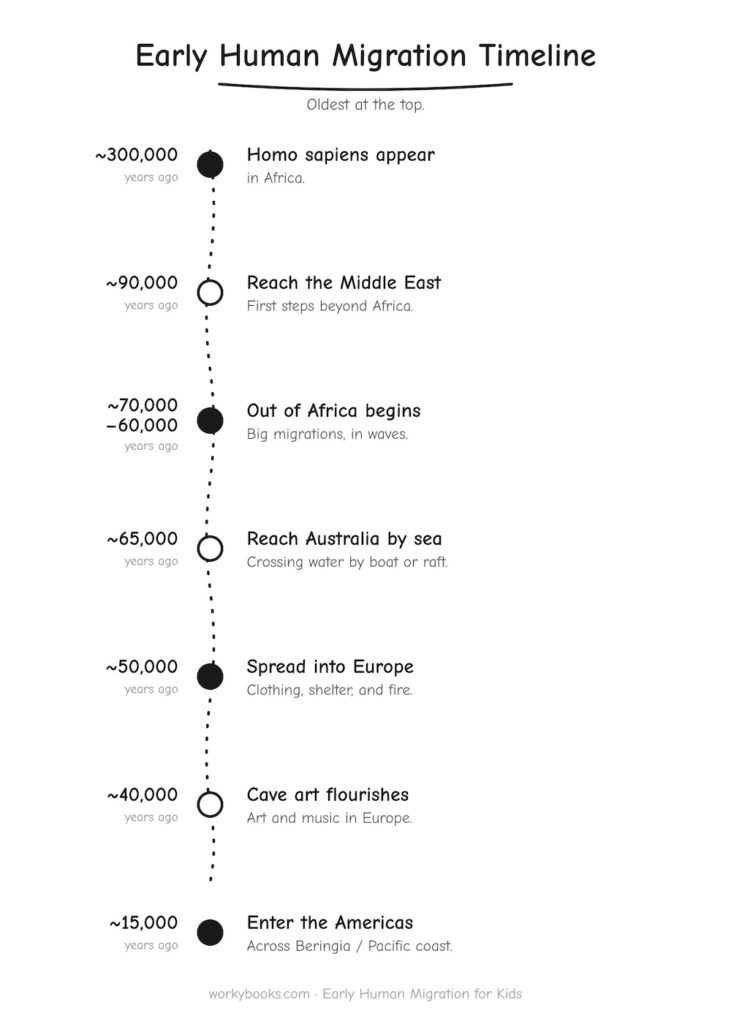
Timeline of Early Human Migration
| Approximate Date | Major Event |
|---|---|
| ~300,000 years ago | Early Homo sapiens appear in Africa |
| ~90,000 years ago | Evidence of humans in the Middle East |
| ~70,000–60,000 years ago | Major Out of Africa migrations begin |
| ~65,000 years ago | Humans reach Australia by sea |
| ~50,000 years ago | Humans spread widely into Europe |
| ~40,000 years ago | Cave art flourishes in Europe |
| ~15,000 years ago | Humans enter the Americas via Beringia and/or Pacific coastal routes |
Conclusion
The story of early human migration is one of the greatest journeys in history. Beginning in Africa, small groups of Homo sapiens gradually spread across continents, adapting to deserts, forests, mountains, coastlines, and icy landscapes. Along the way, they developed new technologies, created art, built communities, and laid the foundations for civilizations around the world.
Fossils, archaeological discoveries, genetic evidence, and ongoing research continue to deepen our understanding of these ancient migrations. By studying how early humans adapted to changing environments and explored new lands, we gain insight into the resilience and creativity that define humanity.
Frequently Asked Questions
Early human migration began in Africa. Modern humans, or Homo sapiens, first appeared there around 300,000 years ago before gradually spreading to Asia, Europe, Australia, and the Americas. You can read more about the origins of the first people.
The major “Out of Africa” migrations began roughly 60,000–70,000 years ago, though smaller groups left earlier. Humans moved in waves over tens of thousands of years, following food, water, and better climates rather than migrating all at once.
Early humans migrated mainly because of climate change and the search for resources. As rainfall patterns shifted during the Ice Ages, food and water became scarce, so groups followed animal herds into new lands, adapting with tools, fire, and clothing.
Humans reached Australia at least 65,000 years ago by crossing open water from Southeast Asia using simple boats or rafts. Since no complete land bridge connected the two, this journey required planning and navigation — making it one of history’s earliest sea crossings.
As humans moved north, they faced colder climates, glaciers, and long winters. They survived by making clothing, building shelters, and mastering fire. Learn more about early humans in Europe and Asia and the cultures they developed.
Most researchers believe people crossed Beringia — a land bridge between Siberia and Alaska — more than 15,000 years ago, possibly also traveling along the Pacific coast by boat. Sites like Monte Verde in Chile show how quickly they spread afterward.
Related Posts

Fun Facts About Jupiter

Weather Quiz: Introduction to Heat Domes