This learning resource is available in interactive and printable formats. The interactive worksheet can be played online and assigned to students. The Printable PDF version can be downloaded and printed for completion by hand.
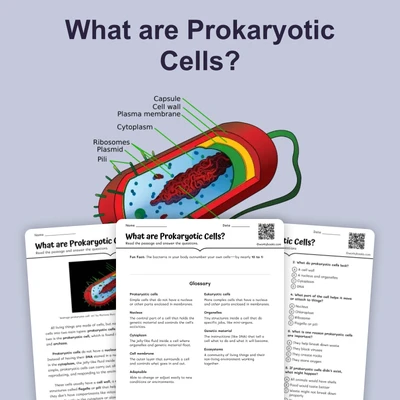
This engaging and audio-integrated reading passage, 'Bacteria: Prokaryotic Cell Structure,' introduces 6th-grade students to the fundamental differences in cell organization. Aligned with NGSS LS1.A: Structure and Function, it explains that prokaryotic cells, like bacteria, lack a nucleus and membrane-bound organelles. Students will learn about the key components of a bacterial cell, such as the cell wall, cell membrane, and cytoplasm, and how these structures enable bacteria to survive and thrive. The passage defines essential terms, providing a solid foundation for understanding basic biology and the diversity of life on Earth. Through simple language and clear explanations, students will grasp the unique structural organization of these fascinating microorganisms. This resource includes a reading passage, multiple-choice questions, glossary, and short answer questions.
CONTENT PREVIEW
Expand content preview
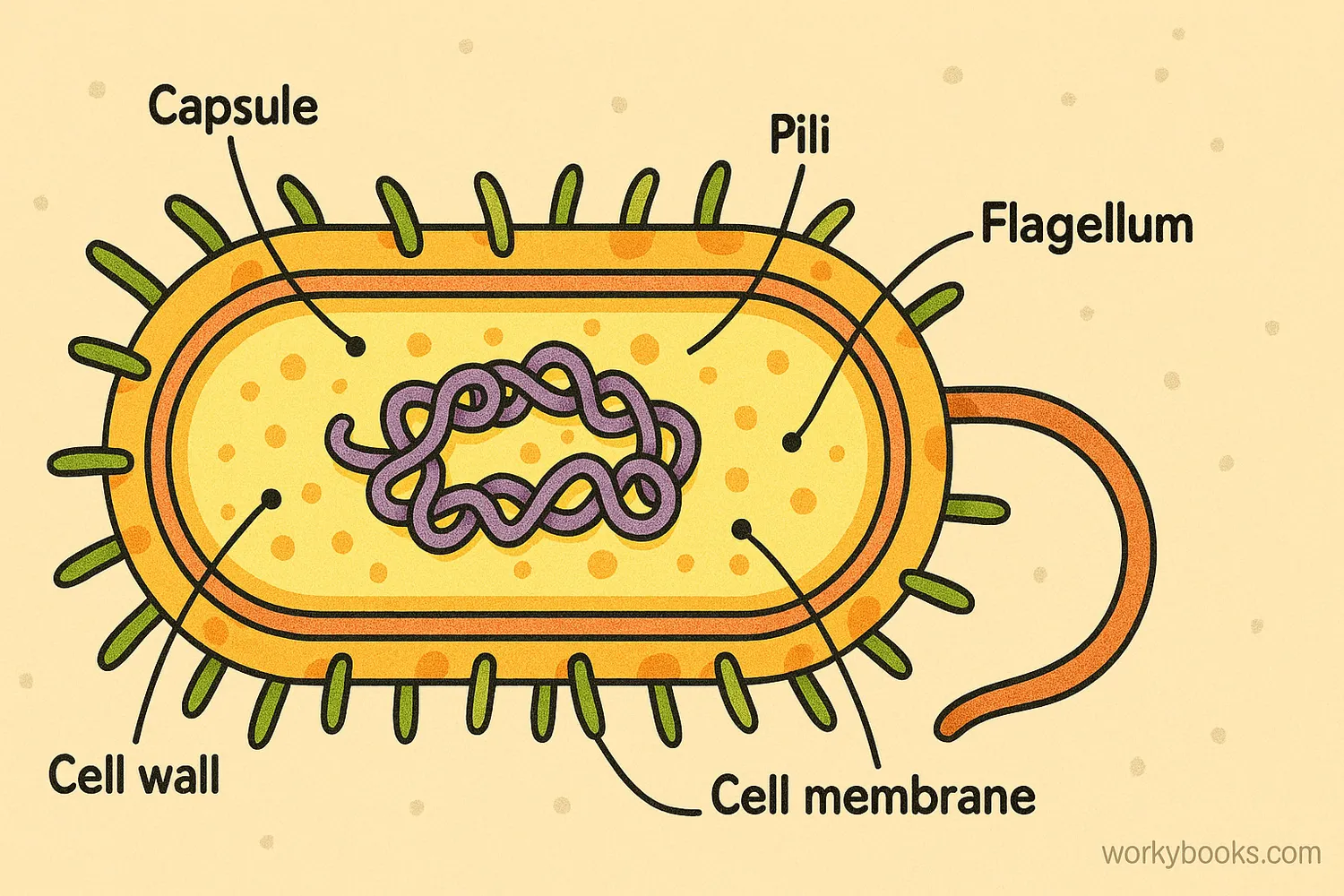
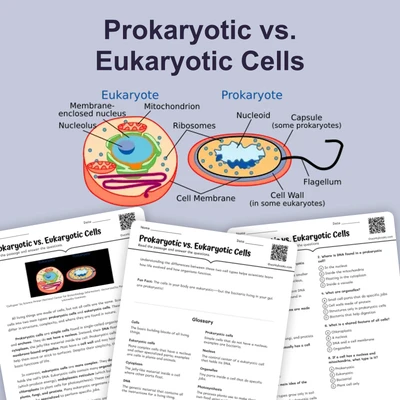
Labeled bacterial cell showing prokaryotic features like capsule, pili, and free-floating DNA.
Imagine life so small you can't see it with your eyes, yet it's everywhere! These tiny living things are called microorganisms, and one of the most common types is bacteria. Bacteria are unique because they have a special kind of cell structure, different from the cells that make up plants and animals. They are known as prokaryotic cells.
So, what makes a prokaryotic cell different? The biggest difference is that bacteria cells do not have a nucleus. In plant and animal cells, the nucleus is like the control center, holding all the cell's genetic material (DNA). But in bacteria, this genetic material floats freely within the cell's cytoplasm, a jelly-like substance that fills the cell. This means bacteria lack the organized internal compartments, or membrane-bound organelles, that are found in more complex cells. Think of it like a studio apartment versus a large house with many rooms – both are living spaces, but one is much simpler in its layout!
Even without a nucleus or complex organelles, bacteria have everything they need to survive. Each bacterial cell is enclosed by a cell membrane, which acts like a protective skin, controlling what goes in and out. Outside the cell membrane, most bacteria have a strong cell wall. This wall gives the bacterium its shape and provides extra protection, helping it withstand different environments. Some bacteria also have a slimy outer layer called a capsule, which can help them stick to surfaces or protect them from harmful substances. Many bacteria also have tiny hair-like structures called pili and a whip-like tail called a flagellum, which help them move around.
Bacteria are incredibly important for our world. They help break down waste, produce oxygen, and even live inside our bodies, helping us digest food. Understanding their simple yet effective prokaryotic cell structure helps us appreciate the diverse ways life can be organized on Earth. This unique structural organization allows bacteria to adapt and thrive in almost every environment imaginable, from hot springs to deep oceans.
Interesting Fact: There are more bacteria living in your mouth right now than there are people on Earth!
What is the primary difference between bacterial cells and plant/animal cells?
Bacteria have a nucleus.Bacteria lack a nucleus.Bacteria have more organelles.Bacteria are much larger.
Which structure gives bacteria shape and protection?
The nucleusThe flagellumThe cell wallThe cytoplasm
True or False: Bacteria have membrane-bound organelles.
TrueFalse
What is the function of the cell membrane?
Holds genetic material.Controls what enters/exits.Helps cell move.Provides rigid shape.
How is genetic material stored in bacteria?
Inside a nucleus.Freely in cytoplasm.Within a capsule.Attached to pili.
If a bacterium loses its cell wall, what might happen?
It becomes faster.It loses its shape.It grows a nucleus.It creates organelles.
Which part helps some bacteria move around?
CapsuleCell wallFlagellumCytoplasm
How do bacteria contribute to our world?
Produce oxygen.Only cause disease.Build complex structures.Are plant-like cells.
What does 'prokaryotic' mean in the context of cells?
Having a true nucleus.Lacking a true nucleus.Having many organelles.Being very large.
A scientist observes a new microorganism without a nucleus. Based on this, how would you classify its cell type?
EukaryoticProkaryoticPlant cellAnimal cell
Perfect For:
👩🏫 Teachers
• Reading comprehension practice
• Auto-graded assessments
• Literacy skill development
👨👩👧👦 Parents
• Reading practice at home
• Comprehension improvement
• Educational reading time
🏠 Homeschoolers
• Reading curriculum support
• Independent reading practice
• Progress monitoring
Reading Features:
📖
Reading Passage
Engaging fiction or nonfiction text
❓
Comprehension Quiz
Auto-graded questions
📊
Instant Feedback
Immediate results and scoring
📄
Printable Version
Download for offline reading
🔊
Read Aloud
Voice-over with word highlighting
Reviews & Ratings
No reviews yet. Be the first to share your experience!
Related Content
The Nature of Life Science
This passage, aligned with NGSS MS-LS1-1, introduces students in grades 6-8 to the foundational concepts of life science...
MS-LS1-1
Aerobic Organisms
This engaging, audio-integrated reading passage, titled 'Aerobic Organisms: The Breath of Life,' introduces students to ...
From Cells to Organisms
This educational passage, "From Cells to Organisms," explores the fundamental concept of how living things are built, st...
Using Dichotomous Keys to Identify Organisms
This audio-integrated passage, 'Using Dichotomous Keys to Identify Organisms,' introduces 6th-grade students to a fundam...
Science Vocabulary
This worksheet on domain-specific words will help students learn some science vocabulary. Students will be asked to matc...
L.3.6L.3.4.A
The Aorta: Molecules to Organisms of the Body's Largest Artery
This educational content features a fascinating reading passage, audio integrated for an enhanced learning experience, a...
Tools and Technology for Life Scientists
This informational passage for grades 6-8 explores the essential tools and technology used by life scientists, aligned t...
MS-LS1-1MS-LS1.A
Simple Machines Science Report
This science writing task requires students to clearly explain how three simple machines work using precise domain-speci...
W.5.4
Cryptobiosis: Pausing Life to Survive
This engaging, audio-integrated reading passage explores the amazing biological process of cryptobiosis, where organisms...
From Senses to Actions
This Grade 4-5 science passage, 'From Senses to Actions,' explores how our senses work together with the brain and body ...
The Science of Hibernation
This educational module, featuring an audio-integrated reading passage titled 'The Science of Hibernation,' is designed ...
The Life Cycle of a Giant Panda
This engaging, audio-integrated reading passage, titled "The Life Cycle of a Giant Panda," explores the fascinating stag...
How Bats Use Sound to See
This Grade 4-5 science passage, 'How Bats Use Sound to See,' explores the fascinating process of echolocation in bats. S...
Citizen Science and Ecological Monitoring
This engaging passage for grades 6-8 introduces the concept of citizen science and its critical role in ecological monit...
MS-LS2-1
Life Cycle Stages
This comprehensive word sort activity helps Grade 3 students understand the universal stages of life cycles as outlined ...
The Pumpkin Life Cycle
This informational worksheet explores the pumpkin lifecycle, guiding students through procedural steps in a scientific t...
RI.2.3RI.2.10
What Is Earth Science?
This engaging middle school science passage introduces students to the field of Earth science, aligning with NGSS standa...
MS-ESS1MS-ESS2MS-ESS3SEP
Barnacles and Biofouling
This engaging, audio-integrated reading passage, 'Barnacles and Biofouling,' delves into the fascinating world of how ti...
Growth and Development of Organisms
This middle school science passage, aligned with NGSS standards MS-LS1-4 and MS-LS1-5, provides an in-depth look at the ...
MS-LS1-4MS-LS1-5
Life Makers
This engaging word sort activity helps elementary students understand the diverse methods of reproduction in living orga...