How can planting trees help fight climate change? — Reading Comprehension
Rate this
Premium Resource
Present
Present in classroom. No work saved
Assign
Classroom with student accounts, Track progress
Quick Play
No student accounts, assign with a link
Grades
2
3
4
Standards
RI.3.1
RI.4.1
4.ESS2.D
4-ESS3
PRINT+DIGITAL RESOURCE
This learning resource is available in interactive and printable formats. The interactive worksheet can be played online and assigned to students. The Printable PDF version can be downloaded and printed for completion by hand.
This passage explains to children how planting trees can help combat climate change. It describes trees as 'nature's air cleaners,' absorbing carbon dioxide and producing oxygen. The text provides a tangible fact - that one tree can absorb up to 48 pounds of carbon dioxide annually. It also explains additional benefits of trees, such as providing shade and cooling urban areas. By mentioning how forests can influence rainfall patterns, the passage helps children understand the broader environmental impacts of trees beyond just carbon absorption.
CONTENT PREVIEW
Expand content preview
How Trees Help the Planet
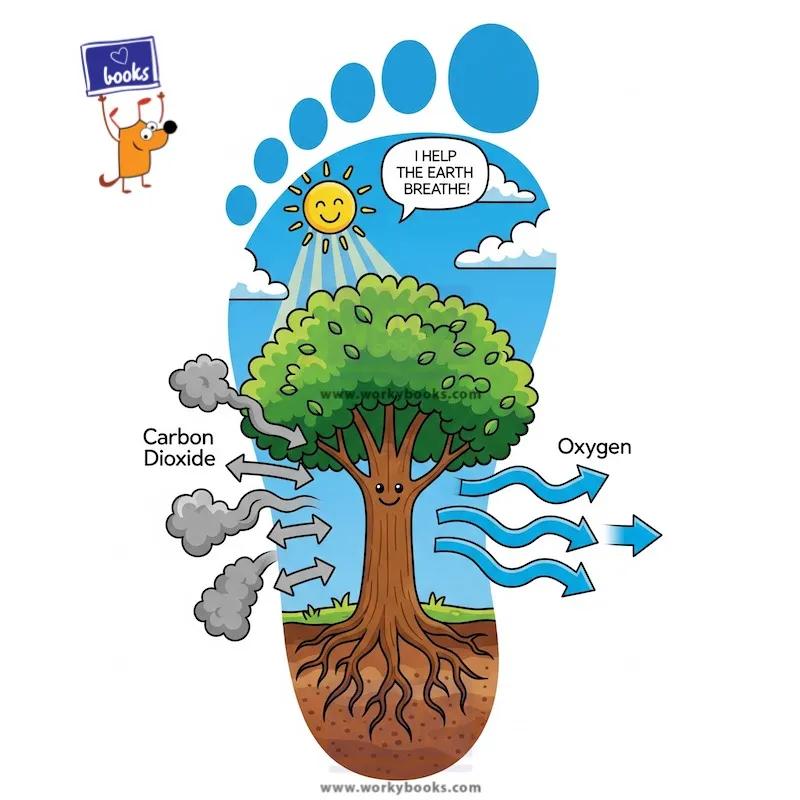
Planting trees is one of nature’s best ways to fight climate change. Trees are like millions of tiny workers that clean the air all day, every day. They do this through a process called photosynthesis. During photosynthesis, trees take in carbon dioxide (CO₂) from the air. This gas is a main cause of climate change. Trees store the carbon in their wood, roots, and leaves.
Carbon Sinks and Climate Change
Forests act as giant carbon sinks. A carbon sink is a place that stores carbon, keeping it out of the atmosphere. One mature tree can absorb about 48 pounds of CO₂ every year! Some forests keep storing carbon for hundreds of years. This helps slow down global warming, because less CO₂ stays in the air.
More Ways Trees Help
Trees are amazing for other reasons too. They release oxygen—the gas we need to breathe. Trees also cool the air by giving shade and letting off water vapor. Their roots absorb rainwater, which helps stop flooding. The leaves trap dust and pollution, making the air cleaner. Forests give homes to many animals and keep soil from washing away.
Where Planting Helps Most
Planting trees is important in many places. Reforestation means planting trees where forests were cut down. Planting trees in cities cools streets and buildings. On farms, trees protect crops and soil. Planting trees on damaged land helps nature recover.
Tree-Planting Efforts and What Kids Can Do
People around the world plant billions of trees. Countries, schools, and communities all help. Kids can plant trees, join tree-planting events, care for trees, and teach others why forests matter. Planting trees helps, but it’s not enough by itself. We also need to reduce pollution and use less fossil fuels.
Interesting Fact: Planting trees is like hiring millions of tiny workers who work 24/7 for free, cleaning pollution from the air and storing it safely in their trunks and branches!
What is photosynthesis?
How plants make food from sunlightHow trees grow rootsHow animals breatheHow rain falls
What do trees store in their wood?
CarbonWaterSunlightSoil
What gas do we need to breathe?
OxygenCarbonNitrogenHelium
Why are forests called carbon sinks?
They store carbon from the airThey let in sunlightThey make rainThey lose leaves
How do trees help prevent flooding?
Their roots absorb rainwaterThey make cloudsThey stop sunlightThey drop leaves
What is reforestation?
Planting trees in cut forestsCutting down treesMaking paperBuilding houses
Trees help fight climate change. True or false?
TrueFalse
What is a habitat?
A home for plants or animalsA type of treeA form of pollutionA kind of soil
Perfect For:
👩🏫 Teachers
• Reading comprehension practice
• Auto-graded assessments
• Literacy skill development
👨👩👧👦 Parents
• Reading practice at home
• Comprehension improvement
• Educational reading time
🏠 Homeschoolers
• Reading curriculum support
• Independent reading practice
• Progress monitoring
Reading Features:
📖
Reading Passage
Engaging fiction or nonfiction text
❓
Comprehension Quiz
Auto-graded questions
📊
Instant Feedback
Immediate results and scoring
📄
Printable Version
Download for offline reading
🔊
Read Aloud
Voice-over with word highlighting
Reviews & Ratings
No reviews yet. Be the first to share your experience!
Related Content
Natural Disasters and Urban flooding
This reading comprehension worksheet focuses on the topic of natural disasters, specifically urban flooding. Following t...
RI.4.44-ESS3ESS3.B4-ESS3-1
How might climate change affect animals?
This passage explains to children how climate change impacts animal life. It uses specific examples like polar bears los...
RI.3.1RI.4.14.ESS2.D4-ESS3
How might climate change affect our food supply?
This passage educates children about the potential impacts of climate change on food production. It explains how changin...
RI.3.1RI.4.14.ESS2.D4-ESS3
Reduce Your Carbon Footprint: Simple Tips for Home
This passage focuses on reducing carbon footprints at home by conserving electricity. It suggests practical actions like...
RI.3.1RI.4.14.ESS2.D4-ESS3
How using less plastic helps the environment?
This passage explains to children how reducing plastic use helps the environment. It outlines the life cycle of plastic,...
RI.3.1RI.4.14.ESS2.D4-ESS3
What is recycling, and why is it important?
This passage introduces the concept of recycling to children. It explains recycling as the process of turning used mater...
RI.3.1RI.4.14.ESS2.D4-ESS3
How Kids Can Help Fight Climate Change?
This passage introduces the concept of 'reduce, reuse, recycle' as a way for children to help fight climate change. It e...
RI.3.1RI.4.14.ESS2.D4-ESS3
How is Climate Different from Weather?
This passage distinguishes climate from weather for young readers. It defines climate as the usual weather patterns over...
RI.3.1RI.4.14.ESS2.D
Can you name three greenhouse gases?
This passage introduces children to three common greenhouse gases: carbon dioxide (CO2), methane, and water vapor. It ex...
RI.3.1RI.4.14.ESS2.D
What can happen to sea levels because of climate change?
This passage explains to children how climate change leads to rising sea levels. It describes two main causes: melting i...
RI.3.1RI.4.14.ESS2.D
Informational Text on Holi
This informational text on Holi is a great way to teach about this holiday and the story of Prahlad. Comprehension quest...
RI.3.10RF.3.4RF.3.4.ARI.3.1
Informational Text —Meet the Governors
This worksheet will get your students thinking about their state governnor. Included is an informational text on the res...
RI.3.10RF.3.4RF.3.4.ARI.3.1
Informational Text on Goods and Services
This short informational text on goods and services will get your students familliar with this concept. Students will re...
RI.3.10RF.3.4RF.3.4.ARI.3.1
Sharks—Informational Text
This informational text on the sharks will teach your students all about these incredible, ancient animals! Free respons...
RI.3.1RI.3.10RF.3.4RI.3.1
Spider—Main Idea
This informational text on spiders is a great introduction to teaching main idea. Students will be asked, in multiple ch...
RI.3.2RF.3.4RI.3.1RI.2.6
Koi Fish—What’s the Main Idea?
This informational text on koi fish is a great introduction to teaching main idea. Students will be asked, in multiple c...
RI.3.2RF.3.4RI.3.1
Informational Text — Cloud Gazing
This informational text teaches students how different types of clouds are formed. A page with pictures of the different...
RI.3.10RF.3.4RF.3.4.ARI.3.1
Informational Text —Bioluminescence
This informational text on bioluminescence will teach your students about this phenomenon. Examples in nature are provid...
RI.3.10RF.3.4RF.3.4.ARI.3.1
Informational Text —Learn About Dinosaurs
This informational text on dinosaurs with comprehension questions to follow is perfect for teaching main idea. Students ...