Cesar Chavez and Dolores Huerta: Yes, We Can!
Interactive passage with audio narration, comprehension questions, and printable PDF.
By completing this purchase you agree to our Terms of Use and Privacy Policy. Your subscription renews automatically until you cancel. You can cancel anytime from your account settings. All sales are final and non-refundable. Digital content is available for download in your account immediately upon purchase.
What's included
Part of this bundle

Cesar Chavez and Dolores Huerta: Yes, We Can! preview and details
About this printable Cesar Chavez and Dolores Huerta: Yes, We Can! reading passage (Grades 3-5)
Sample passage and quiz from Cesar Chavez and Dolores Huerta: Yes, We Can!
Reading passage and comprehension quiz preview
Cesar Chavez and Dolores Huerta
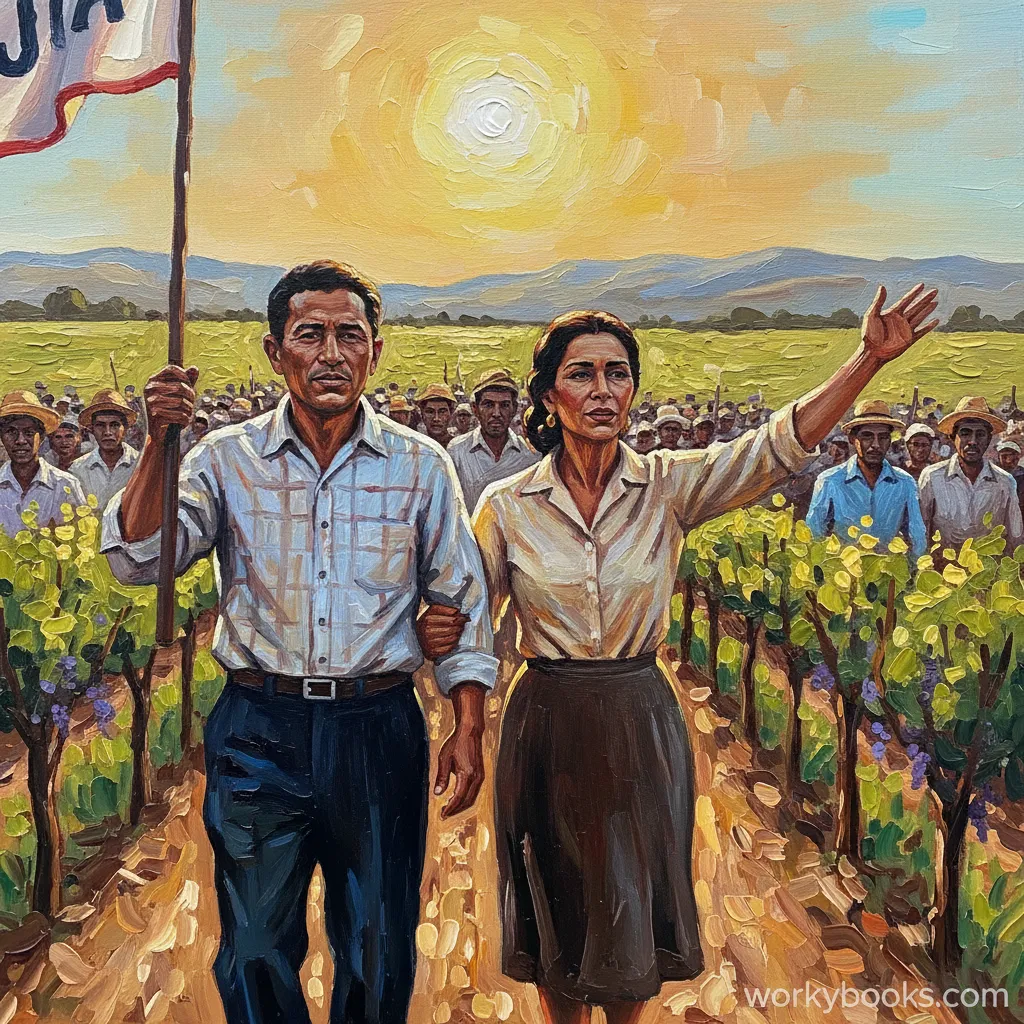
Cesar Chavez and Dolores Huerta were leaders who helped farmworkers in the United States. Many farmworkers picked fruits and vegetables in fields all day. They worked very hard, but did not earn much money. Their working conditions were often unsafe. Chavez and Huerta wanted to change this and help workers have better lives.
In 1962, Chavez and Huerta founded the United Farm Workers (UFW) union. A union is a group of workers that joins together to improve their jobs. They asked farmworkers to join them and speak up for fair treatment. Chavez and Huerta believed in nonviolent protest. This means they did not use violence. Instead, they marched, held rallies, and spoke to the public about the problems farmworkers faced.
One important tool they used was a boycott. A boycott means refusing to buy something as a protest. The UFW asked people across the country to stop buying grapes until farm owners agreed to fair contracts. Many people joined the boycott. It lasted for several years and got a lot of attention. Finally, some farm owners agreed to pay workers more and provide safer conditions.
During these protests, Chavez and Huerta used the phrase "Sí se puede". This is Spanish for “Yes, it can be done.” It became a powerful rallying cry for workers who wanted change. The words inspired people to keep going, even when things were hard. Chavez and Huerta worked together to teach others about hope and unity. Their actions showed that people working together peacefully could make big changes.
The United Farm Workers union helped win important rights, such as better pay and safer working conditions. Because of Chavez, Huerta, and the UFW, farmworkers today have more respect and better lives. Their movement also inspired other groups to fight for their rights using peaceful methods.
Interesting Fact: Dolores Huerta is still active today, teaching people about equality and justice. The words "Sí se puede" are now used by many people fighting for fairness.
Comprehension quiz (8 questions)
1. Who started the United Farm Workers?
2. What year was the UFW founded?
3. What crop did people boycott?
4. Why did Chavez and Huerta use nonviolent protest?
5. What happened after the boycott?
6. Why do people say "Sí se puede"?
7. The UFW helped farmworkers get better lives.
8. What is a boycott?
Common Core standards for Cesar Chavez and Dolores Huerta: Yes, We Can!
Explain events, procedures, ideas, or concepts in a historical, scientific, or technical text, including what happened and why, based on specific information in the text.
Determine the meaning of general academic and domain-specific words or phrases in a text relevant to a grade 4 topic or subject area.
Integrate information from two texts on the same topic in order to write or speak about the subject knowledgeably.
Write informative/explanatory texts to examine a topic and convey ideas and information clearly.
Perfect for the way you teach
- Build comprehension skills
- Auto-graded quiz
- Differentiated reading
- Read together at home
- Improve fluency
- Quiet reading time
- Reading curriculum support
- Independent practice
- Track Lexile growth