This learning resource is available in interactive and printable formats. The interactive worksheet can be played online and assigned to students. The Printable PDF version can be downloaded and printed for completion by hand.
Discover the power of simple machines! This informational text explores how basic tools like levers, pulleys and inclined planes have changed the way humans work. Questions test comprehension of key details and main ideas.
CONTENT PREVIEW
Expand content preview
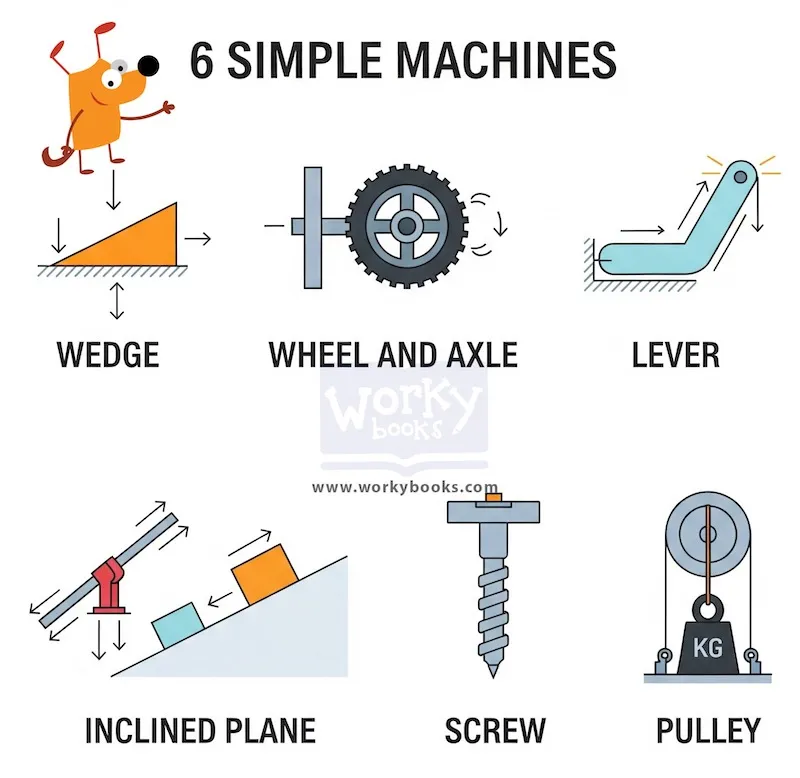
A machine is a tool that makes work easier. Simple machines change the direction or amount of force needed to do work. Six types of simple machines are the wedge, wheel and axle, lever, inclined plane, screw and pulley. Wedges concentrate force on a small point to split or lift objects. Wheels with attached axles reduce friction to roll heavy loads more easily. Levers use a fixed point called a fulcrum to change direction and speed up movement. Inclined planes require less effort to slowly raise objects to different heights. Screws are inclined planes wrapped around structures to hold objects together or lift materials up. Pulleys use ropes and wheels to reduce the amount of force needed by distributing weight. Understanding these simple machines helps explain how many complex modern tools and vehicles work.
What is the main idea of the passage?
Simple machines make work easierWheels reduce frictionWedges concentrate forcePulleys distribute weight
What does a simple machine change about force?
SoundTextureSmellDirection or amount
Which simple machine uses a fixed fulcrum point?
LeverWedgeInclined planePulley
Why are wheels and axles considered simple machines?
They have complex partsThey require few toolsThey reduce frictionThey use pulleys
Perfect For:
👩🏫 Teachers
• Reading comprehension practice
• Auto-graded assessments
• Literacy skill development
👨👩👧👦 Parents
• Reading practice at home
• Comprehension improvement
• Educational reading time
🏠 Homeschoolers
• Reading curriculum support
• Independent reading practice
• Progress monitoring
Reading Features:
📖
Reading Passage
Engaging fiction or nonfiction text
❓
Comprehension Quiz
Auto-graded questions
📊
Instant Feedback
Immediate results and scoring
📄
Printable Version
Download for offline reading
🔊
Read Aloud
Voice-over with word highlighting
Reviews & Ratings
No reviews yet. Be the first to share your experience!
Related Content
Identify Main Idea Graphic Organizer
This graphic organizer on main idea includes space to write the main idea and three supporting details.
RI.1.2RI.2.2RI.3.2RI.4.2
Main Idea and Suporting Details Graphic Organizer
This graphic organizer on main idea includes space to write the main idea and three supporting details.
RI.1.2RI.2.2RI.3.2RI.4.2
Main Idea and Details Graphic Organizer
This graphic organizer on main idea includes space to write the main idea and three supporting details.
RI.1.2RI.2.2RI.3.2RI.4.2
Snorkeling & Scuba Diving
RI.2.2RI.2.6RI.2.10RF.2.4.A
The Rubik's Cube
RI.2.2RI.2.6RI.2.10RF.2.4.A
The Space Needle
Students read a passage about the history and features of Seattle's Space Needle, then answer comprehension questions to...
RI.4.2
Graphic Organizer for Main Idea
This graphic organizer on main idea includes space to write the main idea and three supporting details.
RI.1.2RI.2.2RI.3.2RI.4.2
The Role of Pollinators in Nature
Learn about the fascinating world of pollinators and discover their crucial role in the reproductive process of flowerin...
RI.4.2RI.4.3RI.4.4RI.5.1
Pollination: A Crucial Ecosystem Service
Explore the vital role of pollination beyond plant reproduction, as it sustains ecosystems by ensuring food security, pr...
RI.4.2RI.4.3RI.4.4RI.5.1
Seed Dispersal: How Plants Travel
Plants may seem stationary, but their seeds have amazing ways to travel! Explore the fascinating world of seed dispersal...
RI.4.2RI.4.3RI.4.4RI.5.1
The States of Matter: Solid
Discover the differences between solids, liquids and gases by exploring how their particles are arranged and move. This ...
RI.4.2RI.4.3RI.4.4RI.5.1
How Do Scientists Study Past Climates?
Students will analyze how tools like ice cores and tree rings provide scientific evidence about Earth’s historical clima...
RI.4.1RI.4.2RI.4.3.4.RI.4.74-ESS2-2
Earth Day and Types of Pollution
Earth Day is coming! Get ready to learn about pollution and test your knowledge. Click for a free reading passage and qu...
RI.4.1RI.4.2ESS3.CESS3.A
Earth Day and Green Initiatives
Celebrate Earth Day with this fun and educational activity! Students will begin by reading a short passage that explains...
RI.4.1RI.4.2ESS3.CESS3.A
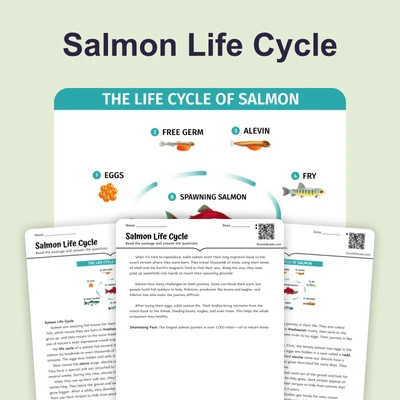
The Life Cycle of a Salmon
Salmon have a remarkable life cycle that takes them from rivers to the ocean and back again. They hatch as alevin, grow ...
RI.3.1RI.4.4RI.4.2
Journey of a Sea Turtle
Sea turtles lay their eggs on beaches, and their hatchlings begin a dangerous journey to the ocean. After growing in the...
RI.3.1RI.4.4RI.4.2
Heroes for Freedom: Harriet Tubman
Harriet Tubman, born into slavery, became a hero who risked her life to lead others to freedom through the Underground R...
RI.3.1RI.4.4RI.4.2RI.5.2
Heroes for Freedom: Fannie Lou Hamer
Fannie Lou Hamer overcame racial segregation and poverty to become a powerful voice for civil rights. Her fight for voti...
RI.3.1RI.4.4RI.4.2RI.5.2
Sports: Lionel Messi
Lionel Messi, known for his unparalleled dribbling and passing, has broken records, won multiple FIFA Ballon d'Or awards...