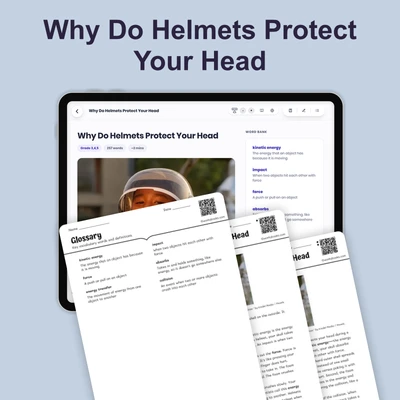
This learning resource is available in interactive and printable formats. The interactive worksheet can be played online and assigned to students. The Printable PDF version can be downloaded and printed for completion by hand.
This engaging 350-word science passage helps Grade 4-5 students understand how collisions produce heat through energy transfer, aligned with NGSS standard 4-PS3-3. Students explore the concept of friction as many tiny collisions that transfer energy and create warmth. The passage uses relatable examples like rubbing hands together and car brakes getting hot to illustrate collision heat and heat production. Through clear explanations and concrete analogies, learners discover how energy moves from one object to another during collisions, making objects and surrounding air warmer. The audio-integrated content includes a simplified differentiated version for struggling readers, Spanish translations, vocabulary glossary, comprehension questions testing scientific understanding, and writing activities that encourage students to explain energy transfer concepts and make real-world connections. Interactive graphic organizers help students analyze cause-and-effect relationships in collision heat and compare different examples of friction and warming in everyday life.
CONTENT PREVIEW
Expand content preview
When two objects bump into each other, something interesting happens—they create heat. A collision is when two things hit or rub against each other, and during these collisions, energy moves from one object to another. This movement of energy is called energy transfer, and it often produces heat that we can feel. Understanding how collisions make heat helps explain many things we experience every day.
When you rub your hands together quickly, they start to feel warm. This happens because rubbing creates thousands of tiny collisions between the surfaces of your hands. Each time the bumps on one hand hit the bumps on your other hand, a little bit of energy transfers. All these tiny collisions add up, and the energy changes into thermal energy, which is the scientific name for heat energy. The faster you rub, the more collisions happen, and the warmer your hands become.
This same process happens in many other places. When a car needs to stop, the driver pushes the brake pedal. This makes brake pads press hard against the wheels. The friction between the brake pads and wheels creates many collisions. Friction is the force that happens when two surfaces rub together. These collisions transfer energy, which turns into heat. That's why car brakes can get very hot after stopping a car, especially if the car was moving fast.
The amount of heat created depends on how hard objects collide and how long they rub together. A gentle collision makes less heat than a strong one. Think about sliding down a playground slide—if you go slowly, your clothes barely warm up. But if you slide down fast, the friction between you and the slide creates more collisions, making both you and the slide warmer.
Scientists measure heat in units called degrees, but they also think about heat as energy moving from one place to another. When collisions happen, the kinetic energy (energy of motion) that objects have gets changed into thermal energy. This is why moving objects that suddenly stop or rub against something often feel warm afterward.
Heat from collisions is an important concept in science because it shows how energy can change from one form to another. Whether you're warming your hands on a cold day or understanding why brakes need time to cool down, you're seeing energy transfer through collisions at work. This process happens all around us, making it a key part of how energy moves through our world.
What is a collision?
When two things hit or rub togetherWhen water turns into iceWhen light shines on objectsWhen air moves quickly
What is thermal energy?
Energy from the sunThe scientific name for heat energyEnergy stored in batteriesEnergy from food
Why do car brakes get hot?
The engine heats them upSunlight makes them warmFriction creates collisions that make heatThey are made of hot metal
What happens during energy transfer?
Objects get colderEnergy moves from one object to anotherObjects become lighterEnergy disappears completely
How do hands get warm when rubbed?
Air between hands heats upBlood flows faster to handsTiny collisions transfer energy as heatMuscles create all the heat
What affects how much heat collisions create?
The color of the objectsHow hard objects collide and rubThe weather outsideThe size of the room
Kinetic energy is energy of motion.
TrueFalse
What does friction mean in the passage?
Force when surfaces rub togetherEnergy from the sunSpeed of moving objectsTemperature of an object
Perfect For:
👩🏫 Teachers
• Reading comprehension practice
• Auto-graded assessments
• Literacy skill development
👨👩👧👦 Parents
• Reading practice at home
• Comprehension improvement
• Educational reading time
🏠 Homeschoolers
• Reading curriculum support
• Independent reading practice
• Progress monitoring
Reading Features:
📖
Reading Passage
Engaging fiction or nonfiction text
❓
Comprehension Quiz
Auto-graded questions
📊
Instant Feedback
Immediate results and scoring
📄
Printable Version
Download for offline reading
🔊
Read Aloud
Voice-over with word highlighting
Reviews & Ratings
No reviews yet. Be the first to share your experience!
Related Content
Motion After Collisions
This engaging 250-word science passage helps Grade 4-5 students understand Motion After Collisions, aligned with NGSS st...
NGSS 4-PS3-3
Sound from Collisions
This engaging 250-word science passage helps Grade 4-5 students understand how collisions produce sound through energy t...
NGSS 4-PS3-3
Predicting Collisions
This engaging 250-word science passage helps Grade 4-5 students understand how scientists predict collision outcomes by ...
NGSS 4-PS3-3
What Is a Collision
This engaging science passage introduces Grade 4-5 students to the concept of collisions and energy transfer, aligned wi...
NGSS 4-PS3-3
Modeling Collisions
This engaging 250-word science passage teaches Grade 4-5 students about modeling collisions and how scientists use model...