This learning resource is available in interactive and printable formats. The interactive worksheet can be played online and assigned to students. The Printable PDF version can be downloaded and printed for completion by hand.
This engaging 250-word science passage teaches Grade 4-5 students about modeling collisions and how scientists use models to understand energy transfer. Aligned with NGSS standard 4-PS3-3, the passage explains how collision models help us predict what happens when objects crash into each other. Students explore concrete examples using toy cars and marbles to model real-world collisions that happen too fast to observe directly. The passage includes audio integration for enhanced accessibility and engagement. Through clear explanations and relatable examples, students learn key vocabulary including collision, model, energy transfer, and predict. The content connects classroom experiments to real-world applications like understanding car crashes and designing safer vehicles. Accompanying activities include multiple-choice comprehension questions, writing prompts requiring application of concepts, and graphic organizers that help students analyze cause-and-effect relationships in collisions. This comprehensive resource supports hands-on science learning and develops critical thinking skills as students discover how models bridge the gap between simple experiments and complex real-world phenomena.
CONTENT PREVIEW
Expand content preview
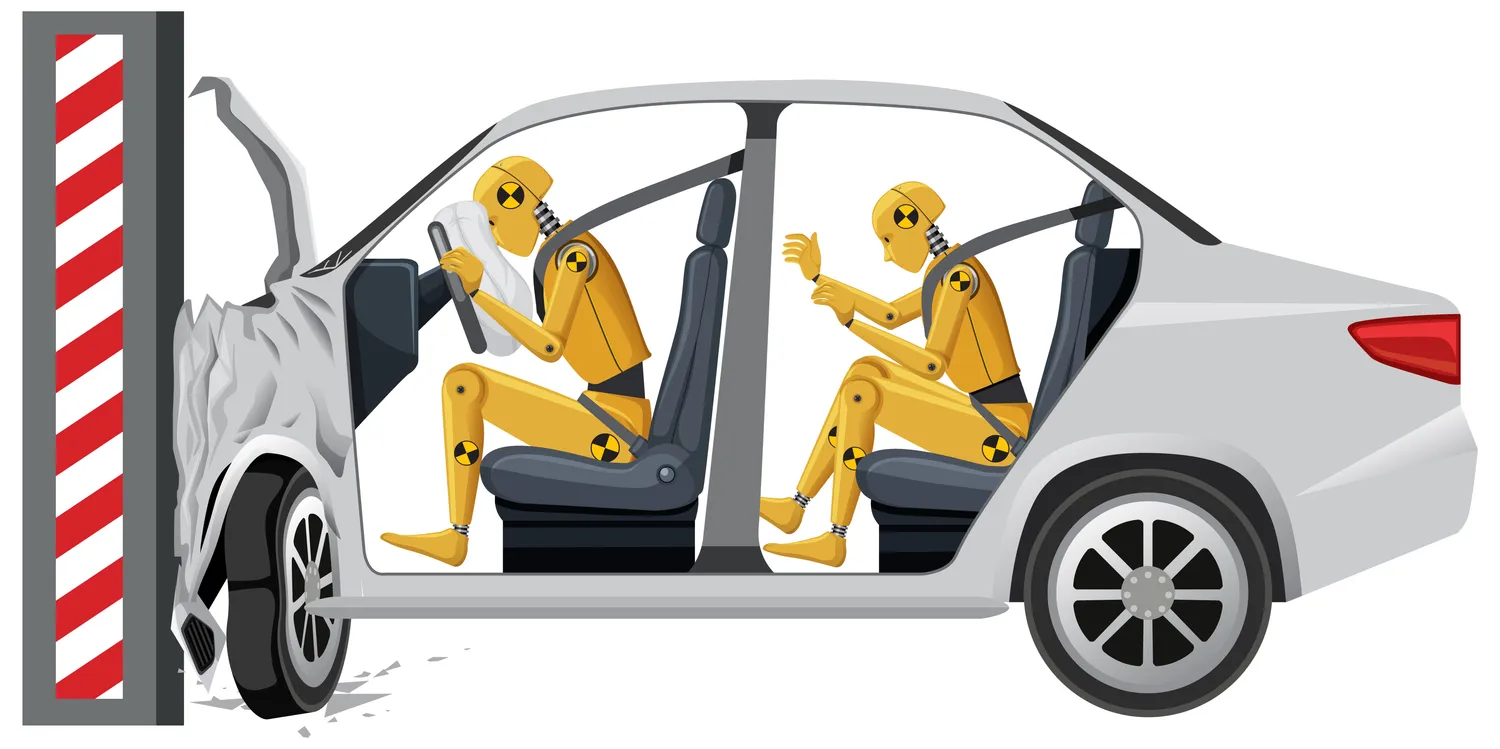
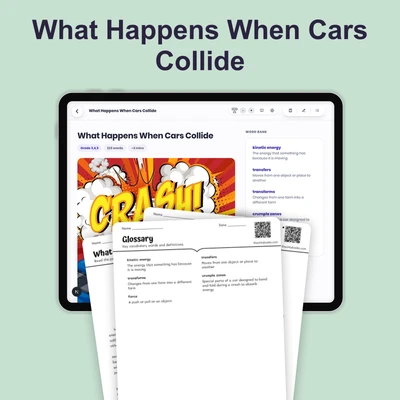
Collision models to understand dangerous situations like car crashes. Image Credit Freepik.
A collision happens when two objects bump into each other and their motion changes. Scientists use models, which are smaller or simpler versions of real things, to study collisions because many crashes happen too quickly for our eyes to see all the details. Models help scientists understand how energy moves from one object to another during a crash.
When scientists want to learn about collisions, they often use toy cars or marbles instead of real vehicles. These small objects are easier and safer to work with in a classroom or laboratory. By rolling toy cars into each other at different speeds, scientists can observe what happens during the crash. They watch how the cars bounce back, stop, or keep moving after they collide. This information helps them predict, or make good guesses about, what will happen in similar real-world situations.
During a collision, energy transfer occurs, which means energy moves from one object to another. When a moving toy car hits a stopped car, some of the moving car's energy transfers to the stopped car. This causes the stopped car to start moving. The faster the first car moves, the more energy it has to transfer, and the faster the second car will move after being hit.
Scientists use collision models to understand dangerous situations like car crashes. By studying how toy cars crumble, bounce, or stop during collisions, engineers can design safer real cars. They add features like crumple zones and airbags based on what they learn from models. These safety features help absorb energy during a crash so people inside the car don't get hurt as badly.
Models also help scientists test their ideas without putting people at risk. Instead of crashing real cars with people inside, they can crash toy cars or use computer programs that act like models. They can change one thing at a time, like speed or the weight of the cars, to see how it affects the collision. This controlled testing helps them understand the rules that govern all collisions.
Modeling collisions is an important scientific tool that helps us understand energy transfer and motion changes during crashes. By using simple objects like toy cars and marbles, scientists can observe, measure, and predict what happens in real collisions. These models make invisible energy transfers visible and help keep people safer in vehicles every day.
What is a collision?
When two objects bump into each otherWhen an object moves very fastWhen energy disappears completelyWhen objects stay perfectly still
Why do scientists use toy cars?
They are more expensive than real carsThey are easier and safer to studyThey don't follow physics rulesThey move faster than real cars
What happens during energy transfer in collisions?
Energy completely disappears from both objectsEnergy stays only in the first objectEnergy moves from one object to anotherEnergy creates new objects during the crash
What would happen if a fast toy car hits a stopped car?
The stopped car would remain completely stillBoth cars would disappear instantlyThe stopped car would start movingThe moving car would speed up more
How do collision models help design safer cars?
They show how to make cars go fasterThey help engineers add safety features like airbagsThey prove cars don't need safety featuresThey make cars more expensive to build
Why can scientists change speed in collision models?
To make the experiments more fun onlyTo see how one change affects collisionsTo prove models don't work wellTo make toy cars go backward
Models make invisible energy transfers visible.
TrueFalse
What does the word predict mean?
To remember something from the pastTo make a good guess about the futureTo measure something very carefullyTo build a model of something
Perfect For:
👩🏫 Teachers
• Reading comprehension practice
• Auto-graded assessments
• Literacy skill development
👨👩👧👦 Parents
• Reading practice at home
• Comprehension improvement
• Educational reading time
🏠 Homeschoolers
• Reading curriculum support
• Independent reading practice
• Progress monitoring
Reading Features:
📖
Reading Passage
Engaging fiction or nonfiction text
❓
Comprehension Quiz
Auto-graded questions
📊
Instant Feedback
Immediate results and scoring
📄
Printable Version
Download for offline reading
🔊
Read Aloud
Voice-over with word highlighting
Reviews & Ratings
No reviews yet. Be the first to share your experience!
Related Content
Motion After Collisions
This engaging 250-word science passage helps Grade 4-5 students understand Motion After Collisions, aligned with NGSS st...
NGSS 4-PS3-3
Sound from Collisions
This engaging 250-word science passage helps Grade 4-5 students understand how collisions produce sound through energy t...
NGSS 4-PS3-3
Heat from Collisions
This engaging 350-word science passage helps Grade 4-5 students understand how collisions produce heat through energy tr...
NGSS 4-PS3-3
Predicting Collisions
This engaging 250-word science passage helps Grade 4-5 students understand how scientists predict collision outcomes by ...
NGSS 4-PS3-3
What Is a Collision
This engaging science passage introduces Grade 4-5 students to the concept of collisions and energy transfer, aligned wi...