

This learning resource is available in interactive and printable formats. The interactive worksheet can be played online and assigned to students. The Printable PDF version can be downloaded and printed for completion by hand.
This engaging science passage explores the concept of light reflection for Grade 4-5 students, aligned with NGSS standard 4-PS4-2. Students learn how reflection happens when light bounces off surfaces and travels in new directions following predictable rules. The passage explains why smooth, shiny surfaces like mirrors reflect light evenly to create clear images, while rough surfaces scatter light in many directions. Through relatable examples and concrete analogies, students discover how we see our reflections in mirrors because light bounces off the mirror surface and enters our eyes. The passage includes real-world applications of reflection in everyday life, from bathroom mirrors to safety reflectors. Audio-integrated features support diverse learners, while differentiated versions ensure accessibility for all reading levels. Key vocabulary terms are bolded and defined in context, with a comprehensive glossary provided. Students explore reflection, light bouncing, mirrors, smooth surfaces, and reflected light through multiple activities including comprehension questions, writing prompts, and graphic organizers that reinforce understanding of this fundamental physics concept.
CONTENT PREVIEW
Expand content preview
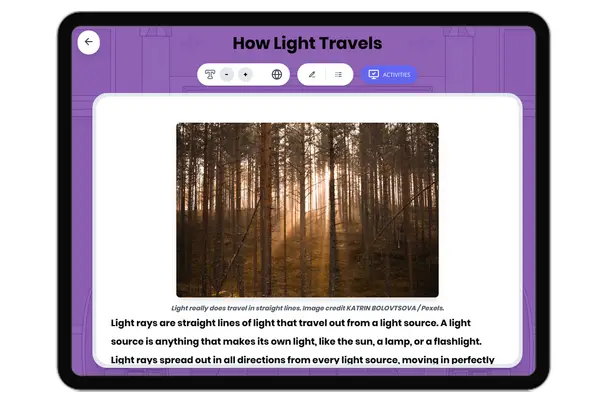
Light is a form of energy that travels in straight lines. When light hits an object, something important happens—some of the light bounces off. This bouncing is called reflection. Reflection is why we can see objects around us.
Think about looking in a mirror. A mirror is a smooth, shiny surface that reflects almost all the light that hits it. When light from a lamp or the sun strikes the mirror, it bounces off in a predictable way. The reflected light then travels to your eyes, and you see your image in the mirror.
But mirrors are not the only things that reflect light. Every object you see reflects some light. A red ball reflects red light into your eyes. A blue book reflects blue light. Even rough surfaces like tree bark or carpet reflect light, though not as clearly as a mirror does.
Without reflection, we could not see anything except light sources like the sun or a lightbulb. The reason you can see your desk, your friend, or this paper is because light bounces off these objects and enters your eyes. Different objects reflect different amounts of light. Shiny objects like metal spoons reflect a lot of light. Dull objects like rocks reflect less light but still enough for us to see them.
Understanding reflection helps explain how our eyes work and why we see the world around us.
What happens when light hits an object?
Some of it bounces offIt disappears completelyIt turns into heatIt stops moving
What is reflection?
When light travels in circlesWhen light bounces off objectsWhen light gets brighterWhen light changes colors
Why can we see a mirror image?
Mirrors create new lightMirrors absorb all lightLight bounces off the mirrorMirrors make light disappear
Why can we see objects around us?
Objects make their own lightLight reflects off themOur eyes create lightObjects glow in the dark
Which object reflects the most light?
A rockTree barkA metal spoonCarpet
What would happen without light reflection?
We could see betterWe could only see light sourcesEverything would be brighterObjects would glow
All objects reflect some amount of light.
TrueFalse
What does the word 'reflection' mean?
Light bouncing off objectsLight being absorbedLight being createdLight traveling straight
Perfect For:
👩🏫 Teachers
• Reading comprehension practice
• Auto-graded assessments
• Literacy skill development
👨👩👧👦 Parents
• Reading practice at home
• Comprehension improvement
• Educational reading time
🏠 Homeschoolers
• Reading curriculum support
• Independent reading practice
• Progress monitoring
Reading Features:
📖
Reading Passage
Engaging fiction or nonfiction text
❓
Comprehension Quiz
Auto-graded questions
📊
Instant Feedback
Immediate results and scoring
📄
Printable Version
Download for offline reading
🔊
Read Aloud
Voice-over with word highlighting
Reviews & Ratings
No reviews yet. Be the first to share your experience!
Related Content
How Light Travels
This engaging 250-word science passage for Grade 4-5 students explores how light travels in straight lines called rays. ...
NGSS 4-PS4-2
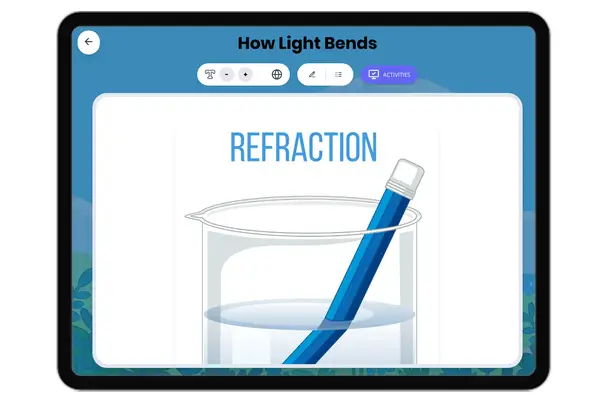
How Light Bends
This engaging 250-word science passage explains refraction for Grade 4-5 students, aligned with NGSS 4-PS4-2. Students d...
NGSS 4-PS4-2
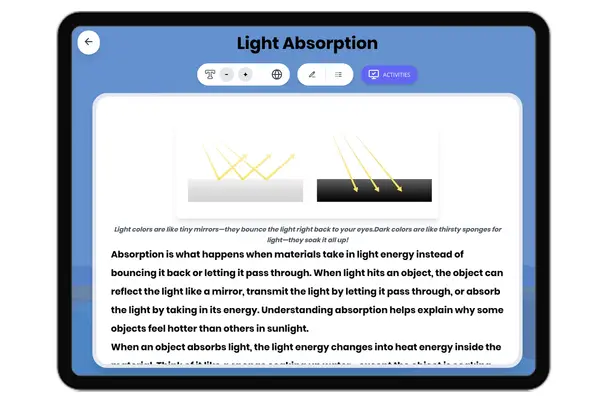
How Light Is Absorbed
This engaging 250-word science passage explains how light absorption works for Grade 4-5 students. Aligned with NGSS sta...
NGSS 4-PS4-2
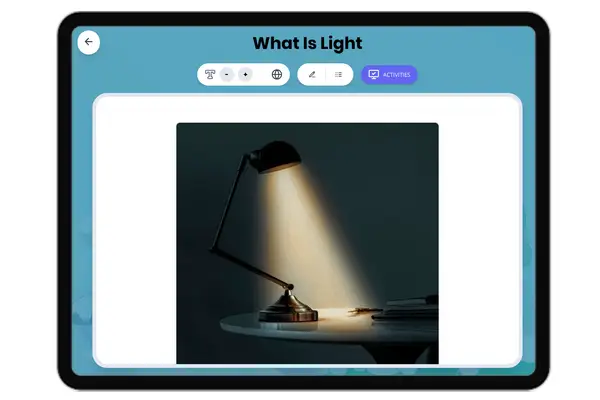
What Is Light
This Grade 4 physical science reading passage introduces students to the fundamental concept of light as a form of energ...