How Light Travels
Interactive passage with audio narration, comprehension questions, and printable PDF.
By completing this purchase you agree to our Terms of Use and Privacy Policy. Your subscription renews automatically until you cancel. You can cancel anytime from your account settings. All sales are final and non-refundable. Digital content is available for download in your account immediately upon purchase.
What's included
How Light Travels preview and details
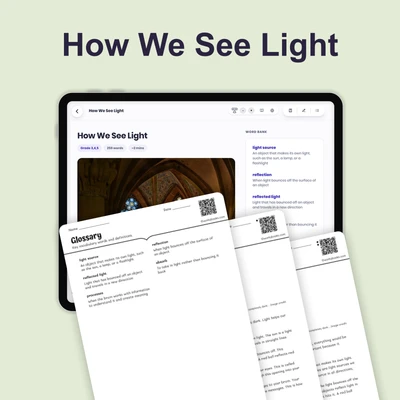
About this printable How Light Travels science reading passage, NGSS-aligned (Grades 3-5)
Sample passage and quiz from How Light Travels
Reading passage and comprehension quiz preview
How Light Travels
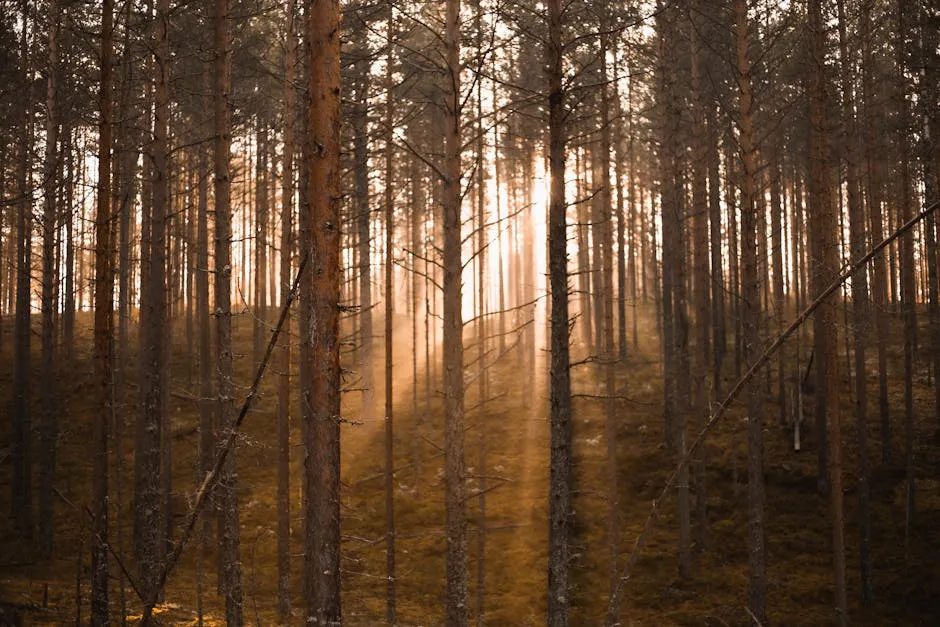
Light really does travel in straight lines. Image credit KATRIN BOLOVTSOVA / Pexels.
Light is a form of energy that allows us to see the world around us. Understanding how light moves helps us explain shadows, reflections, and why we cannot see around corners.
Light travels in straight lines called light rays. A light ray is the path that light follows as it moves from one place to another. When you turn on a flashlight, the light does not curve or bend around objects on its own. Instead, it travels forward in a straight path until something blocks it or it hits a surface.
A light source is any object that produces light, like the sun, a lamp, or a flashlight. Light spreads out from its source in all directions, but each individual ray travels in a straight line. Think of light rays like arrows shot from a bow—they fly straight ahead until they hit something.
Because light travels in straight lines, it creates shadows. A shadow is a dark area that forms when an object blocks light. When you stand between a lamp and a wall, your body blocks some of the light rays traveling in straight lines. The rays cannot bend around you to reach the wall, so a shadow appears in the shape of your body.
This is also why you cannot see around corners. Light from objects around the corner cannot bend to reach your eyes. The light rays travel straight and are blocked by the wall. If you want to see what is around the corner, you must move so that light rays from that area can travel in a straight line to your eyes.
Comprehension quiz (8 questions)
1. What is a light ray?
2. Which is an example of a light source?
3. How does light travel from its source?
4. Why do shadows form behind objects?
5. What happens when you stand between a lamp and a wall?
6. Why can't you see around corners?
7. Light can bend around corners on its own.
8. What does 'shadow' mean in this passage?
Perfect for the way you teach
- Build comprehension skills
- Auto-graded quiz
- Differentiated reading
- Read together at home
- Improve fluency
- Quiet reading time
- Reading curriculum support
- Independent practice
- Track Lexile growth