How Scientists Know How Far Stars Are
Interactive passage with audio narration, comprehension questions, and printable PDF.
By completing this purchase you agree to our Terms of Use and Privacy Policy. Your subscription renews automatically until you cancel. You can cancel anytime from your account settings. All sales are final and non-refundable. Digital content is available for download in your account immediately upon purchase.
What's included
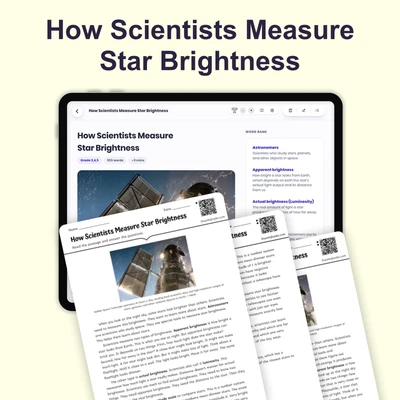
How Scientists Know How Far Stars Are preview and details
About this printable How Scientists Know How Far Stars Are science reading passage, NGSS-aligned (Grades 4-6)
Sample passage and quiz from How Scientists Know How Far Stars Are
Reading passage and comprehension quiz preview
How Scientists Know How Far Stars Are
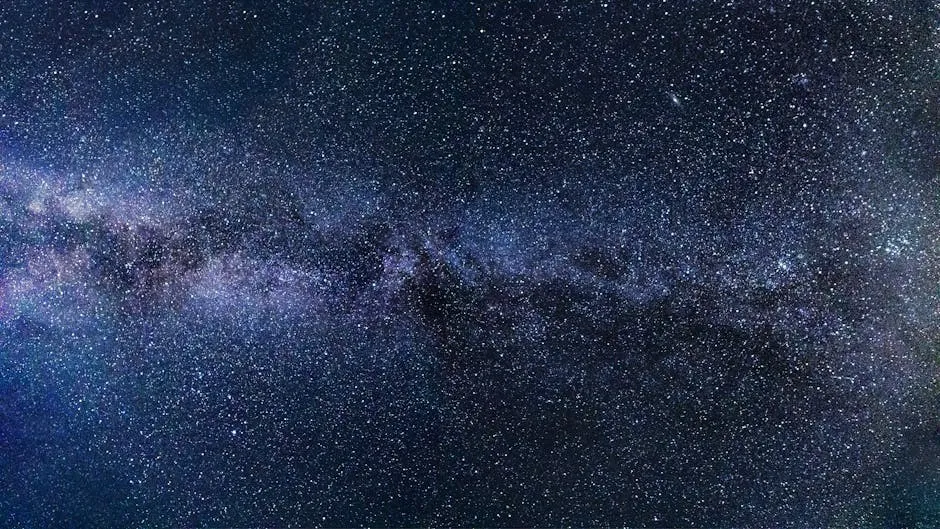
The stars we see twinkling in the night sky are incredibly far away from Earth. Understanding these distances helps scientists study space and learn about our place in the universe. Distance in space is so large that regular measurements like miles or kilometers become difficult to use and understand.
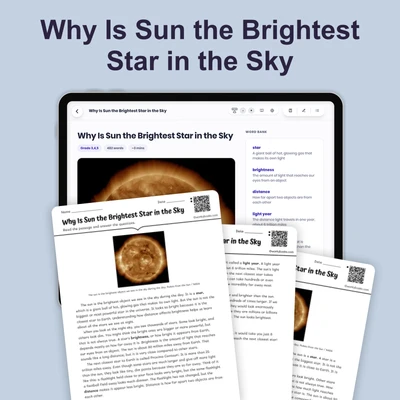
Our closest star is the sun, which is about 93 million miles away from Earth. That might sound enormous, but compared to other stars, the sun is practically next door. If you could drive a car at highway speed directly to the sun without stopping, the trip would take about 177 years! The sun's light takes about 8 minutes to reach Earth, traveling at the speed of light, which is 186,000 miles per second.
The next closest star to Earth is called Proxima Centauri. This star is about 25 trillion miles away. To help understand such huge numbers, scientists use a special unit called a light-year. A light-year is the distance light travels in one year, which equals about 6 trillion miles. Proxima Centauri is about 4.2 light-years away. If you could travel at the speed of light, it would still take over four years to reach this star!
Think of it this way: if the distance from Earth to the sun was the length of one football field, then the distance to Proxima Centauri would be about 1,700 miles. That's like comparing your classroom to the distance from New York to Denver. This comparison shows why we need special measurements for space distances.
Most stars visible in the night sky are even farther away than Proxima Centauri. Some are hundreds or thousands of light-years distant. When you look at stars at night, you're actually seeing light that left those stars many years ago. The light from distant stars travels through space for years before reaching your eyes. This means you're looking back in time when you observe stars.
Scientists use powerful telescopes to measure star distances and study objects in space. These instruments help us understand that our universe is much larger than we can easily imagine. Learning about star distances reminds us that Earth is just one small planet orbiting one star among billions of stars in space.
Interesting Fact: The farthest star visible to the naked eye is V762 Cas, located about 16,000 light-years away. When the light you see from this star began its journey to Earth, humans were still living in the Stone Age!
Comprehension quiz (8 questions)
1. How far is the sun from Earth?
2. What is the next closest star to Earth?
3. How long does sunlight take to reach Earth?
4. Why do scientists use light-years for measurement?
5. What does looking at distant stars show you?
6. If Earth-sun distance equals one football field, how far is Proxima Centauri?
7. Light from stars takes years to reach Earth.
8. What is a light-year?
Perfect for the way you teach
- Build comprehension skills
- Auto-graded quiz
- Differentiated reading
- Read together at home
- Improve fluency
- Quiet reading time
- Reading curriculum support
- Independent practice
- Track Lexile growth