What Is Star Brightness
Interactive passage with audio narration, comprehension questions, and printable PDF.
By completing this purchase you agree to our Terms of Use and Privacy Policy. Your subscription renews automatically until you cancel. You can cancel anytime from your account settings. All sales are final and non-refundable. Digital content is available for download in your account immediately upon purchase.
What's included
What Is Star Brightness preview and details
About this printable What Is Star Brightness science reading passage, NGSS-aligned (Grades 4-6)
Sample passage and quiz from What Is Star Brightness
Reading passage and comprehension quiz preview
What Is Star Brightness
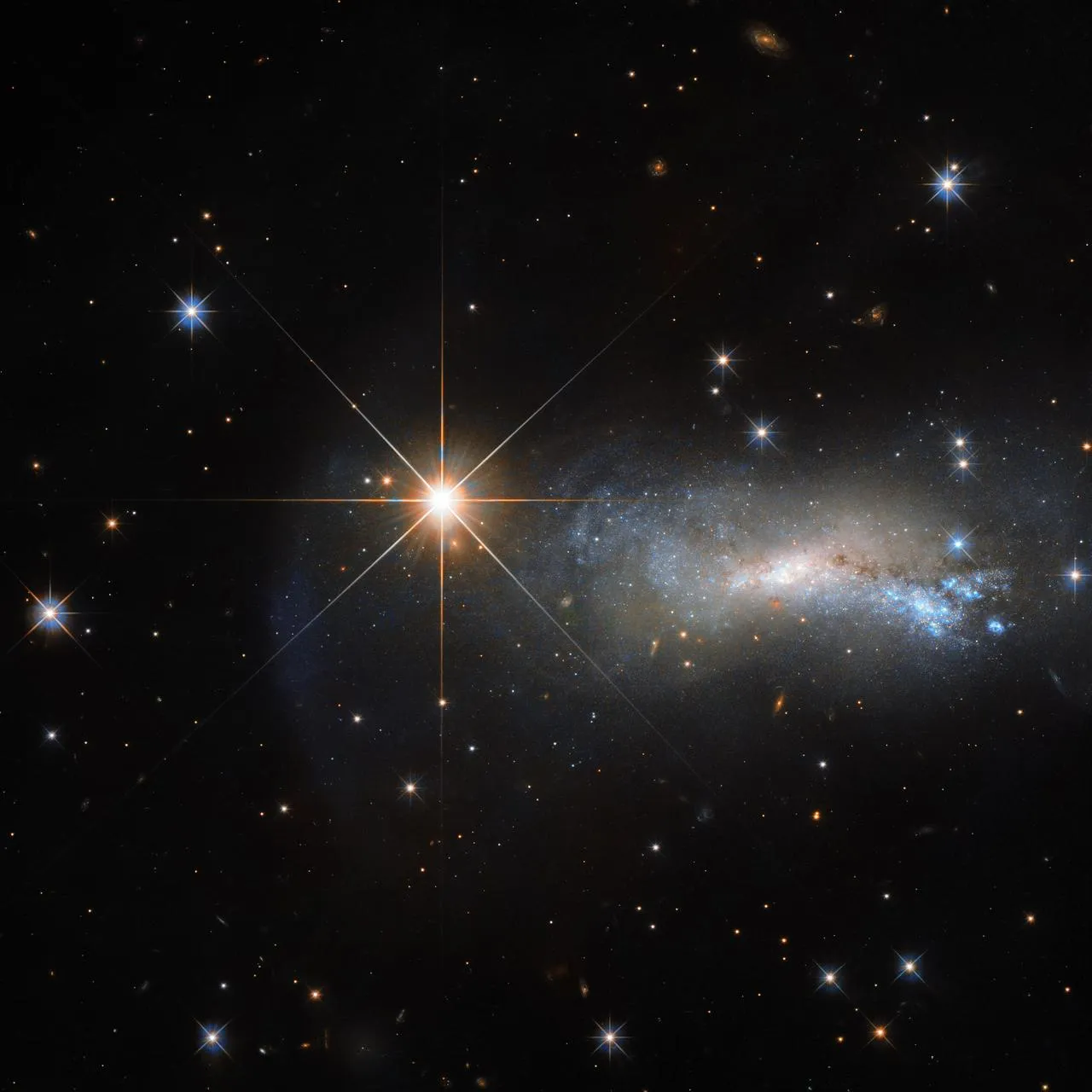
"Star from the Lizard Constellation Photobombs Hubble Observation" / NASA
Brightness is the amount of light we see from a star when we look at it from Earth. When you look up at the night sky, you notice that some stars look very bright while others look dim. This difference in how much light reaches our eyes is what scientists call brightness. Understanding brightness helps astronomers study stars and learn more about the universe.
Scientists measure brightness to compare different stars. They use special tools called telescopes, which are instruments that collect light and make distant objects appear larger and clearer. Just like you might use a ruler to measure length, astronomers use brightness measurements to describe how much light a star sends to Earth. Some stars shine with intense light that we can easily see, while other stars are so dim that we need telescopes to spot them at all.
The brightness of a star depends on two main things. First, it depends on how much light the star actually produces. Think of this like comparing a small flashlight to a powerful spotlight—the spotlight produces more light. Second, brightness depends on how far away the star is from Earth. A very bright star that is extremely far away might look dim to us, just like a car's headlights look bright when the car is close but appear as tiny dots of light when the car is miles away on a distant highway.
Astronomers have created a system to measure and record star brightness. The magnitude scale is a number system that describes how bright stars appear from Earth. Smaller numbers mean brighter stars, while larger numbers mean dimmer stars. The brightest stars visible to our eyes without telescopes have magnitudes around 0 or 1. The dimmest stars we can see without tools have magnitudes around 6. Stars with magnitudes greater than 6 are too dim for our eyes to detect without help from telescopes.
When scientists observe and measure star brightness carefully, they can learn important information. By comparing the brightness of different stars, astronomers can figure out which stars are closer to Earth and which are farther away. They can also learn about the size and temperature of stars. Brightness measurements help scientists understand that stars are not all the same—they vary in distance, size, and the amount of light they produce.
Interesting Fact: The brightest star in our night sky is called Sirius, and it appears so bright partly because it is one of the closest stars to Earth, located only about 8.6 light-years away!
Comprehension quiz (8 questions)
1. What is brightness?
2. What tool do scientists use to study stars?
3. What magnitude do the brightest visible stars have?
4. Why might a bright star look dim?
5. What can astronomers learn by comparing star brightness?
6. How does distance affect star brightness?
7. Smaller magnitude numbers always mean brighter stars.
8. What does the term 'magnitude scale' mean?
Perfect for the way you teach
- Build comprehension skills
- Auto-graded quiz
- Differentiated reading
- Read together at home
- Improve fluency
- Quiet reading time
- Reading curriculum support
- Independent practice
- Track Lexile growth