How Scientists Measure Star Brightness
Interactive passage with audio narration, comprehension questions, and printable PDF.
By completing this purchase you agree to our Terms of Use and Privacy Policy. Your subscription renews automatically until you cancel. You can cancel anytime from your account settings. All sales are final and non-refundable. Digital content is available for download in your account immediately upon purchase.
What's included
How Scientists Measure Star Brightness preview and details
About this printable How Scientists Measure Star Brightness science reading passage, NGSS-aligned (Grades 4-6)
Sample passage and quiz from How Scientists Measure Star Brightness
Reading passage and comprehension quiz preview
How Scientists Measure Star Brightness
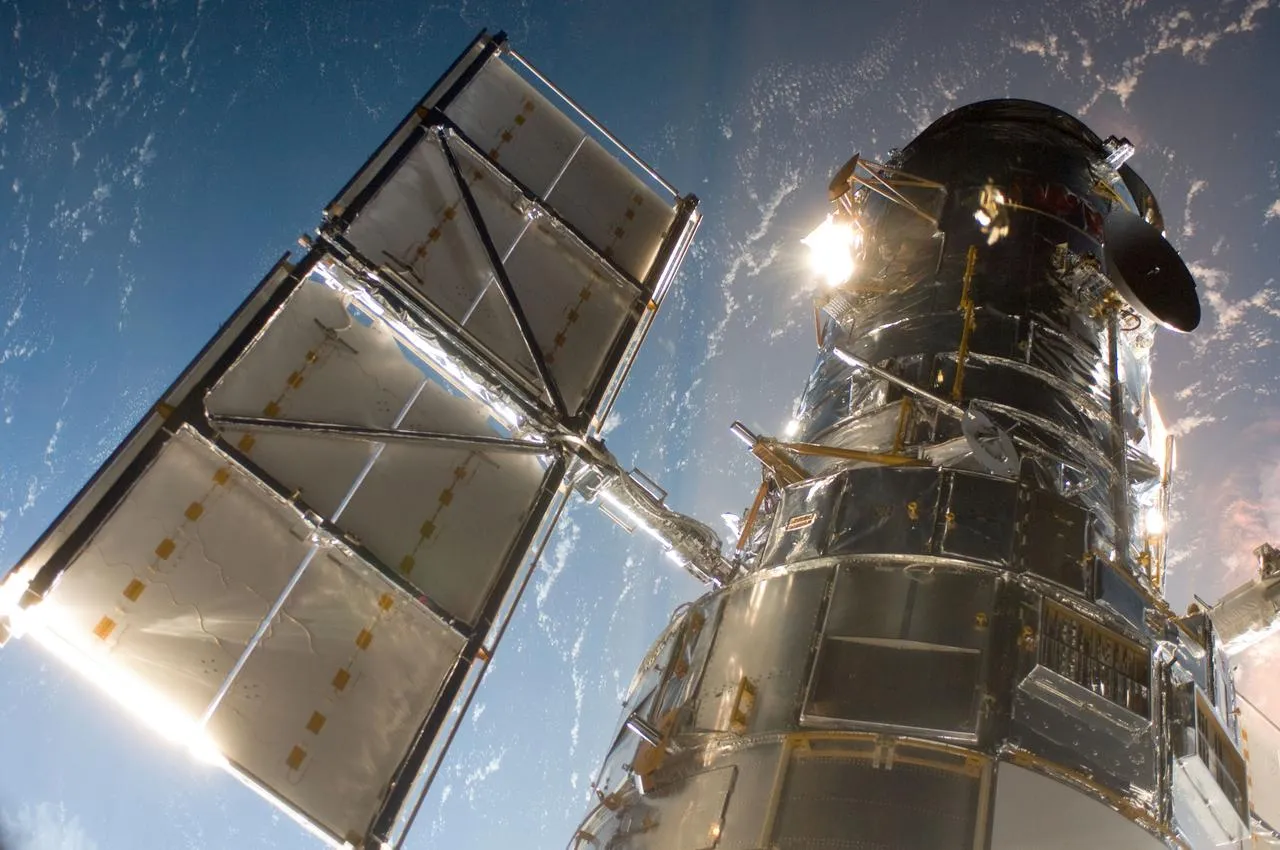
Hubble Space Telescope operates 24 hours a day, sending back scientific data and high-resolution images of stars, galaxies, and other celestial objects to Earth. / NASA
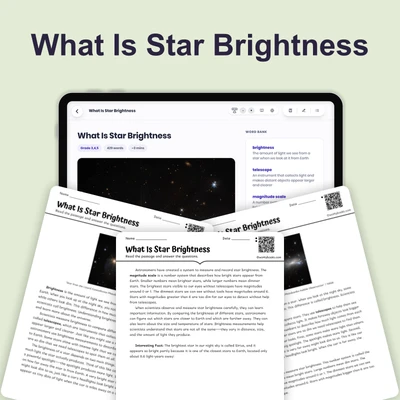
When you look at the night sky, some stars appear brighter than others. Scientists need a way to measure and compare this brightness so they can learn more about stars. Astronomers—scientists who study space—use special tools and measurement systems to understand star brightness. This helps them figure out important information like how far away a star is and how much energy it produces.
Scientists measure two different types of brightness. Apparent brightness is how bright a star looks from Earth. This is what you see when you look up at the night sky. However, apparent brightness can be tricky because it depends on two things: how much light the star actually makes and how far away it is. A star that is very close to Earth might look bright even if it doesn't produce much light. Meanwhile, a star that is very far away might look dim even if it produces huge amounts of light. Think of it like a flashlight—when you hold it close to a wall, the light looks bright, but when you move it far away, the same flashlight looks much dimmer.
The other type is actual brightness, also called luminosity. This measures how much light a star really gives off, no matter how far away it is. Scientists use math and measurements to figure out actual brightness. They need to know both the apparent brightness and the distance to the star. Once they have both pieces of information, they can calculate how much light the star truly produces.
To compare stars, astronomers use the magnitude scale. This is a number system where smaller numbers mean brighter stars and larger numbers mean dimmer stars. The scale might seem backwards at first! A star with a magnitude of 1 is brighter than a star with a magnitude of 6. Very bright objects can even have negative numbers. For example, our Sun has a magnitude of about -27 because it looks extremely bright from Earth. The faintest stars we can see without a telescope have a magnitude of about 6.
Telescopes are important tools that help astronomers measure star brightness. Telescopes collect more light than our eyes can, allowing scientists to see fainter stars and measure their brightness more accurately. Modern telescopes can even measure stars that are millions of times too dim for us to see with just our eyes. Scientists use special instruments attached to telescopes to measure exactly how much light comes from each star.
By separating apparent brightness from actual brightness, scientists can learn amazing things about stars. They can tell which stars are nearby and which are far away. They can figure out which stars are similar to our Sun and which are very different. This careful measurement of star brightness is one of the key ways astronomers gather evidence about the universe.
Interesting Fact: The brightest star in the night sky is Sirius, which has a magnitude of -1.46. It looks so bright partly because it's one of the closest stars to Earth—only 8.6 light-years away!
Comprehension quiz (8 questions)
1. What do astronomers study?
2. What is apparent brightness?
3. What is another name for actual brightness?
4. Why might a close star look bright?
5. On the magnitude scale, which number is brighter?
6. How do telescopes help astronomers?
7. The Sun has a negative magnitude number.
8. What does luminosity measure?
Perfect for the way you teach
- Build comprehension skills
- Auto-graded quiz
- Differentiated reading
- Read together at home
- Improve fluency
- Quiet reading time
- Reading curriculum support
- Independent practice
- Track Lexile growth