Why Is Sun the Brightest Star in the Sky
Interactive passage with audio narration, comprehension questions, and printable PDF.
By completing this purchase you agree to our Terms of Use and Privacy Policy. Your subscription renews automatically until you cancel. You can cancel anytime from your account settings. All sales are final and non-refundable. Digital content is available for download in your account immediately upon purchase.
What's included
Why Is Sun the Brightest Star in the Sky preview and details
About this printable Why Is Sun the Brightest Star in the Sky science reading passage, NGSS-aligned (Grades 4-6)
Sample passage and quiz from Why Is Sun the Brightest Star in the Sky
Reading passage and comprehension quiz preview
Why Is Sun the Brightest Star in the Sky
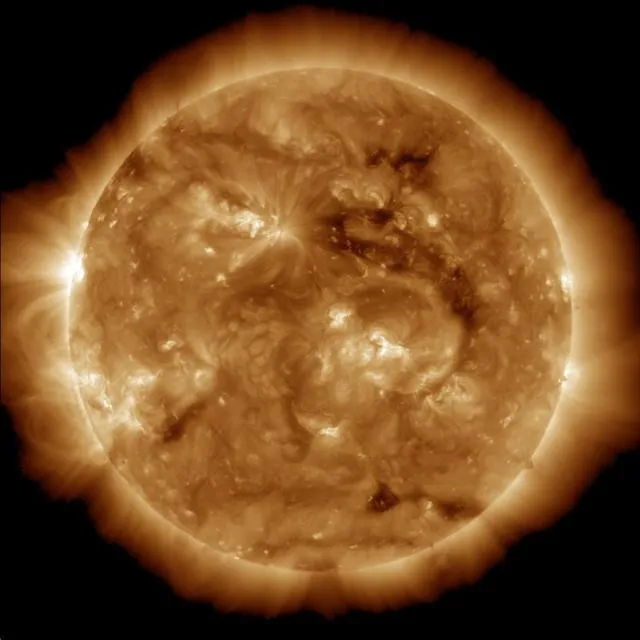
The sun is the brightest object we see in the sky during the day. Pulses from the Sun / NASA
The sun is the brightest object we see in the sky during the day. It is a star, which is a giant ball of hot, glowing gas that makes its own light. But the sun is not the biggest or most powerful star in the universe. It looks so bright because it is the closest star to Earth. Understanding how distance affects brightness helps us learn about all the stars we see at night.
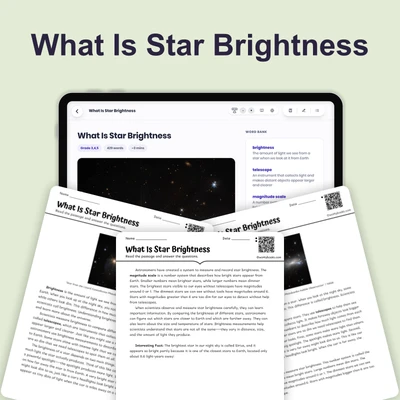
When you look at the night sky, you see thousands of stars. Some look bright, and others look dim. You might think the bright ones are bigger or more powerful, but that is not always true. A star's brightness, or how bright it appears from Earth, depends mostly on how far away it is. Brightness is the amount of light that reaches our eyes from an object. The sun is about 93 million miles away from Earth. That sounds like a long distance, but it is very close compared to other stars.
The next closest star to Earth is called Proxima Centauri. It is more than 25 trillion miles away. Even though some stars are much larger and give off more light than the sun, they look like tiny, dim points because they are so far away. Think of it like this: a flashlight held close to your face looks very bright, but the same flashlight a football field away looks much dimmer. The flashlight has not changed, but the distance makes it appear less bright. Distance is how far apart two objects are from each other.
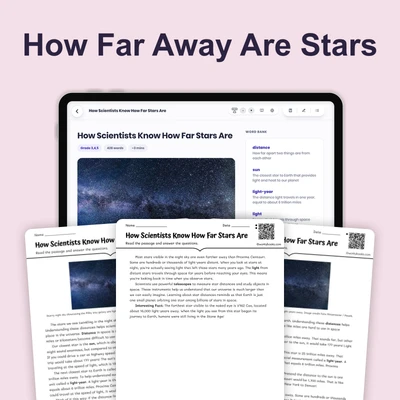
Scientists measure distances to stars using a unit called a light year. A light year is the distance light travels in one year, which is about 6 trillion miles. The sun's light takes only about 8 minutes to reach Earth. Light from the next closest star takes more than 4 years to reach us. Light from other stars can take hundreds or even thousands of years to reach Earth. This shows just how incredibly far away most stars are compared to our sun.
Many stars in the night sky are actually much bigger and brighter than the sun. Some stars are called supergiants because they are hundreds of times larger. If we could move these stars as close to Earth as the sun is, they would look enormously bright—so bright they could be dangerous. But because they are millions or billions of miles farther away, they look like small, twinkling dots. The sun looks brightest simply because it is our closest neighbor in space.
Interesting Fact: If you could travel at the speed of light, it would take you just 8 minutes to reach the sun from Earth, but over 4 years to reach the next closest star!
Comprehension quiz (8 questions)
1. Why does the sun look brightest?
2. How far is the sun from Earth?
3. What is a light year?
4. Why do far stars look dim?
5. What determines how bright stars appear?
6. If supergiants were close, what would happen?
7. All stars make their own light.
8. What does brightness mean in the passage?
Perfect for the way you teach
- Build comprehension skills
- Auto-graded quiz
- Differentiated reading
- Read together at home
- Improve fluency
- Quiet reading time
- Reading curriculum support
- Independent practice
- Track Lexile growth