Louisiana Purchase Deal of 1803
Interactive passage with audio narration, comprehension questions, and printable PDF.
By completing this purchase you agree to our Terms of Use and Privacy Policy. Your subscription renews automatically until you cancel. You can cancel anytime from your account settings. All sales are final and non-refundable. Digital content is available for download in your account immediately upon purchase.
What's included
Louisiana Purchase Deal of 1803 preview and details
About this printable Louisiana Purchase Deal of 1803 reading passage (Grades 3-5)
Sample passage and quiz from Louisiana Purchase Deal of 1803
Reading passage and comprehension quiz preview
Louisiana Purchase Deal of 1803
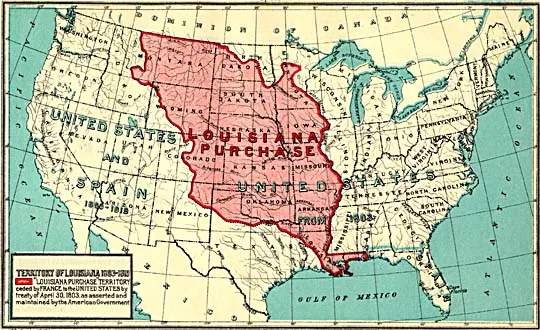
"Frank bond 1912 louisiana and the louisiana purchase" / Wikimedia Commons (Public domain).
The Louisiana Purchase was a deal made in 1803 that doubled the size of the United States. President Thomas Jefferson wanted to help the country grow and give people more land. At that time, the land west of the Mississippi River belonged to France. It was called Louisiana, and it stretched from the Gulf of Mexico to Canada.
France was ruled by Napoleon Bonaparte. He needed money for his wars in Europe. At first, Jefferson only wanted to buy the port city of New Orleans. He sent American ministers to France to try to make this negotiation. But something surprising happened. Napoleon offered to sell all of Louisiana, not just New Orleans. He wanted $15 million for the whole territory.
Jefferson was shocked by the offer. He knew it was a huge chance for the United States. If America owned Louisiana, the country would have more land to farm, more control of the Mississippi River, and more room for people to move west. But Jefferson had a problem. He was not sure if the President was allowed by the Constitution to buy land from other countries. He also did not have time to ask Congress for permission. The offer might disappear if he waited.
Jefferson decided to act quickly. He told the American ministers to agree to the deal. The two sides signed a treaty in Paris on April 30, 1803. The United States paid France $15 million. This was about 4 cents an acre. The land doubled the size of the young nation overnight. All the citizens of the new territory became Americans.
The Louisiana Purchase showed how leaders sometimes have to make fast decisions. Jefferson’s choice changed the country forever. It helped the United States become bigger, richer, and more powerful. People started moving west to build new towns and farms. The purchase also showed the importance of smart negotiation and taking big opportunities.
Interesting Fact: The Louisiana Purchase gave the United States land that would later become 15 new states!
Comprehension quiz (8 questions)
1. Who was the U.S. president in 1803?
2. What country sold Louisiana?
3. How much did the U.S. pay?
4. Why did Napoleon sell Louisiana?
5. Why was Jefferson unsure about buying land?
6. What did the purchase do to the U.S.?
7. The Louisiana Purchase happened in 1803. True or false?
8. What is a treaty?
Common Core standards for Louisiana Purchase Deal of 1803
Refer to details and examples in a text when explaining what the text says explicitly and when drawing inferences from the text.
Perfect for the way you teach
- Build comprehension skills
- Auto-graded quiz
- Differentiated reading
- Read together at home
- Improve fluency
- Quiet reading time
- Reading curriculum support
- Independent practice
- Track Lexile growth