Reading PassagePremium

Earth Day and Green Initiatives

Interactive passage with audio narration, comprehension questions, and printable PDF.

No ratings yet
Grades 4–5ElaReadingScienceEnglish · SpanishInteractive · Printable
Aligned toRI.4.1RI.4.2ESS3.CESS3.A
Just this resource
$1.50
One-time purchase
Best value
Unlock everything
$49.99$24.99/yr
50% off until Sept 15 — 10,000+ resources
Renews at $49.99/year.

By completing this purchase you agree to our Terms of Use and Privacy Policy. Your subscription renews automatically until you cancel. You can cancel anytime from your account settings. All sales are final and non-refundable. Digital content is available for download in your account immediately upon purchase.

Unlock above to use these actions

What's included

Reading passage
Audio narration
Comprehension quiz
Writing activity
Glossary & flashcards
Differentiated version
Spanish translation

Earth Day and Green Initiatives preview and details

About this printable Earth Day and Green Initiatives science reading passage, NGSS-aligned (Grades 4-5)

Celebrate Earth Day with this fun and educational activity! Students will begin by reading a short passage that explains what Earth Day is, why it is celebrated on April 22nd each year, and how green initiatives like renewable energy help protect our planet. This Earth Day Quiz for Kids reinforces key ideas from the passage.
Written by Neha Goel Tripathi Published by Workybooks
Preview

Sample passage and quiz from Earth Day and Green Initiatives

Reading passage and comprehension quiz preview

Earth Day and Green Initiatives

Earth Day, green initiatives, renewable energy, recycling, tree planting, environmental conservation

Earth Day is a special day celebrated on April 22nd every year to remind us about the importance of protecting our planet. It’s a day when people around the world come together to learn about environmental issues and take action to make the Earth a cleaner, healthier place to live.


One way we can help the Earth is by supporting green initiatives. Green initiatives are projects and ideas that aim to reduce pollution, conserve natural resources, and protect the environment. For example, some cities have started using renewable energy sources like solar and wind power to generate electricity instead of burning fossil fuels, which can create pollution.

  • Another green initiative is planting trees. Trees are important because they absorb carbon dioxide, a gas that contributes to global warming, and release oxygen back into the air. They also provide homes for animals and help prevent soil erosion. Some communities organize tree-planting events on Earth Day to help make their neighborhoods greener.
  • Recycling is another important green initiative. When we recycle materials like paper, plastic, and glass, we reduce the amount of waste that ends up in landfills and conserve natural resources. Many schools and businesses have recycling programs that make it easy for people to recycle.


Green initiatives like these are important because they help protect the Earth and ensure that it remains a healthy, beautiful place for future generations. By supporting green initiatives and making small changes in our daily lives, we can all make a difference in helping to protect our planet.

Comprehension quiz (4 questions)

1. What is the purpose of Earth Day?

To celebrate the invention of the car
To watch movies about the Earth
To buy new clothes and toys
To learn about environmental issues and take action

2. Which of the following is an example of a green initiative?

Using renewable energy sources
Cutting down trees
Throwing away plastic bottles
Driving cars everywhere

3. Why are trees important for the environment?

They make the Earth look prettier
They absorb carbon dioxide and release oxygen
They make it harder to build houses and roads
They are fun to climb

4. What happens when we recycle materials like paper, plastic, and glass?

We create more waste for landfills
We conserve natural resources
We make the Earth dirtier
We use more energy and water
Curriculum

Common Core standards for Earth Day and Green Initiatives

RI.4.1

Refer to details and examples in a text when explaining what the text says explicitly and when drawing inferences from the text.

RI.4.2

Determine the main idea of a text and explain how it is supported by key details; summarize the text.

Who it's for

Perfect for the way you teach

Teachers
  • Build comprehension skills
  • Auto-graded quiz
  • Differentiated reading
Parents
  • Read together at home
  • Improve fluency
  • Quiet reading time
Homeschoolers
  • Reading curriculum support
  • Independent practice
  • Track Lexile growth
Topics

Reviews & Ratings

No reviews yet. Be the first to share your experience!

More reading you might love

19 more
Passage
Earth Day and Types of Pollution - reading educational content
Grades 4–5

Earth Day and Types of Pollution

life science · RI.4.1+3

Free
Worksheet
Snorkeling & Scuba Diving - worksheet educational content
Grade 4

Snorkeling & Scuba Diving

reading informational text · RI.2.2+11

$1.50
Worksheet
Climate and Water Cycle - worksheet educational content
Grades 4–5

Climate and Water Cycle

writing · W.4.2.A+2

Free
Worksheet
The Rubik's Cube - worksheet educational content
Grades 4–5

The Rubik's Cube

reading informational text · RI.2.2+11

Free
Worksheet
Earthquakes and Infrastructure - worksheet educational content
Grades 4–5

Earthquakes and Infrastructure

reading informational text · W.4.7+2

$1.50
Worksheet
Polar Bears and Climate - worksheet educational content
Grades 4–5

Polar Bears and Climate

reading informational text · RI.4.1+3

Free
Worksheet
Understanding Climate Action Context Clues - worksheet educational content
Grades 4–5

Understanding Climate Action Context Clues

vocabulary development · L.4.4.A+2

$1.50
Worksheet
Earthquake and buildings - worksheet educational content
Grades 4–5

Earthquake and buildings

reading informational text · RI.4.1+3

$1.50
Passage
How Do Scientists Study Past Climates? - reading educational content
Grades 4–7

How Do Scientists Study Past Climates?

reading literature · RI.4.1+5

Free
Passage
Sunspots and Solar Flares - reading educational content
Grades 4–5

Sunspots and Solar Flares

earth and space science · RI.4.1+4

Free
Passage
How is Climate Different from Weather? - reading educational content
Grades 2–4

How is Climate Different from Weather?

weather and climate · RI.3.1+2

Free
Passage
Can you name three greenhouse gases - reading educational content
Grades 2–4

Can you name three greenhouse gases

weather and climate · RI.3.1+2

Free
Passage
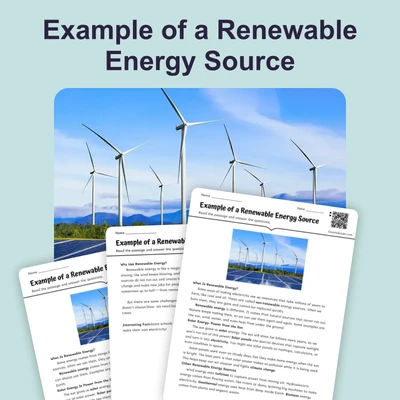
Can you give an example of a renewable energy source? - reading educational content
Grades 2–4

Can you give an example of a renewable energy source?

weather and climate · RI.3.1+2

Free
Passage
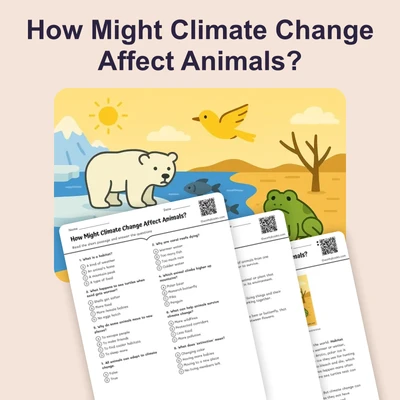
How might climate change affect animals? - reading educational content
Grades 2–4

How might climate change affect animals?

weather and climate · RI.3.1+3

$1.50
Passage
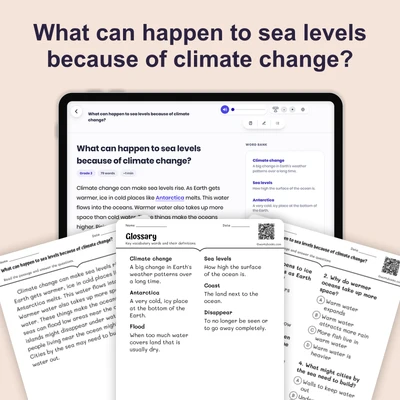
What can happen to sea levels because of climate change? - reading educational content
Grades 2–4

What can happen to sea levels because of climate change?

weather and climate · RI.3.1+2

Free
Passage
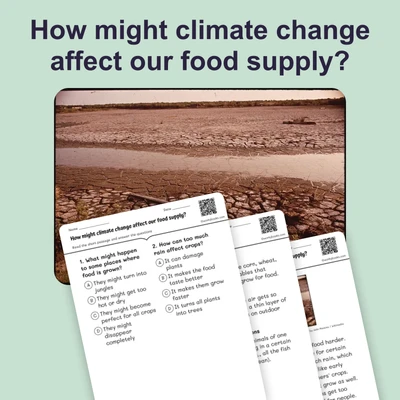
How might climate change affect our food supply? - reading educational content
Grades 2–4

How might climate change affect our food supply?

weather and climate · RI.3.1+3

Free
Passage
How can planting trees help fight climate change? - reading educational content
Grades 2–4

How can planting trees help fight climate change?

weather and climate · RI.3.1+3

$1.50
Passage
Reduce Your Carbon Footprint: Simple Tips for Home - reading educational content
Grades 2–4

Reduce Your Carbon Footprint: Simple Tips for Home

weather and climate · RI.3.1+3

Free
Passage
How using less plastic helps the environment? - reading educational content
Grades 2–4

How using less plastic helps the environment?

weather and climate · RI.3.1+3

Free
Copyright © 2026 Workybooks. Made with ♥ in California.