Origins of Social Classes
Interactive passage with audio narration, comprehension questions, and printable PDF.
By completing this purchase you agree to our Terms of Use and Privacy Policy. Your subscription renews automatically until you cancel. You can cancel anytime from your account settings. All sales are final and non-refundable. Digital content is available for download in your account immediately upon purchase.
What's included
Part of this bundle

Origins of Social Classes preview and details
About this printable Origins of Social Classes reading passage (Grades 5-8)
Sample passage and quiz from Origins of Social Classes
Reading passage and comprehension quiz preview
Origins of Social Classes
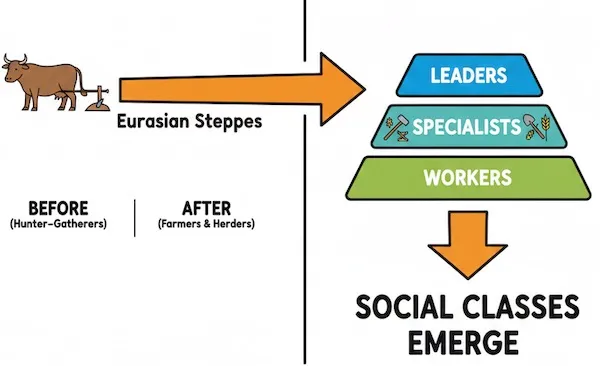
The emergence of social classes began when early humans shifted from hunting and gathering to farming and herding animals on the Eurasian steppes around 6000 BCE. This region, a vast grassland stretching from Eastern Europe to Mongolia, became home to pastoral nomads who depended on herds of sheep, goats, and horses for food and trade. As these groups settled and managed resources, the first signs of inequality appeared among human societies.
Archaeological evidence from burial sites such as those at Sintashta (in modern Russia, c. 2100-1800 BCE) shows that some individuals were buried with elaborate goods—gold jewelry, decorated weapons, and chariots—while others had only simple graves. These discoveries suggest the development of a social hierarchy, with leaders or chiefs gaining more wealth and power than ordinary herders. Artifacts like horse harnesses and bronze tools reveal the increasing specialization of labor, with some people focusing on crafts, trade, or warfare, while most remained herders.
The cause of this growing inequality lies in the control of valuable resources. Those who owned more livestock or land could exchange their surplus for luxury goods or gain influence over others. The introduction of new technologies, such as the chariot (first used by steppe peoples around 2000 BCE), allowed elites to display power and lead in warfare. Over time, these differences created distinct social classes: chiefs, warriors, skilled craftsmen, and common herders. Oral traditions and early written sources, such as the Avesta (a collection of ancient Iranian texts), describe noble families and warrior classes among steppe peoples.
This change over time marked a turning point in human society. Instead of equal sharing, daily life became shaped by status and wealth. Geography played a key role: the open steppes made it possible for herders to build large herds, but also encouraged competition and raids. Social classes continued to develop, influencing later civilizations across Eurasia and even inspiring legends about powerful horse-riding peoples.
The rise of social classes among pastoral nomads of the steppes connects to broader themes in world history, such as the impact of geography on human societies, the causes and consequences of inequality, and the role of technology and resources in shaping civilizations.
Interesting Fact: Some steppe leaders were buried with sacrificed horses, showing the importance of these animals in status and belief.
Comprehension quiz (8 questions)
1. Where did pastoral nomads live?
2. What is an artifact?
3. When did farming begin on the steppes?
4. Why did inequality appear?
5. What did the chariot help elites do?
6. How did geography affect nomads?
7. Social classes exist in all societies. True or false?
8. What is a social hierarchy?
Perfect for the way you teach
- Build comprehension skills
- Auto-graded quiz
- Differentiated reading
- Read together at home
- Improve fluency
- Quiet reading time
- Reading curriculum support
- Independent practice
- Track Lexile growth