This learning resource is available in interactive and printable formats. The interactive worksheet can be played online and assigned to students. The Printable PDF version can be downloaded and printed for completion by hand.
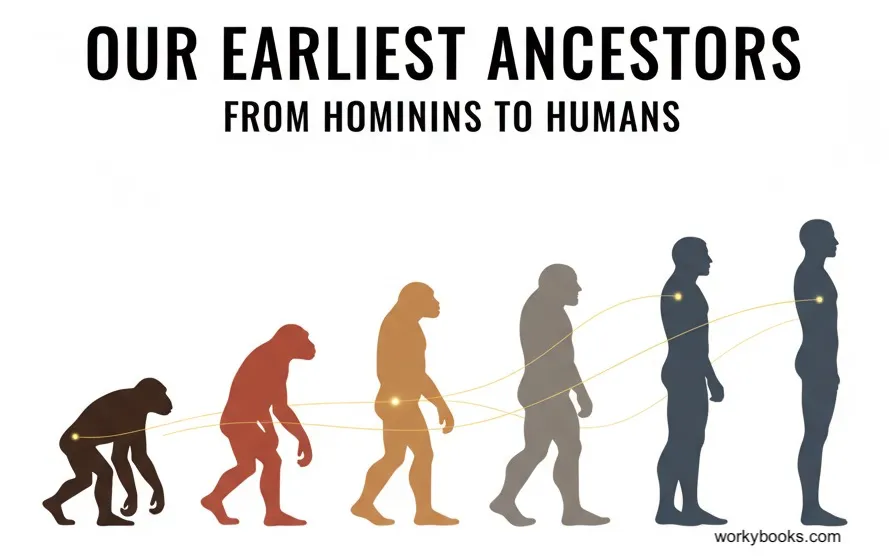
This engaging history reading passage explores the evolution of early humans, tracing the journey from the earliest hominins to modern Homo sapiens. Students will discover key archaeological discoveries such as the famous 'Lucy' fossil and stone tools from Olduvai Gorge, as well as the geographic context of human migration out of Africa. The passage highlights changes over time, cause-and-effect relationships, and the significance of these developments for human society. Academic vocabulary is woven throughout, and students are challenged to analyze evidence and make connections like historians. Activities include a multiple-choice quiz, explanatory writing prompts, and graphic organizers to support learning. The passage is available with read aloud audio and a Spanish translation. Aligned with CA HSS 6.1, CCSS RH.6-8.1, RH.6-8.2, and W.6.2 standards.
CONTENT PREVIEW
Expand content preview
Understanding the journey from early hominins to Homo sapiens helps us connects to broader themes in ancient history.
The story of human evolution begins in Africa over 6 million years ago with the earliest hominins, a group that includes modern humans and our ancient ancestors. Scientists have discovered fossils and stone tools that help us understand how early hominins gradually changed over time. Fossils of species such as Australopithecus afarensis, like the famous skeleton called 'Lucy' found in Ethiopia in 1974, provide evidence for how early humans walked upright. Archaeological sites, such as Olduvai Gorge in Tanzania, show that early hominins began using simple stone tools around 2.6 million years ago.
As time passed, new species of hominins appeared. One important development was the emergence of Homo habilis about 2.4 million years ago. Homo habilis is often called the "handy man" because evidence shows they made and used tools for cutting and processing food. Later, Homo erectus appeared around 1.9 million years ago. Fossils found in Africa and Asia show that Homo erectus had a larger brain and a more human-like body. This species is believed to be the first to control fire and to leave Africa, spreading into Europe and Asia.
The development of larger brains and more complex tools allowed early humans to adapt to different environments. Archaeological discoveries, such as ancient hearths and cave art, show that early Homo species learned to cooperate, communicate, and hunt together. By around 300,000 years ago, modern Homo sapiens appeared in Africa. Fossil evidence from Jebel Irhoud, Morocco, shows some of the earliest known examples of our species. Over thousands of years, Homo sapiens migrated out of Africa, eventually spreading across the globe and encountering other hominins like the Neanderthals in Europe and Denisovans in Asia.
These changes did not happen overnight. The process of evolution was gradual and sometimes involved extinction of entire species. For example, Neanderthals disappeared about 40,000 years ago, possibly due to competition or climate change. The ability to create new tools, adapt to changing environments, and develop social structures was essential for the survival of Homo sapiens. Geography played a key role, as different landscapes required new solutions for finding food, making shelter, and staying safe. The discoveries of ancient bones, footprints, and cave paintings help us piece together the daily lives of our ancestors.
Understanding the journey from early hominins to Homo sapiens helps us see how humans became the only surviving members of our family tree. These developments shaped our ability to cooperate, create culture, and transform the world around us.
This topic connects to broader themes in ancient history, such as the development of societies, adaptation to geographic environments, and the roots of technology.
Interesting Fact: The footprints of early hominins found at Laetoli, Tanzania, are about 3.6 million years old and show that our ancestors walked upright on two feet.
Where was 'Lucy' discovered?
EthiopiaMoroccoAsiaEurope
Which species controlled fire first?
Homo sapiensAustralopithecusHomo habilisHomo erectus
What do Laetoli footprints show?
Tool useUpright walkingFire makingCave painting
Why was Homo habilis called 'handy man'?
Large brainUsed fireMade toolsLived in Asia
How did bigger brains help early humans?
Helped adapt to environmentsCaused extinctionMade them slowerAttracted predators
What caused Neanderthals to disappear?
Competition or climate changeFire useMigrationNew languages
Homo sapiens first appeared in Asia. True or false?
TrueFalse
What does 'extinction' mean?
MigrationTool makingDisappearance of a speciesGrowth of brains
Perfect For:
👩🏫 Teachers
• Reading comprehension practice
• Auto-graded assessments
• Literacy skill development
👨👩👧👦 Parents
• Reading practice at home
• Comprehension improvement
• Educational reading time
🏠 Homeschoolers
• Reading curriculum support
• Independent reading practice
• Progress monitoring
Reading Features:
📖
Reading Passage
Engaging fiction or nonfiction text
❓
Comprehension Quiz
Auto-graded questions
📊
Instant Feedback
Immediate results and scoring
📄
Printable Version
Download for offline reading
🔊
Read Aloud
Voice-over with word highlighting
Reviews & Ratings
No reviews yet. Be the first to share your experience!
Related Content
Battle of the Alamo 1836
This rigorous history reading passage examines the Battle of the Alamo (1836) within the broader context of the Texas Re...
D2.HIS.2.3-5D2.HIS.3.3-5RI.6.3RI.6.4
Kansas-Nebraska Act 1854
This engaging history reading passage examines the Kansas-Nebraska Act of 1854, a pivotal moment in American history tha...
D2.HIS.2.3-5D2.HIS.3.3-5RI.6.3RI.6.4
Andrew Carnegie's Empire
This engaging U.S. History reading passage examines Andrew Carnegie's rise in the steel industry and his influential phi...
D2.HIS.2.3-5D2.HIS.3.3-5RI.6.3RI.6.4
American Federation of Labor
This engaging U.S. history reading passage explores the origins, strategies, and impact of the American Federation of La...
D2.HIS.2.6-8D2.HIS.3.6-8RI.6.3RI.6.4
Triangle Shirtwaist Factory Fire 1911: Worker Safety
This engaging U.S. history reading passage examines the Triangle Shirtwaist Factory Fire of 1911, one of the most signif...
D2.HIS.2.3-5D2.HIS.3.3-5RI.6.3RI.6.4
Tenement Life
This history reading passage examines the difficult realities of tenement life and urban poverty in America during the l...
D2.HIS.2.3-5D2.HIS.3.3-5RI.6.3RI.6.4
Ida Tarbell and Standard Oil Monopoly
This history reading passage explores the significant role of Ida Tarbell in exposing the Standard Oil monopoly and shap...
D2.HIS.2.3-5D2.HIS.3.3-5RI.6.3RI.6.4
Angel Island
This reading passage examines Angel Island, the main immigration processing center for Asians entering the United States...
D2.HIS.2.6-8D2.HIS.3.6-8RI.6.3RI.6.4
Temperance Movement: Push for Prohibition
This passage explores the Temperance Movement and the push for Prohibition in the United States. Students will learn abo...
D2.HIS.2.3-5D2.HIS.3.3-5RI.6.3RI.6.4
Lend-Lease Act 1941: Supporting Britain
This rigorous history reading passage explores the Lend-Lease Act of 1941, focusing on the causes, motivations, and cons...
D2.HIS.2.3-5D2.HIS.3.3-5RI.6.3RI.6.4
World War II Home Front
This rigorous U.S. history reading passage explores the complexities and challenges of the World War II Home Front, focu...
D2.HIS.2.3-5D2.HIS.3.3-5RI.6.3RI.6.4
Tuskegee Airmen
This engaging history reading passage explores the story of the Tuskegee Airmen, the first Black fighter pilots in the U...
D2.HIS.2.3-5D2.HIS.3.3-5RI.6.3RI.6.4
GI Bill Benefits 1944
This reading passage explores the GI Bill of 1944 and its transformative impact on World War II veterans and American so...
D2.HIS.2.3-5D2.HIS.3.3-5RI.6.3RI.6.4
Letter from Birmingham Jail 1963
This passage explores Martin Luther King Jr.'s historic 'Letter from Birmingham Jail' from 1963, a turning point in the ...
D2.HIS.2.3-5D2.HIS.3.3-5RI.6.3RI.6.4
Voting Rights Act 1965
This engaging passage examines the Voting Rights Act of 1965 and its impact on voting rights in the United States. Stude...
D2.HIS.2.3-5D2.HIS.3.3-5RI.6.3RI.6.4
Meroë: Capital of Kush
This passage explores the rise and significance of Meroë, once the capital of the Kingdom of Kush in ancient Africa. Loc...
CA HSS 6.2.6RH.6-8.1RH.6-8.2WHST.6-8.2
Egypt Kush Trade
This engaging history reading passage explores the complex trade networks that connected Ancient Egypt, Kush, and region...
6.2.3RH.6-8.1RH.6-8.4RH.6-8.7
New Kingdom Egypt
This engaging history reading passage explores the rise of Ancient Egypt during the New Kingdom, when Egypt became a pow...
CA HSS 6.2RH.6-8.2WHST.6-8.2
Cognitive Revolution
This engaging reading passage explores the Cognitive Revolution, a major turning point in human history that occurred ar...