Han Dynasty Wheelbarrow
Interactive passage with audio narration, comprehension questions, and printable PDF.
By completing this purchase you agree to our Terms of Use and Privacy Policy. Your subscription renews automatically until you cancel. You can cancel anytime from your account settings. All sales are final and non-refundable. Digital content is available for download in your account immediately upon purchase.
What's included
Han Dynasty Wheelbarrow preview and details
About this printable Han Dynasty Wheelbarrow reading passage (Grades 6-8)
Sample passage and quiz from Han Dynasty Wheelbarrow
Reading passage and comprehension quiz preview
Han Dynasty Wheelbarrow
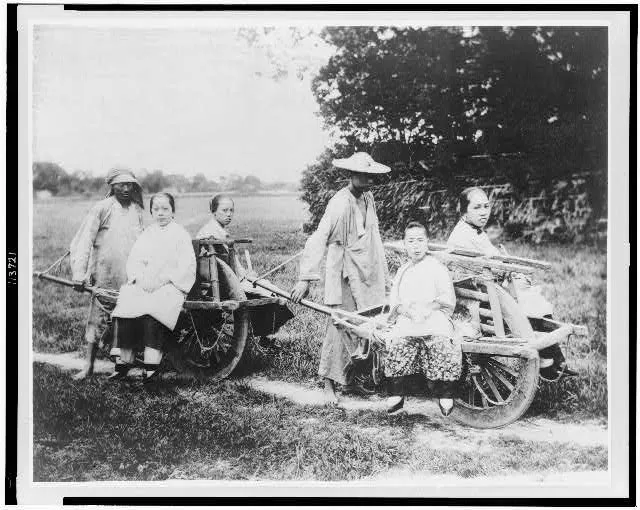
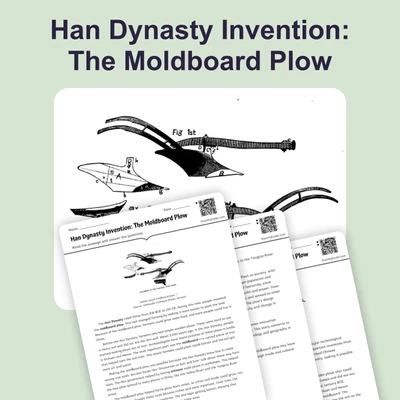
"China. Passenger wheelbarrows" /
Source: Library of Congress.
The Han dynasty of ancient China, which lasted from 206 BCE to 220 CE, was a period of remarkable technological progress. One of its most important inventions was the wheelbarrow, a simple but powerful tool that transformed daily life and work in China.
The earliest known reference to the wheelbarrow comes from a painted tomb relief from Sichuan province dated to 118 CE, during the reign of Emperor Huandi. The device was called a "wooden ox" or "gliding horse" and was designed to help farmers and workers carry heavy loads. The Han wheelbarrow featured a single large wheel placed under the center of a wooden frame, with handles extending at the back. This design allowed one person to move goods that would have required several people to carry before, increasing efficiency and reducing physical strain. Archaeological evidence, such as ancient carvings and texts like the Records of the Three Kingdoms, describe its use in both agriculture and military settings.
The impact of the wheelbarrow on Chinese society was significant. In agriculture, it enabled farmers to transport crops, tools, and fertilizer across uneven terrain, making farming more productive. In cities, merchants used it to move goods through crowded marketplaces. The military also adopted the wheelbarrow to carry supplies and injured soldiers on the battlefield. The invention supported the complex infrastructure of the Han dynasty, such as road construction and large-scale building projects. The wheelbarrow's use spread to different regions, adapting to local needs and materials over time.
The wheelbarrow reflected the Han dynasty's ability to solve practical problems with innovative engineering. Its design took advantage of China's varied geography, from river valleys to mountain paths, showing how technology and environment interact. Over centuries, the wheelbarrow influenced transportation and labor not only in China but eventually, through trade and cultural exchange, in other parts of the world. The invention is an example of how a single idea can create lasting change, improving daily life for people across social classes, from peasant farmers to soldiers.
Today, the wheelbarrow remains a common tool worldwide, a testament to the Han dynasty's legacy in science and technology. Its history highlights the importance of innovation in human progress and reminds us that even simple inventions can have a profound effect on civilization.
By studying the wheelbarrow and other Han inventions, we gain a deeper understanding of how technological advances shape societies through time and connect different regions of the world.
Interesting Fact: The Chinese word for wheelbarrow, "lu che," literally means "deer cart"—early designs were sometimes shaped like animals to honor Han beliefs about nature and technology.
Comprehension quiz (8 questions)
1. When did the Han dynasty rule?
2. What is a wheelbarrow?
3. Who used wheelbarrows in ancient China?
4. How did wheelbarrows help agriculture?
5. Why was the single wheel important?
6. What does the passage suggest about innovation?
7. The Han dynasty invented the wheelbarrow. True or false?
8. What does 'legacy' mean in the passage?
Perfect for the way you teach
- Build comprehension skills
- Auto-graded quiz
- Differentiated reading
- Read together at home
- Improve fluency
- Quiet reading time
- Reading curriculum support
- Independent practice
- Track Lexile growth